



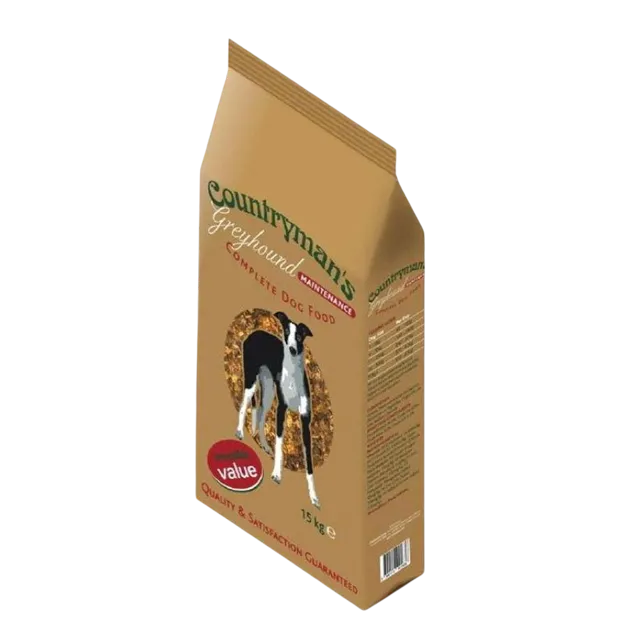

Countrymans
Countrymans Countryman's Greyhound Maintenance 20% review
Countryman's Greyhound Maintenance 20% is a plain, no-frills kibble written for the resting sighthound and sold by the sack. The label keeps every entry general. Cereals lead, with meat and animal derivatives behind them. A vegetable derivative and an oil blend finish the job, and salt is the only item that names itself exactly. Protein is set at 20% and fat at 8%, a gentle pairing pitched at a dog ticking over between seasons, not one in hard work. It sits in our Poor band. What drives that is a vague label, and nothing in the sack itself is alarming.
Our view
Likely to suit
If you keep sighthounds and buy feed by the sack, this is the quiet everyday ration that does the ordinary job without fuss.
- Greyhound and lurcher keepers wanting a steady maintenance ration for a dog between racing or coursing seasons
- Owners of a resting or lightly exercised adult, with protein at 20% and fat at 8% both pitched low for a kibble
- Kennels and multi-dog households feeding several sighthounds from one recipe rather than juggling bags
- Dogs long settled on a simple cereal-based bowl, with no sensitivities to work around
Worth watching
A few things about the way this label is written are worth having clear first.
- No animal is named anywhere on the list, so the meat can vary and the recipe cannot anchor an elimination plan
- Cereals is all you get for the grain, with no type named, so wheat cannot be ruled in or out
- Cereals lead the recipe and carbohydrate lands at 56.5% of dry matter against 46.2% typical for adult dry food, worth knowing if your dog does best with more meat in the bowl
- Energy here is an estimate, with no figure declared on the label, so let the ribs and the waistline fine-tune the scoop over the first fortnight
Written by our editorial team. Independent guidance, not veterinary advice.
How this scores
How we scoreThe Details
Dog fit
If you keep sighthounds and buy feed by the sack, this is the quiet everyday ration that does the ordinary job without fuss. A few things about the way this label is written are worth having clear first.
Dry
Adult
The score, in context
This lands in our Poor band, two bands below the Good band the typical adult dry food occupies. Almost all of that gap comes from what the label chooses not to say. Every working entry names a category and never an ingredient, so there is no reading the quality of the meat or the grain. Protein and processing, nutritional balance and transparency all come back Poor because of it. That is a comment on the writing of the label. Nothing about the sack itself is a warning. Plenty of sighthounds have been kept in steady condition on exactly this kind of plain maintenance ration.
What's in it
Ingredients, as declared: Cereals, meat & animal derivatives, derivatives of vegetable origin, oils & fats & sodium chloride.
Named ingredients
Ingredient notes
Not one entry on this list names an actual ingredient. Every one of them is a category. Cereals opens the recipe. That one word covers everything from good whole grains to the poorest grain by-products. Nothing tells you which is in the sack, and nothing obliges the maker to keep the same one from batch to batch. Some genuinely decent foods use the term to protect a recipe, so it is not proof of anything poor. It is simply a door left shut.
Meat and animal derivatives applies the same idea to the animal side. It is a legal category for the parts of a carcass left once the cuts bound for human food have been taken. The material inside it ranges from good clean organ meat to much less appealing offcuts. No species is named, which is the part that matters most to an owner managing a sensitivity.
Derivatives of vegetable origin sits behind the meat. It can be almost anything left over when grains, vegetables, legumes or oilseed are processed. Oils and fats is the fat entry with neither the source nor the animal given. Sodium chloride, plain salt, is the one thing here that says precisely what it is.
The analysis tells a plainer story than the ingredients do. Protein is set at 20% and fat at 8%, which convert to 21.7% and 8.7% of dry matter, a gentle mix for a dog that is resting rather than racing. Moisture is not declared, so those conversions assume the 8% a kibble of this kind normally carries. Carbohydrate lands at 56.5% of dry matter where 46.2% is typical for adult dry food. Energy is estimated at about 320 kcal per 100 grams against a typical 357. Read together, those figures describe a food built to keep a lean dog level.
Price and value
£1.17 a kilo, sold as a 15kg sack and also listed as a case of six.
As a guide, a 15kg adult dog in moderate condition works through about 262 grams a day on around 840 kcal a day. That is the standard maintenance estimate, 110 × bodyweight^0.75, and it comes to £0.31 a day. A racing or coursing dog in season will eat more than that, so treat the figure as a starting point.
Nutritional analysis
Declared analysis
Estimated using Modified Atwater factors*
20%
8%
3%
9%
Dry weight
21.7%
8.7%
3.3%
9.8%
56.5%
As-fed composition
Estimated breakdown of the finished product by ingredient category, from the declared ingredient list and ingoing weights. These are estimates, not measurements.
29.4%
64.4%
6.2%
Pricing & size
- Pack size
- 15kg, 6 Pack (6 x 15kg) - the page's own bullet reads "15kg per bag"
- Retailer pricing
- Coming soon
Live retailer pricing is not yet available for this food. Prices, cost per day and where to buy will appear here once retailer data is live.
Ingredients and nutrition are taken from manufacturer data. Retailer pricing is not yet live for this food.
Related dog food guides
Ranked shortlists that include foods like this one.