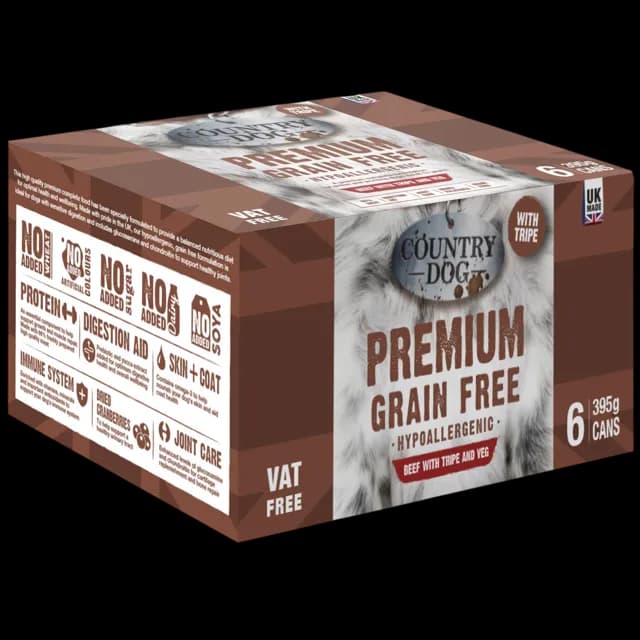


Country Dog
Country Dog Premium Grain Free Tins With Country Veg: Beef review
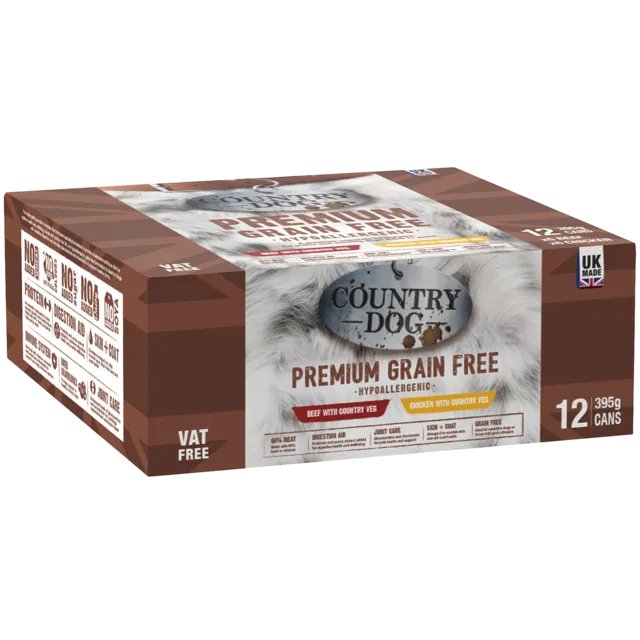
Country Dog's grain free tins with country veg are about as short as a wet label gets. One named animal takes 66% of the tin, with dried carrots and either potatoes or peas at 1.2%. Rapeseed oil supplies the fat, and the rest is minerals and a few extras at trace level. Two recipes, beef and chicken, both fed to adults and older dogs, and both sit in our Outstanding band.
Our view
Likely to suit
For a dog on a careful avoidance list, a label this short is a genuine advantage.
- Dogs kept to one meat, since beef is the only species named on one label and chicken the only one on the other
- Grain avoiding dogs, with dried carrots and either potatoes or peas the only plants of any size
- Owners who want a printed meat figure, which both tins give at 66%
- Older dogs as well as adults, the two life stages these tins are fed to
- Dogs on a smaller bowl who still need the calories, which the chicken tin supplies at an estimated 126 kcal per 100g
Worth watching
The list is short enough that the few things it leaves unsaid stand out.
- Neither the glucosamine at 0.004% nor the chondroitin at 0.002% is tied to a source on the label, and both usually come from animal material, so ask the maker before a true elimination trial
- The joint pair is named but not dosed to work, so keep a dog with diagnosed joint trouble on whatever the vet has already set
- Neither added panel names vitamin E or selenium, where most wet labels carry both
- For a dog watching its weight, note that the chicken tin is the richer of the two, with fat converting to 36.5% of dry matter
Written by our editorial team. Independent guidance, not veterinary advice.
How this scores
How we scoreThe Details
Dog fit
For a dog on a careful avoidance list, a label this short is a genuine advantage. The list is short enough that the few things it leaves unsaid stand out.
Wet
Adult, Senior
Toy, Small, Medium, Large, Giant
Beef
The score, in context
Our Outstanding band holds both tins, and neither is ahead of the other. The typical adult wet food sits a band below them, which is what 66% of a named animal and a list you can read at a glance tend to buy.
Estimated carbohydrate comes to 14.5% of dry matter in the beef tin and 13.6% in the chicken, both a shade under the 15.8% the typical adult wet food carries. Protein converts to 39.6% and 36.5% respectively.
What's in it
Ingredients, as declared: Beef (66%), Rapeseed Oil (1.5%), Dried Carrots (1.2%), Dried Potatoes (1.2%), Minerals, Prebiotic Mannan Oligosaccharides (0.01%), Glucosamine (0.004%), Chondroitin (0.002%), Dried Cranberries (0.002%), Yucca Extract (0.002%).
Named ingredients
Nutritional additives
Vitamin a 2250 IU, Vitamin D3 328 IU, Zinc (Zinc Sulphate Monohydrate) 24mg, Iron (Iron II Sulphate Monohydrate) 12.5mg, Copper (Copper II Sulphate Pentahydrate) 2.5mg, Manganese (Manganous Sulphate Monohydrate) 2mg, Iodine (Calcium Iodate Anhydrous) 0.5mg.
Ingredient notes
Sixty six per cent of one named animal is the whole story here, and it is a properly high figure for a tin. Beef and chicken are both highly digestible and highly palatable, and because each label names one species and stops, you can see at a glance what your dog is eating.
The vegetables are real but small. Dried carrots at 1.2% appear on both tins, with dried potatoes on the beef and dried peas on the chicken, also at 1.2%. Carrots bring vitamin A and antioxidants and peas bring fibre, though at these levels they are seasoning. That is exactly why the carbohydrate figures stay low.
Rapeseed oil carries the added fat: 1.5% in the beef tin, 0.5% in the chicken one. The label names it, where an oils and fats heading would have hidden it. Saturated fat is low and it is a perfectly sound choice for a dog food, if a less generous one than a fish oil would be.
The tail of both lists is the same. Prebiotic mannan oligosaccharides at 0.01% come from yeast cell walls and encourage the useful bacteria in the gut. Glucosamine at 0.004% and chondroitin at 0.002% are a nod towards the joints, both of them naturally present in meat and cartilage anyway. Dried cranberries and yucca extract close the list at 0.002% each. Cranberry is a traditional urinary tract ingredient, and yucca is an old remedy for stool odour.
The added panel prints a dose beside every entry, with vitamin A and vitamin D3 ahead of zinc, iron, copper, manganese and iodine. Vitamin E and selenium are not on it, and calcium is not declared in the analysis. Meat itself supplies a good deal of the micronutrition in a tin this meat heavy, but those are still two gaps a fuller label would fill.
How this variety differs
Beef at 66% with dried potatoes alongside the carrots, and the more generous pour of rapeseed oil at 1.5%. It is the lighter tin of the two at an estimated 109 kcal per 100g and the wetter at 76.0% moisture, so bowls look bigger. Protein converts to 39.6% of dry matter, the higher of the pair.
Price and value
Sold in 395g cans. There is no current per kilo figure to quote against either tin.
Work from a maintenance estimate of about 840 kcal a day for a 15kg adult dog in moderate condition (110 × bodyweight^0.75). The beef then runs to about 769 grams a day and the chicken to 666 grams, the difference being how much energy each tin carries.
Nutritional analysis
Declared analysis
Estimated using Modified Atwater factors*
9.5%
7.5%
1%
2.5%
76%
Dry weight
39.6%
31.3%
4.2%
10.4%
14.5%
As-fed composition
Estimated breakdown of the finished product by ingredient category, from the declared ingredient list and ingoing weights. These are estimates, not measurements.
66%
18%
1.2%
1.2%
1.5%
12.1%
Pricing & size
- Pack size
- 395g cans
- Retailer pricing
- Coming soon
Live retailer pricing is not yet available for this food. Prices, cost per day and where to buy will appear here once retailer data is live.
Ingredients and nutrition are taken from manufacturer data. Retailer pricing is not yet live for this food.
Related dog food guides
Ranked shortlists that include foods like this one.