


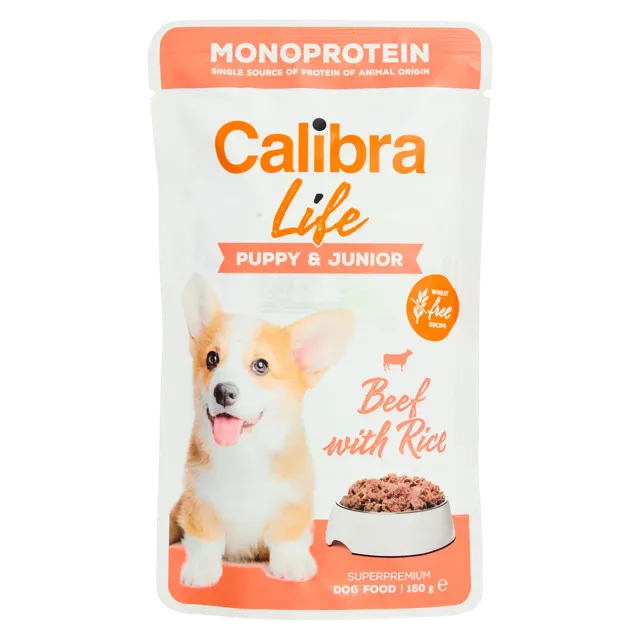

Calibra
Calibra Life Puppy & Junior Pouches: Beef with Rice review
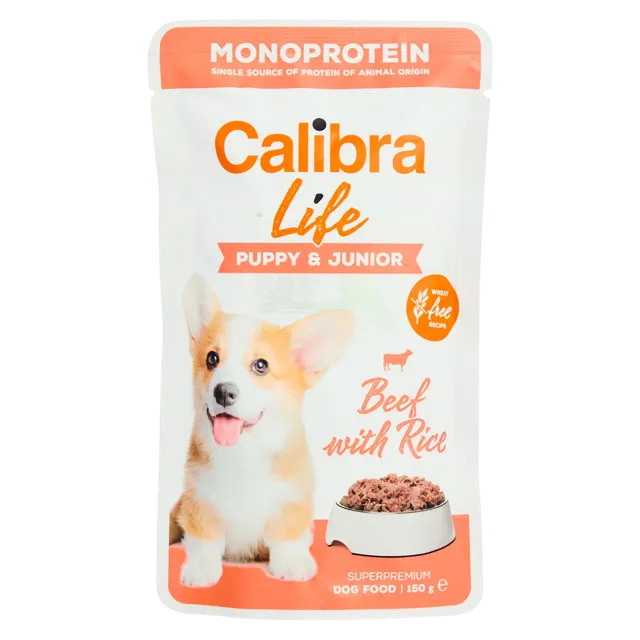
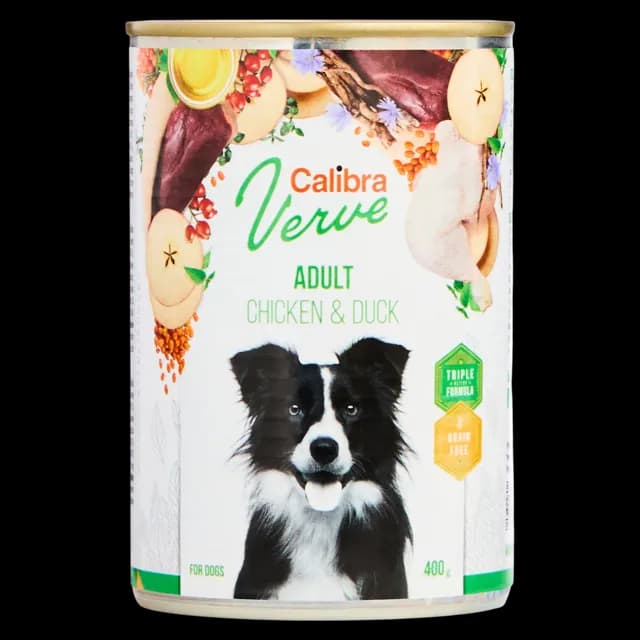
Calibra Life Puppy & Junior arrives as a 400g pouch with a list you can read out in one breath. Each recipe puts 70% of its weight into a single animal, lamb in one pouch and chicken with chicken hearts in the other. The rest is a little rice at 4%, some pea flour and lignocellulose, salmon oil and a dried algae for the marine omega 3s. Protein converts to 43.2% of dry matter in both, and the declared calcium at 1.36% of dry matter clears the level big breed growth is planned to. The chicken pouch reaches our Excellent band, with the lamb one a step above it in Outstanding.
Our view
Likely to suit
If you want to know exactly what is going into a growing dog, these pouches make that unusually easy.
- Puppies of any build, the large and giant breeds included, with calcium declared at 1.36% of dry matter and inside what a big breed growth plan works to
- Growing dogs who need the bowl built on meat, with protein converting to 43.2% of dry matter
- Owners keeping a pup on one animal at a time, since each pouch takes its meat from a single species
- Households topping up a kibble bowl, where 78% declared moisture brings water and appetite to the same meal
- Pups with a small appetite and a lot of growing to do, given how much of each pouch is meat
Worth watching
A handful of practical points are worth having straight before these become the main meal.
- Salmon oil at 1% is in both pouches, and a fish free elimination diet cannot be built on them
- Rice comes in at 4%, small but enough to keep these pouches off a grain free list
- A 400g pouch is a large unit for a young puppy, so expect to cover and chill what is left of one
- Fat converts high for a wet food, which is what growth wants but does mean the changeover is best made gradually
Written by our editorial team. Independent guidance, not veterinary advice.
How this scores
How we scoreThe Details
Dog fit
If you want to know exactly what is going into a growing dog, these pouches make that unusually easy. A handful of practical points are worth having straight before these become the main meal.
Wet
Puppy
Toy, Small, Medium, Large, Giant
Lamb
The score, in context
The lamb pouch reaches our Outstanding band and the chicken our Excellent, and both get there the same way. One named animal carries the bulk of the recipe, the starch list is short enough to memorise, and the analysis backs up what the front of the pack claims. Nutritional balance and transparency both read Outstanding across the pair with protein and processing Good, so this is an even performance rather than one strength doing the lifting.
The wet puppy field scores strongly with us, and its middle reaches our Excellent band too. Finishing above that middle mark therefore counts for something, because it means holding position in genuinely good company rather than standing out from a weak crowd.
What's in it
Ingredients, as declared: lamb (70 %), rice (4 %), pea flour, lignocellulose, salmon oil (1 %), calcium carbonate, dried algae (0.2 %, Schizochytrium limacinum).
Named ingredients
Nutritional additives
| Additive | per 1 kg | |---|---| | vitamin A (3a672a) | 800 IU | | vitamin D3 (3a671) | 200 IU | | vitamin E (3a700) | 120 mg | | taurine (3a370) | 800 mg | | vitamin B1 (3a821) | 1 mg | | biotin (3a880) | 0.4 mg | | zinc (3b606) | 10 mg | | manganese (3b504) | 2.4 mg | | iodine (3b201) | 0.6 mg | | copper (3b406) | 3.2 mg | | iron (3b106) | 8 mg |
Ingredient notes
Seventy per cent of each pouch is meat, which is the number that shapes everything else. In one recipe that is a single lamb entry; in the other it is chicken at 40% with chicken hearts at 30% behind it. Heart is working muscle, not offal in the everyday sense, and it is dense in protein and naturally rich in taurine. Seeing it written out on a label is a thoughtful touch.
The plant side is deliberately slight. Rice at 4% and a little pea flour are the only real carriers, with lignocellulose there as an insoluble fibre to give the stool some body. Estimated carbohydrate lands around a tenth of dry matter in both pouches, comfortably under the 13.6% usual for wet puppy food. That estimate is reached by difference, a method that tends to read a shade high on wet recipes.
The fat finishers are 1% salmon oil and 0.2% dried algae, the marine microalga Schizochytrium limacinum. The algae is a direct source of the long chain omega 3s that a growing brain and retina draw on. Taking that from a plant source is a neat piece of recipe design, even if the salmon oil means fish is on the label regardless.
Calcium carbonate is added to bring the mineral side up to growth level, and the result is calcium at 1.36% of dry matter. A large breed puppy owner wants that figure above all, and it lands where a big breed growth plan wants it. That is why these pouches are listed for the toy breeds and the giants and everything between.
The additive panel is short but printed properly, with taurine at 800 mg/kg standing out. Vitamin A at 800 IU, vitamin D3 at 200 IU and vitamin E at 120 mg sit alongside biotin, zinc, manganese, iodine, copper and iron, each with a figure beside it. Taurine matters for heart muscle and vision, and a dose you can actually read is better than a mention in passing.
How this variety differs
This pouch is sold under a beef name, but the ingredient list printed on it declares lamb at 70% as the only meat in the recipe, and the declared list is what we have read. If a bird has already caused trouble, lamb is a sound alternative, and here the whole 70% animal share is lamb.
Fat converts to 34.1% of dry matter here, the richer of the pair, and ash at 8.2% makes it the lighter on minerals. Estimated carbohydrate comes out at 10.9% of dry matter, under the 13.6% usual for a wet puppy food. There is no starchy middle hiding behind the meat headline.
Price and value
Sold in 400g pouches, six to a pack.
As a guide from our standard energy estimate, a 10kg pup aged four to twelve months works through somewhere around 647 to 791 grams a day. A younger one of the same weight gets through a good deal more again. A wet bowl is simply a bigger bowl than a dry one, and a puppy's needs shift from month to month. Treat that as a starting point. The pack's own growth chart and your pup's outline set the real pace.
Nutritional analysis
Declared analysis
9.5%
7.5%
0.8%
1.8%
78%
Dry weight
43.2%
34.1%
3.6%
8.2%
10.9%
As-fed composition
Estimated breakdown of the finished product by ingredient category, from the declared ingredient list and ingoing weights. These are estimates, not measurements.
70%
14.9%
10.7%
0.2%
1%
3.2%
Pricing & size
- Pack size
- 6x400g
- Retailer pricing
- Coming soon
Live retailer pricing is not yet available for this food. Prices, cost per day and where to buy will appear here once retailer data is live.
Ingredients and nutrition are taken from manufacturer data. Retailer pricing is not yet live for this food.
Related dog food guides
Ranked shortlists that include foods like this one.