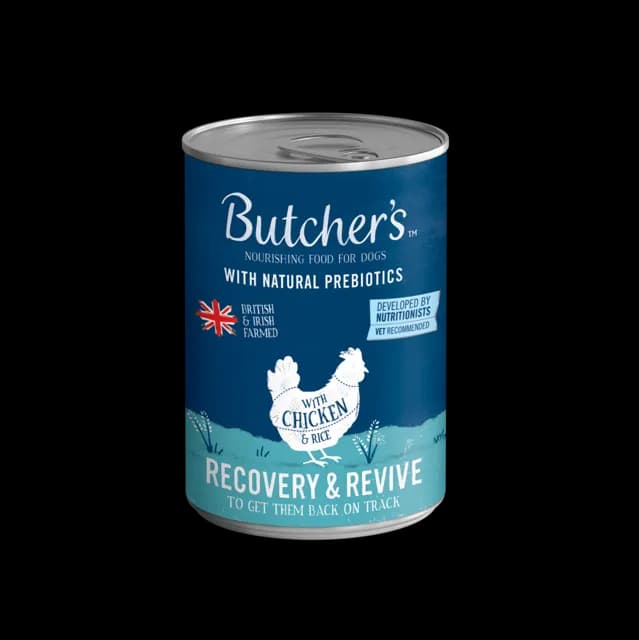




Butchers
Butchers Puppy Perfect Can: With Chicken review
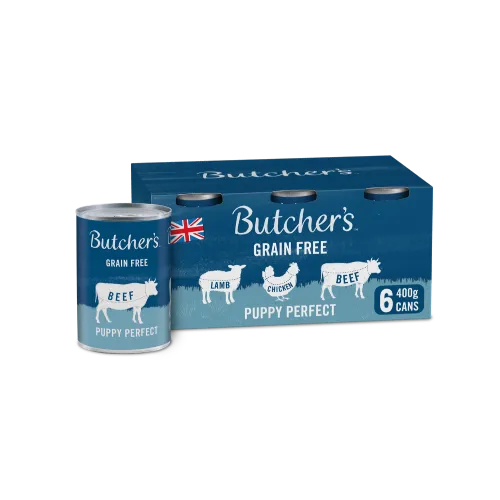
Butchers Puppy Perfect is a set of three tinned growth foods that keep their meat British and Irish and name every species inside it. Half of each tin is farmed meat, chicken leads all three regardless of what the front of the can says, and there is no cereal anywhere in the range. Protein converts to 44.4% of dry matter and carbohydrate to an estimated 10.1%, a meaty shape for a wet food. Docosahexaenoic acid is declared at 0.07% for a brain and eyes still under construction. The chicken and the lamb sit in our Good band, with the beef a step up in Excellent.
Our view
Likely to suit
If you want a growth food your pup will clear in seconds and you like knowing whose farms the meat came from, these tins make a straightforward case.
- Puppies who eat far better from a wet bowl, with 82.0% moisture bringing water in alongside the meal
- Owners who want the meat traced and named, since each label declares British and Irish farmed meat and then breaks it down species by species
- Growing dogs whose brains and eyes are still forming, with docosahexaenoic acid printed at 0.07% and salmon oil in every recipe
- Puppies kept off cereal, since no grain shows up in any of the three tins
- Pups whose digestion likes a prebiotic, with mannan-oligosaccharides on every label
Worth watching
A few points about this range are worth carrying with you before you order a case.
- Chicken leads all three recipes, so the beef and lamb on the front of those tins describe an accent rather than the main meat
- Salmon oil runs through the whole range, so fish is in the bowl whichever tin you pick
- At 85 kcal per 100g these are on the lighter side for a growth food, so the portions run large, particularly for a pup expected to finish big
Written by our editorial team. Independent guidance, not veterinary advice.
How this scores
How we scoreThe Details
Dog fit
If you want a growth food your pup will clear in seconds and you like knowing whose farms the meat came from, these tins make a straightforward case. A few points about this range are worth carrying with you before you order a case.
Wet
Puppy
Toy, Small, Medium, Large, Giant
Chicken
The score, in context
The typical tin or tray of wet puppy food reaches our Excellent band, so this is a strong field to be judged in. Two of these recipes land just underneath in our Good band, and the beef pulls level in Excellent. Nutritional balance reads Outstanding on all three, transparency Outstanding on the beef and the lamb and Excellent on the chicken, protein and processing Average throughout.
What earns the position is genuine. The named meats add up to half of each tin, protein converts to 44.4% of dry matter, and the carbohydrate estimate is a light 10.1% where 13.6% is typical for wet puppy food. What keeps it from pressing higher sits at the thin end of the label. The calcium reporting is inconsistent across the three and the trace element declaration is short, and at 85 kcal per 100g the energy density is modest against the 106 typical of the format.
What's in it
Ingredients, as declared: British & Irish Farmed Meats (Chicken 40%, Beef 6%, Liver 4%), Salmon Oil, Sunflower Oil, Parsley, Rosehip, Chicory, Mint, Minerals, Prebiotic Mannan-Oligosaccharide, Docosahexaenoic Acid (Dha 0.07%).
Named ingredients
Nutritional additives
_(the page labels this "Nutritional Additives (per kg)")_: Vitamins: Vitamin A 1250 I.U., Vitamin D3 250 I.U., Vitamin E 13mg, Trace Elements: Zinc (3b605) 20mg, Manganese (3b503) 2.5mg, Iodine (3b202) 0.5mg.
Ingredient notes
The meat declaration is the best thing about these labels. Each tin names British and Irish farmed meat and then itemises the species inside it with their own figures. That is exactly what an owner checking for a particular meat needs. Chicken is the leading species in every recipe, and the flavour name on the tin tells you what has been added around it rather than what makes up most of it.
The analysis is the same across all three: 8.0% protein, 6.0% fat, 0.2% fibre, 2.0% ash and 82.0% moisture as fed. Wet food figures always look small until the water is taken out. Once it is, protein converts to 44.4% of dry matter and fat to 33.3%, the profile of a food built out of meat. Carbohydrate converts to an estimated 10.1%, comfortably under the 13.6% typical for the format, which is what happens when no cereal or potato is asked to do any binding.
Salmon oil appears in every recipe and carries the marine omega 3 a young dog draws on, and the declared docosahexaenoic acid at 0.07% is the reason to take that seriously. DHA is the fatty acid most closely tied to a puppy's brain and retinal development, and seeing it printed with a figure on a supermarket tin is a genuinely good sign. It is also the reason fish belongs on your allergy list here.
The botanical tail is small but sensibly chosen: parsley, rosehip, chicory and mint. Chicory is the one doing real work, since its root is where inulin comes from and inulin feeds the gut bacteria a young digestion depends on. Every tin also carries a mannan-oligosaccharide prebiotic, though only one of the three prints a dose for it.
The added vitamins and trace elements are declared per kilo, with vitamin A at 1250 I.U., vitamin D3 at 250 I.U. and vitamin E at 13mg, then zinc at 20mg, manganese at 2.5mg and iodine at 0.5mg. That is a shorter trace element list than most growth foods print, with no copper or selenium figure given, so those minerals are left to the ingredients and not counted on the label.
Calcium is the one line where the range is untidy. One of the three tins declares it and the other two do not. On a food listed for puppies of every finishing size that is awkward, because a large breed owner wants the calcium figure more than any other. The variety notes carry what each label actually prints.
How this variety differs
The chicken tin lists chicken at 40%, beef at 6% and liver at 4%. That comes to the same half tin of named meat as its siblings, even though this label does not print the 50% total. The liver is doing real work here. Liver is among the most nutrient rich things a dog can eat, with vitamin A, B12, copper and iron in it, and puppies almost universally love the taste of it.
Sunflower oil joins the salmon oil here, adding a light plant oil rich in vitamin E. The prebiotic mannan-oligosaccharide is on the list but without a printed dose.
This is the only tin of the three to declare calcium, and it converts to 2.22% of dry matter. Growth plans for a large or giant breed usually work to a lower level than that, and a pup on course to finish big wants the portion set with a vet, not filled by eye. It reads far more comfortably for a puppy heading for a toy, small or medium adult size.
Price and value
Sold in cases of 6, 18 and 24 cans of 400g.
Wet food feeds in bigger volumes than kibble does. Take the guide on the tin for your pup's age and the adult weight you expect as the starting point, and adjust to how they are filling out.
Nutritional analysis
Declared analysis
8%
6%
0.2%
2%
82%
Dry weight
44.4%
33.3%
1.1%
11.1%
10.1%
As-fed composition
Estimated breakdown of the finished product by ingredient category, from the declared ingredient list and ingoing weights. These are estimates, not measurements.
47.1%
17%
5.9%
22.6%
7.5%
Pricing & size
- Pack size
- 6 x 400g can, 18 x 400g can, 24 x 400g can
- Retailer pricing
- Coming soon
Live retailer pricing is not yet available for this food. Prices, cost per day and where to buy will appear here once retailer data is live.
Ingredients and nutrition are taken from manufacturer data. Retailer pricing is not yet live for this food.
Related dog food guides
Ranked shortlists that include foods like this one.