



Butchers
Butchers Recovery & Revive Foil review
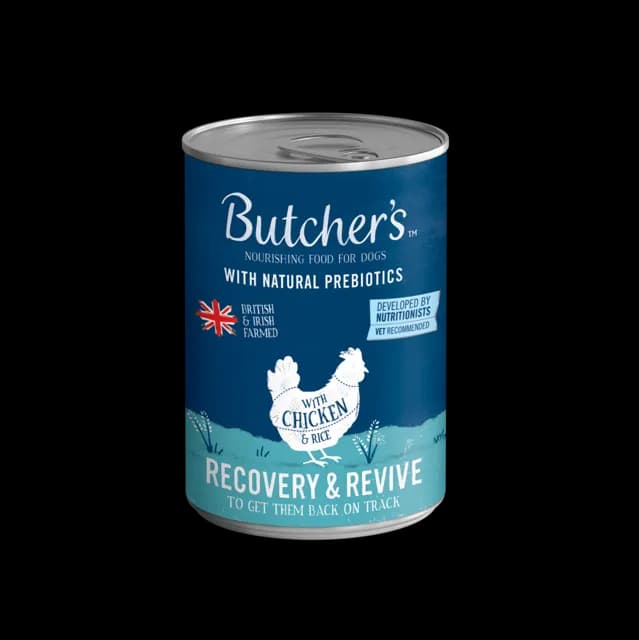
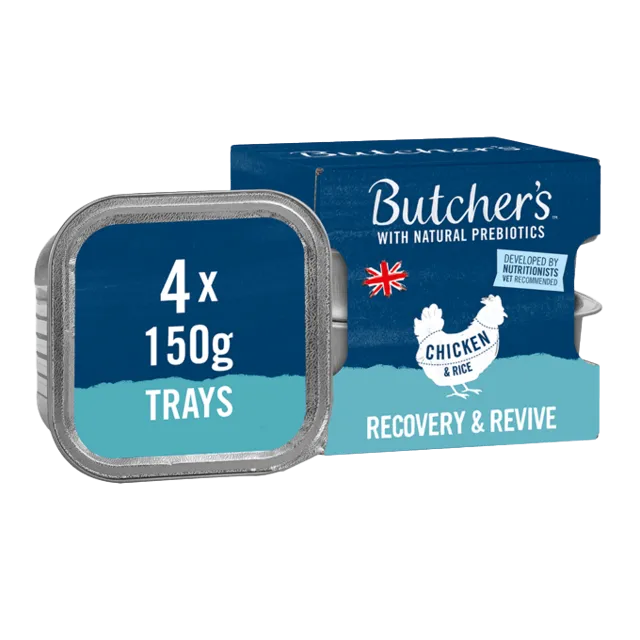
Butchers Recovery & Revive in the tray takes the same idea and shrinks the serving. Chicken leads at 51%, and the broth behind it, water with dried seaweed, is declared at 33.5%. Cooked white rice at 12.5% does the gentle work, with salmon oil and a printed set of prebiotics after that. A 150g tray opens fresh every time, which suits a dog eating small amounts often far better than a big tin does. It sits in our Excellent band.
Our view
Likely to suit
A small serving, opened fresh, is often what gets a hesitant dog started again.
- Dogs eating little and often, since each 150g tray is opened new rather than kept covered for the next meal
- Dogs putting condition back on, with fat at 35.0% of dry matter and 93 kcal per 100g
- Owners who want the animal content on the label, with chicken at 51% and the broth declared at 33.5%
- Dogs with unsettled digestion, since cooked white rice is the mildest cereal there is and it is the only one here
- Households nursing a dog through a fussy stretch who would rather serve something meat-first than a topper
Worth watching
Give the label a read before you order a case.
- Chicken is the only meat named, though salmon oil is in the tray as well, so it will not stand up as a single-animal exclusion diet
- Cooked white rice at 12.5% is on the list, so a grain-free household is not served here
- There is more rice and less broth here than the tin carries, which lifts the estimated carbohydrate to 14.0% of dry matter
- It is a rich tray by design, so a dog already in settled condition will want rather less of it than a dog rebuilding
Written by our editorial team. Independent guidance, not veterinary advice.
How this scores
How we scoreThe Details
Dog fit
A small serving, opened fresh, is often what gets a hesitant dog started again. Give the label a read before you order a case.
Wet
Adult
Toy, Small, Medium, Large, Giant
Chicken
The score, in context
This tray takes an Excellent placing. It shares that band with the tin it mirrors while being built a little differently: more white rice, less broth, protein converting to 37.5% of dry matter and fat close behind at 35.0%. The estimated carbohydrate of 14.0% still lands just under the 15.8% a typical adult wet food carries.
The wet shelf is a strong field whose middle also falls in our Excellent band, and this tray sits comfortably inside it. Naming the chicken at 51% and giving the broth a percentage instead of burying it as water is what does most of the lifting.
What's in it
Ingredients, as declared: British and Irish Farmed Chicken 51%, Broth 33.5% (Including Water and Dried Seaweed), Cooked White Rice 12.5, Salmon Oil 1%, Minerals, Yeast 0.15% (Prebiotic MOS 0.05%, Beta-Glucans 0.045%), Chicory Root; Prebiotic FOS 0.05%, Yucca 0.005%, Paraprobiotic Lactobacillus Helveticus 0.001%.
Named ingredients
Nutritional additives
_(the page labels this "Nutritional Additives (per kg)")_: Vitamin A 1,250 I.U., Vitamin D3 125 I.U., Vitamin E 63 mg, Vitamin C 30 mg, Manganese (3b503) 2.5 mg, Zinc (3b605) 20 mg, Copper (3b405) 0.5 mg, Iodine (3b202) 0.5 mg.
Ingredient notes
Chicken at 51% is the one animal here, farmed in Britain and Ireland by the label's account. The plain name on the list marks it as fresh meat. For a tray sold to tempt a dog back into eating, a fresh, highly palatable meat at that share is the right first ingredient.
Broth at 33.5% is water carrying dried seaweed, and it comes with its own percentage. Most trays do not go that far. What the label will not tell you is how the 33.5% divides between the water and the seaweed, and seaweed is worth knowing about in quantity since it is a concentrated iodine source.
Cooked white rice at 12.5% is a bigger share than the tin version carries, and it is what makes this the starchier of the two. White rice is low in fibre and quickly broken down, and gentle recipes reach for it constantly. The estimated carbohydrate of 2.8% as fed, or 14.0% of dry matter, is a by-difference figure worked out from the declared analysis, and the maker prints no number of its own.
The gut cluster is dosed and printed: yeast at 0.15% carrying MOS at 0.05% and beta-glucans at 0.045%, chicory root with FOS at 0.05%, then yucca at 0.005% and a paraprobiotic at 0.001%. MOS and FOS are prebiotics that feed the bacteria already at work in the large intestine. Trace amounts they are, but the label names and measures each of them.
Marine omega oils come in with the salmon oil at 1%, and fish comes with them. The added panel is fuller than the brand's everyday trays, with vitamin C at 30 mg and vitamin E at 63 mg. Vitamin A, vitamin D3, manganese, zinc, copper and iodine follow, each printed with its dose.
Price and value
Sold in packs of 4 x 150g trays.
Feeding a 15kg adult dog in moderate condition comes to about 902 grams a day, taken from an energy estimate of 840 kcal (110 × bodyweight^0.75, the standard maintenance calculation). That works out at six trays. The label's own guide is lighter, putting a dog between 10 and 25kg at 562.5 to 975 grams a day.
Nutritional analysis
Declared analysis
7.5%
7%
0.2%
2.5%
80%
Dry weight
37.5%
35%
1%
12.5%
14%
As-fed composition
Estimated breakdown of the finished product by ingredient category, from the declared ingredient list and ingoing weights. These are estimates, not measurements.
51%
33.5%
11%
0.1%
1%
3.5%
Pricing & size
- Pack size
- 4 x 150g tray
- Retailer pricing
- Coming soon
Live retailer pricing is not yet available for this food. Prices, cost per day and where to buy will appear here once retailer data is live.
Ingredients and nutrition are taken from manufacturer data. Retailer pricing is not yet live for this food.
Related dog food guides
Ranked shortlists that include foods like this one.