



Brit
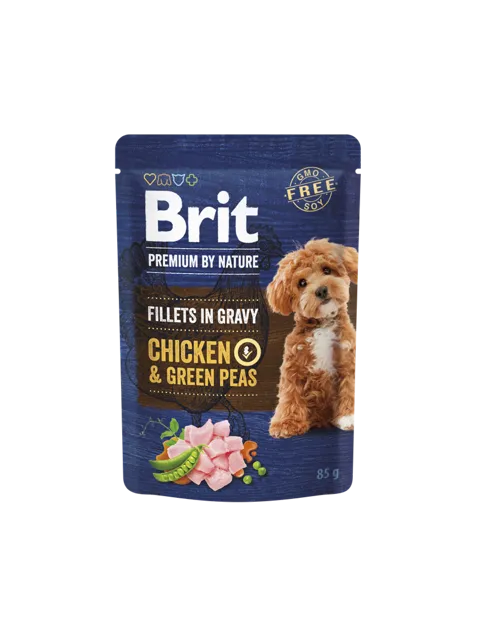
Brit Premium by Nature Dog Fillets in Gravy Chicken & Green Peas review
Brit's by Nature Chicken and Green Peas is a single serving of fillets in gravy with a short list and a mixed way of writing it. Chicken is declared at 75% inside an 85% block called meat and animal derivatives, and green peas at 4% sit inside a line called derivatives of vegetable origin. Minerals close the list without being broken down. It sits in our Good band, and the analysis underneath is rather better than that placement suggests.
Our view
Likely to suit
If you would rather open something fresh at each meal than cover half a tin, this format is built for that.
- Dogs that need a leaner bowl, with fat converting to a modest 19.4% of dry matter
- Owners of one small dog, since a pack is a meal and nothing goes back into the fridge
- Chicken loving dogs, as chicken is the one animal named on the label and it is declared at 75%
- Dogs that like a meal to feel filling, with fibre at 4.4% of dry matter running a little above the wet norm
- Households that feed little and often, since the servings portion themselves
Worth watching
The wording on this label is the part to get straight before you choose it.
- Beyond the named chicken, the animal content is meat and animal derivatives, which can cover any warm blooded land animal and can change between batches, so the pack cannot anchor an elimination diet
- Derivatives of vegetable origin is as broad as it sounds, and only the green peas at 4% are named inside it
- The minerals are listed as a single word with no breakdown, so which ones went in and in what proportion is not on the label
- Carbohydrate converts to an estimated 26.2% of dry matter against 15.8% for the typical adult wet food
Written by our editorial team. Independent guidance, not veterinary advice.
How this scores
How we scoreThe Details
Dog fit
If you would rather open something fresh at each meal than cover half a tin, this format is built for that. The wording on this label is the part to get straight before you choose it.
Wet
Adult
Toy, Small, Medium, Large, Giant
Chicken
The score, in context
This placement is about wording, not about what ends up in the bowl. The pillars come out strong, with nutritional balance and transparency both reading Outstanding and protein and processing Good, the category wording on the two biggest lines being the one thing holding that last one back. The analysis itself is respectable. Protein converts to 41.7% of dry matter, which is strong for a wet food and better than the label's own phrasing lets on. Most wet foods score well and the everyday one reaches our Excellent band, so a Good reading here describes a sound recipe written in the least helpful way rather than a poor dinner.
What's in it
Ingredients, as declared: 85% meat and animal derivatives in fillets (75% chicken), derivatives of vegetable origin (4% green peas), minerals
Named ingredients
Nutritional additives
vitamin A (3a672a) 500 IU, vitamin D3 (3a671) 100 IU, vitamin E (3a700) 50 mg, choline chloride (3a890) 600 mg, vitamin B1 (3a821) 0.3 mg, biotin (3a880) 0.15 mg, folic acid (3a316) 0.08 mg, calcium-D-pantothenate (3a841) 1.2 mg, zinc (3b612) 3.5 mg, manganese (3b505) 0.7 mg, potassium iodide (3b201) 0.15 mg, iron (3b107) 2.4 mg, copper (3b407) 0.5 mg
Ingredient notes
The label puts its best fact inside its vaguest line. Chicken is printed at 75%, but it appears within an 85% entry called meat and animal derivatives. That is a legal term covering the fleshy parts of any warm blooded land animal, from the finest cuts down to the plainest. The named chicken accounts for the great majority of that block, and what remains of it is animal content nobody outside the factory can put a name to.
Derivatives of vegetable origin is the second category term, with green peas at 4% named inside it. Whole peas are a decent ingredient in their own right, bringing fibre and a broad spread of minerals. The wider term can stand for almost anything grown, and it lets the mix vary from batch to batch while the label reads the same. Estimated carbohydrate lands at 26.2% of dry matter against 15.8% for the typical adult wet food, though on a wet analysis that figure is calculated by difference and tends to read high.
The analysis is the pleasant surprise here. Protein converts to 41.7% of dry matter, a strong reading for a wet food. Fat stays modest at 19.4%, and crude fibre at 4.4% runs a little above what wet recipes usually show. A dog that needs a meal to feel like one will do well on that. Energy is 76 kcal per 100g, so the servings are light and the portions look generous in the bowl.
Every entry on the added panel carries a dose, and the panel is a long one. Vitamins A, D3 and E come first, then choline, B1, biotin, folic acid and pantothenate, then the trace elements. Calcium works out at 1.11% of dry matter, a comfortable adult level, even though the label's own mineral line says nothing about it.
Price and value
Sold in 85 g servings.
As a guide, a 15kg adult dog in moderate condition would need roughly 1113 grams a day, taking about 840 kcal a day as the maintenance estimate (110 × bodyweight^0.75). Light servings make that a large daily weight. Many owners spoon a pack like this over a dry food as a topper, not as the whole meal.
Nutritional analysis
Declared analysis
7.5%
3.5%
0.8%
1.5%
82%
Dry weight
41.7%
19.4%
4.4%
8.3%
26.2%
As-fed composition
Estimated breakdown of the finished product by ingredient category, from the declared ingredient list and ingoing weights. These are estimates, not measurements.
85%
9%
4.6%
1.4%
Pricing & size
- Pack size
- 0.085 kg
- Retailer pricing
- Coming soon
Live retailer pricing is not yet available for this food. Prices, cost per day and where to buy will appear here once retailer data is live.
Ingredients and nutrition are taken from manufacturer data. Retailer pricing is not yet live for this food.
Related dog food guides
Ranked shortlists that include foods like this one.