



Brit
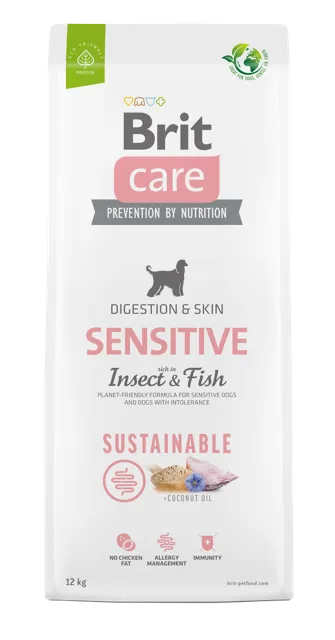
Brit Care Dog Sustainable Sensitive review
Brit Care Dog Sustainable Sensitive is the range's answer for dogs that cannot get on with the usual suspects. Chicken and grain are absent altogether. Dehydrated insect and dehydrated white fish lead at 14% each, peas carry the plant side, coconut oil at 8% supplies much of the fat and hydrolysed white fish protein at 4% eases digestion further. Our scoring places it in the Good band.
Our view
Likely to suit
If your dog's stomach keeps a grudge list, this recipe removes most of the usual entries.
- Dogs that react to chicken, since chicken appears nowhere on the ingredients list
- Dogs with delicate digestion, helped by hydrolysed fish protein, prebiotics and a probiotic culture
- Grain-avoiding dogs and their owners, as peas and pulses do the binding instead
- Households keen on lower-impact protein, with insect sharing the lead at 14%
Worth watching
The label is honest about what it leaves out, and you deserve the same honesty about what stays in.
- Insect, fish and egg all feature, so despite the short allergen list it cannot serve as a strict single-protein elimination diet
- Peas arrive in four forms, from whole yellow and green peas to pea protein and pea flour, so plant protein is doing a meaningful share of the total
- Coconut oil at 8% is an unusual main fat, worth a gradual transition for a dog with a delicate gut
Written by our editorial team. Independent guidance, not veterinary advice.
How this scores
How we scoreThe Details
Dog fit
If your dog's stomach keeps a grudge list, this recipe removes most of the usual entries. The label is honest about what it leaves out, and you deserve the same honesty about what stays in.
Dry
Adult
Fish
The score, in context
This one earns our Good band, level with the typical adult dry food. Transparency reads Outstanding here, nutritional balance Average, and both protein and processing and value come out Good. Nothing anywhere lets it down, and for a sensitivity recipe that steadiness is rather the point.
What's in it
Ingredients, as declared: dehydrated insect (14%), dehydrated white fish (14%), yellow peas (14%), green peas (14%), dried apple pulp, pea protein, coconut oil (8%), hydrolysed white fish protein (4%), brewer's yeast, salmon oil (2%), linseed (2%), egg shells, pea flour, glucosamine (300 mg/kg), fructo-oligosaccharides (230 mg/kg), chondroitin sulphate (230 mg/kg), mannan-oligosaccharides (180 mg/kg), Mojave yucca (180 mg/kg), milk thistle seed (110 mg/kg), β-glucans (60 mg/kg), dried motherwort (60 mg/kg), dried sea buckthorn (60 mg/kg), probiotic Lactobacillus helveticus HA - 122 inactivated (15x109 cells/kg).
Named ingredients
Nutritional additives
vitamin A (3a672a) 23,000 IU, vitamin D3 (3a671) 1,700 IU, vitamin E (3a700) 550 mg, vitamin C (3a312) 350 mg, taurine (3a370) 1,500 mg, choline chloride (3a890) 1,800 mg, L-carnitine (3a910) 300 mg, vitamin B1 (3a821) 3 mg, vitamin B2 (3a825i) 11 mg, biotin (3a880) 4 mg, folic acid (3a316) 1.4 mg, vitamin B6 (3a831) 3 mg, calcium-D-pantothenate (3a841) 30 mg, niacinamide (3a315) 38 mg, vitamin B12 0.12 mg, iodine (3b201) 0.9 mg, organic zinc (3b606) 100 mg, organic manganese (3b504) 45 mg, organic copper (3b406) 20 mg, organic iron (3b106) 88 mg, organic selenium (3b810) 0.18 mg. Contains EU approved antioxidants: tocopherol extracts from vegetable oil (1b306(i)), ascorbyl palmitate (1b304) & rosemary extract.
Ingredient notes
Dehydrated insect and dehydrated white fish open the label at 14% apiece, with hydrolysed white fish protein at 4% behind them. Both lead proteins arrive dried, so their shares are honest ones, and hydrolysed protein is broken into fragments small enough that a touchy digestion tends to accept it more readily. Protein converts to 27.8% of dry matter overall.
Read to the bottom of the list and the chicken-free claim still holds. Even the fat is coconut oil at 8% rather than the poultry fat most kibbles lean on, joined by salmon oil at 2% for marine omega 3s and linseed at 2% for the plant kind.
Peas do a great deal of work here: whole yellow and green peas at 14% each, then pea protein and pea flour further down. Whole peas bring fibre and micronutrients, but the refined forms are there to boost protein, and plant protein is less digestible for dogs than animal protein. Estimated carbohydrate comes out at 47.0% of dry matter, in step with the 46.2% typical for adult dry food.
Egg shells are the calcium source, a simple and natural one, and they place egg on the allergen list, worth registering for the rare egg-reactive dog.
The support package is dosed in print: glucosamine at 300 mg/kg, chondroitin sulphate at 230 mg/kg, fructo-oligosaccharides at 230 mg/kg, mannan-oligosaccharides at 180 mg/kg and an inactivated Lactobacillus probiotic. Milk thistle and sea buckthorn sit at trace level behind them.
Price and value
£5.00 a kilo across the 1kg, 3kg and 12kg bags.
Feeding a 15kg adult dog in moderate condition takes about 230 grams a day, which works out at £1.15, on an assumption of about 840 kcal daily (110 × bodyweight^0.75, the standard maintenance estimate). The bag's own guide asks 140 to 190 grams for dogs between 10kg and 15kg, a touch leaner than our estimate, so let your dog's condition decide.
Nutritional analysis
Declared analysis
25%
13%
3.2%
6.5%
10%
Dry weight
27.8%
14.4%
3.6%
7.2%
47%
As-fed composition
Estimated breakdown of the finished product by ingredient category, from the declared ingredient list and ingoing weights. These are estimates, not measurements.
35.7%
39.2%
8.1%
10%
7.1%
Pricing & size
- Pack size
- 1 kg, 3 kg, 12 kg
- Retailer pricing
- Coming soon
Live retailer pricing is not yet available for this food. Prices, cost per day and where to buy will appear here once retailer data is live.
Ingredients and nutrition are taken from manufacturer data. Retailer pricing is not yet live for this food.
Related dog food guides
Ranked shortlists that include foods like this one.