

Bonacibo
Bonacibo Adult Can: Beef review
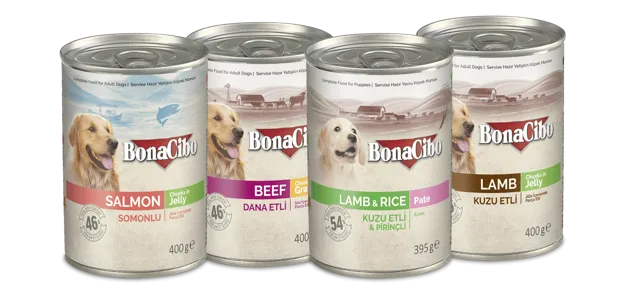
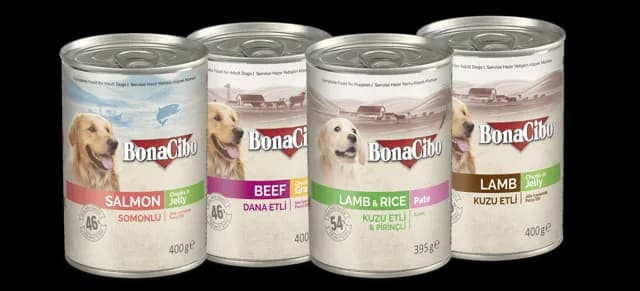
Bonacibo Adult Can is a plain, traditional tin sold in beef, lamb and salmon. Each one is built on meat and animal derivatives with the flavour animal guaranteed at a minimum of 4%, and the rest of the list runs on cereals and derivatives of vegetable origin. All three land in our Average band, and that placement comes from how little the label names rather than from anything the analysis shows.
Our view
Likely to suit
If your dog is settled on a traditional tin and doing well on it, nothing here needs to change that.
- Dogs that thrive on plain tinned food and make no fuss about the recipe behind it
- Owners feeding a larger dog who want a straightforward everyday can in one 400 g size
- Households that like to rotate flavours without changing the underlying recipe, since beef, lamb and salmon share one construction
- Dogs kept away from heavy starch, since the estimated carbohydrate lands between 10.5% and 18.0% of dry matter
- Owners who serve a wet meal alongside a dry food, not on its own
Worth watching
Most of what goes into these tins sits under category headings, so it helps to know what stays unnamed.
- A named animal accounts for just 4% of each tin, too little for any of them to anchor an elimination diet
- Neither the cereals nor the vegetable derivatives are named, and the exact grain can change from batch to batch under the same label
- Salmon flavours this tin without filling it: meat and animal derivatives lead at 42% and fish and fish derivatives sit at 4% behind
- Ash converts to 14.0% of dry matter, at the higher end for a wet food
Written by our editorial team. Independent guidance, not veterinary advice.
How this scores
How we scoreThe Details
Dog fit
If your dog is settled on a traditional tin and doing well on it, nothing here needs to change that. Most of what goes into these tins sits under category headings, so it helps to know what stays unnamed.
Wet
Adult
Toy, Small, Medium, Large, Giant
Beef
The score, in context
All three tins sit in our Average band, two bands beneath the typical adult wet food, which lands up in our Excellent band. The distance is worth explaining, because it is not what the analysis alone would suggest. On dry matter the panel is respectable: protein between 40.0% and 45.0%, fat between 25.0% and 27.5%, estimated carbohydrate between 10.5% and 18.0% against the 15.8% typical of adult wet food. What the score responds to is the label. When the animal content is a category term with 4% named, and the grain and the vegetables are category terms too, there is very little for a scoring system to reward. That shows in the pillars, where protein and processing reads Poor on all three tins while the respectable panel carries nutritional balance to Outstanding across the range, and one band covers the lot. None of that is a safety verdict; it is a description of how much this label chooses to show.
What's in it
Ingredients, as declared: Meat and animal derivatives (46%, including minimum 4% Beef), Cereals, Derivatives of vegetable origin, Minerals.
Named ingredients
Nutritional additives
| Additive | Per kg | | --- | --- | | Vitamin A | 2.250 IU/kg | | Vitamin D3 | 328 IU/kg | | Vitamin E | 26 mg/kg | | Pentahydrate | 2,5 mg/kg |
Ingredient notes
Meat and animal derivatives is a legal category term covering the fleshy parts and processing derivatives of any warm blooded land animal. It says nothing about which animals or which parts, and it can be made up differently from one batch to the next. Here it sits at 46% on the beef and lamb tins and 42% on the salmon, with only 4% pinned to the species on the front of the can.
Cereals and derivatives of vegetable origin work the same way. Both are broad enough to cover very good ingredients and very ordinary ones, and the label gives no way to tell which is in the tin. Worth saying plainly: the estimated carbohydrate does not read like a grain heavy recipe. It lands at 18.0% of dry matter on the beef and 10.5% on the other two, against the 15.8% typical of adult wet food.
What the analysis can tell you it tells clearly. Protein converts to 40.0% of dry matter on the beef and 45.0% on the lamb and salmon, fat to 25.0% and 27.5%, and moisture is declared at 80% across all three. Ash at 14.0% of dry matter is on the high side, which usually points to a good deal of mineral and bone material in the mix.
The added panel is short. Vitamins A, D3 and E are each printed per kilo, and then there is a line that reads only as pentahydrate, which leaves that trace element unnamed on the label as captured. Calories are not declared either, so the energy figures shown on this page are our own estimate from the analysis.
Taken as a whole, this is an ordinary European tin of the sort that has fed a great many dogs perfectly well. Choosing it means trusting the maker's recipe rather than reading it, because reading it is not on offer here.
How this variety differs
Beef is named at a minimum of 4% inside a 46% block of meat and animal derivatives. This is the lightest of the three at an estimated 83 kcal per 100g, and the one where estimated carbohydrate runs highest, at 18.0% of dry matter.
Price and value
Sold in one 400 g can size across the beef, lamb and salmon flavours.
As a guide, a 15kg adult dog in moderate condition needs about 840 kcal a day (110 × bodyweight^0.75, the standard maintenance estimate). That works out at roughly 1011 grams of the beef tin and 981 grams of the lamb or the salmon. That is two and a half cans. The label's own guide for a dog of 12 to 25 kg is 800 to 1200 grams a day.
Nutritional analysis
Declared analysis
Estimated using Modified Atwater factors*
8%
5%
0.6%
2.8%
80%
Dry weight
40%
25%
3%
14%
18%
As-fed composition
Estimated breakdown of the finished product by ingredient category, from the declared ingredient list and ingoing weights. These are estimates, not measurements.
46%
32.4%
19.4%
2.2%
Pricing & size
- Pack size
- 400 g
- Retailer pricing
- Coming soon
Live retailer pricing is not yet available for this food. Prices, cost per day and where to buy will appear here once retailer data is live.
Ingredients and nutrition are taken from manufacturer data. Retailer pricing is not yet live for this food.
Related dog food guides
Ranked shortlists that include foods like this one.