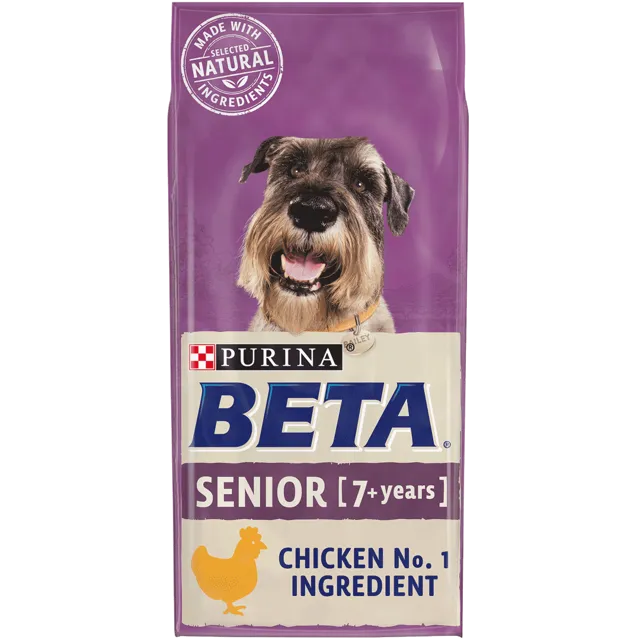

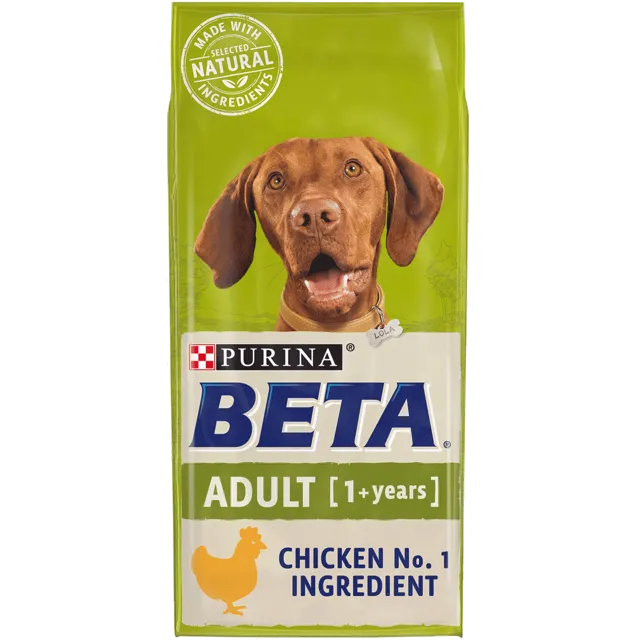

Beta
Beta Puppy: With Chicken review
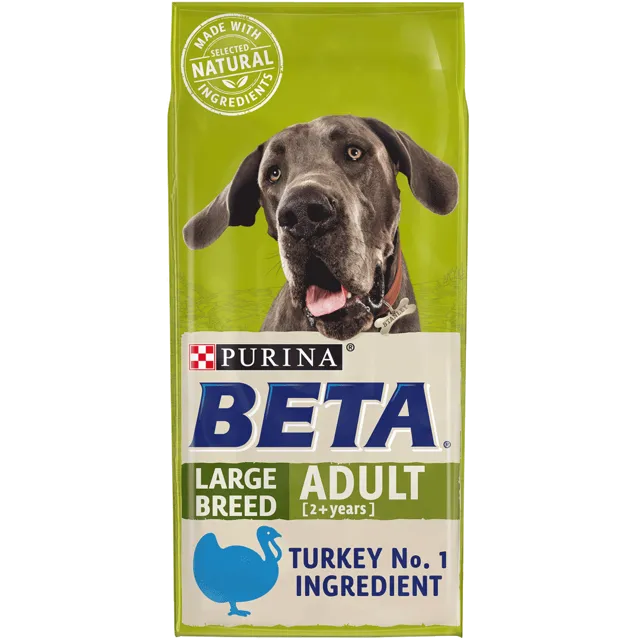
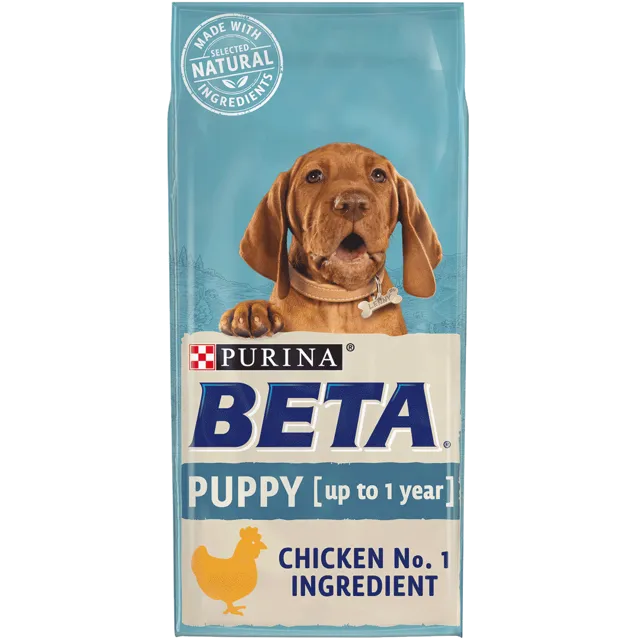
Beta Puppy is a familiar, cereal-based growth kibble sold in two recipes, one led by chicken meal and one splitting its meat between turkey and lamb. Both open with a named dried meat and then lean on wheat, corn and rice. Both declare 28.0% protein and 14.0% fat, and both print their energy at 375 kcal per 100g, right on the mark for a puppy food. A calcium figure appears on neither label. The two recipes land together on our reading, both of them in our Average band.
Our view
Likely to suit
If you want a straightforward growth kibble that most pups take to without any fuss, this range keeps things simple.
- Pups of any size, with both recipes listed for the smallest breeds through to the giants
- Households that feed a cereal-based kibble happily, with wheat, corn and rice behind the meat meal
- Owners who like the daily amount easy to judge, since energy is declared at 375 kcal per 100g rather than estimated
- Pups whose digestion appreciates a prebiotic, with dried chicory root at 1% on both lists
- Owners who want the trace mineral panel dosed in print, zinc at 110 mg/kg and iron at 83 mg/kg among the figures
Worth watching
A few habits run through both of these labels and are worth knowing up front.
- Neither bag prints a calcium figure, and that is the number large and giant breed growth leans on hardest, so owners of big pups should ask the maker for it
- Neither recipe puts a species name on its animal fats or its digest, so a strict exclusion diet has nothing to hold on to
- Wheat, wheat middlings, corn and soya meal all appear, and that is worth knowing for a pup who has had trouble with cereal or soya
- Carbohydrate converts into the low forties of dry matter on both, over the 39.0% a puppy kibble typically carries
Written by our editorial team. Independent guidance, not veterinary advice.
How this scores
How we scoreThe Details
Dog fit
If you want a straightforward growth kibble that most pups take to without any fuss, this range keeps things simple. A few habits run through both of these labels and are worth knowing up front.
Dry
Puppy
Toy, Small, Medium, Large, Giant
Chicken
The score, in context
The two bags in this range finish in the same place. Both come out in our Average band, with the turkey and lamb version the narrow pick of the two. Both land under the Good that a typical growth kibble occupies. Protein and processing reads Average on both, with nutritional balance and transparency a step up in Good. The labels do nothing badly and nothing remarkably: a named dried meat at the front, a long cereal middle, soya meal carrying part of the protein, and no calcium declaration at all. That last omission is the one worth chasing. These bags are sold for every size of pup, giants included, and calcium is the figure a big breed owner most needs in front of them.
What's in it
Ingredients, as declared: Chicken meal (27%), Wheat*, Corn*, Animal fats, Wheat middlings*, Rice*, Dried animal protein, Soya meal, Dried beet pulp, Digest, Dried chicory root*1 (1%), Minerals, Fish oil, Dried carrot* (0.07%), Dried spinach* (0.07%), Dried parsley* (0.07%), *Natural ingredients, 1natural prebiotic
Named ingredients
Nutritional additives
- Nutritional additives - IU/kg: Vit A: 22 000; - Vit D3: 1 100; - Vit E: 95. - mg/kg: - Ferrous sulphate monohydrate: (Fe: 83); - Calcium iodate anhydrous: (I: 2.0); - Copper sulphate pentahydrate: (Cu: 9.2); - Manganous sulphate monohydrate: (Mn: 6.2); - Zinc sulphate monohydrate: (Zn: 110); - Sodium selenite: (Se: 0.20). - Antioxidants
Ingredient notes
Both recipes open with a dried meat meal, and that is worth decoding. The water is already out of a meal before it goes in, so the share printed on the label is close to the share that reaches the finished kibble. A fresh meat headline does not work that way. What sits immediately behind the meat on both lists is cereal: wheat, corn, rice and wheat middlings between them.
Protein reads 28.0% on both bags, 30.8% once moisture is taken out, which is a sound growth figure on paper. Some of it comes from soya meal, though, and not all of it from the meat. A pup makes less of plant protein than of the same weight of animal protein, so the number does a little less in the bowl than it does on the panel.
Fat is 14.0%, 15.4% of dry matter, and it comes from animal fats that name no species. Fish oil sits further down and is where the omega 3 for coat and brain comes from, and it is also why fish shows on the allergen picture on both recipes.
Digest is the entry most owners will not recognise. It is a processed animal protein sprayed on as a palatability coating, the reason a plain-looking kibble tastes of something to a dog, and like the animal fats it names no species.
Dried chicory root at 1% is a real inclusion, and it brings inulin, the prebiotic that the gut's useful bacteria live on. Dried beet pulp supplies the rest of the fibre, with the panel reading 2.5%. Dried spinach, carrot and parsley at 0.07% each are decoration. The label at least prints how little of them there is.
The label declares energy at 375 kcal per 100g, almost exactly the 376 a growth kibble typically carries. Portions work out much as you would expect from experience with other bags. Moisture is 9.0%, and carbohydrate converts into the low forties of dry matter, above the 39.0% typical.
The mineral panel is dosed in print: zinc at 110 mg/kg, iron at 83 mg/kg, copper at 9.2 mg/kg, manganese at 6.2 mg/kg, iodine at 2.0 mg/kg and selenium at 0.20 mg/kg. Vitamin D3 is at 1,100 IU and vitamin E at 95. What the panel never gives is calcium. This food is listed for every size of dog, toy through to giant, so that is the line most worth having. That is worth asking the maker before a big pup starts on the bag.
How this variety differs
Chicken meal at 27% is the larger meat inclusion of the two recipes, and chicken is the only bird named on this list. A dried animal protein appears further down without naming its species, so the chicken headline does not make this a single-protein food. It is still the more straightforward of the pair for an owner who simply wants to know what the meat is. Crude ash reads 7.0%, or 7.7% of dry matter, and carbohydrate is 39.5% as fed, 43.4% once moisture comes out. Vitamin A is dosed a little higher on this recipe than on its stablemate.
Price and value
The chicken recipe is sold in 2kg and 14kg bags, and the turkey and lamb in a 14kg bag.
A growing dog's ration climbs steeply and then levels off. Use the chart on the bag as your reference point and reset it as your pup gets heavier. One scoop will not carry you through the whole of puppyhood.
Nutritional analysis
Declared analysis
28%
14%
2.5%
7%
9%
Dry weight
30.8%
15.4%
2.7%
7.7%
43.4%
As-fed composition
Estimated breakdown of the finished product by ingredient category, from the declared ingredient list and ingoing weights. These are estimates, not measurements.
31.1%
60%
1.1%
6.1%
1.6%
Pricing & size
- Pack size
- 2kg, 14kg
- Retailer pricing
- Coming soon
Live retailer pricing is not yet available for this food. Prices, cost per day and where to buy will appear here once retailer data is live.
Ingredients and nutrition are taken from manufacturer data. Retailer pricing is not yet live for this food.
Related dog food guides
Ranked shortlists that include foods like this one.