



Acana
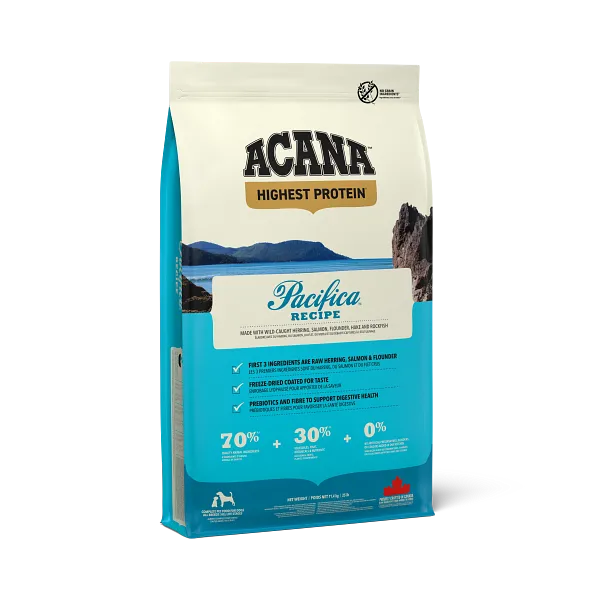
Acana Highest Protein: Pacifica Dog Recipe review
Acana Highest Protein is the brand's meat-densest line, four grain-free recipes that reach a declared protein of 35%. Raw meats and dried meals do the stacking, with organ cuts in among them. The builds run from an all-fish recipe to a three red meat one, and every label spans puppy to senior. All four varieties sit in our Excellent band.
Our view
Likely to suit
If you want the bowl to look as much like prey as a kibble can manage, this range takes the idea seriously.
- Dogs that flourish on a meat-heavy bowl, with declared protein at 35% and organ meats on every list
- Active adults with real work or long walks to fuel
- Owners rotating between beef and lamb or fish and poultry without changing the recipe underneath
- Dogs kept off land meats entirely, since one variety builds its animal content from fish alone
Worth watching
It is a rich range, and a few things are worth squaring away first.
- Every variety carries several species, so only the all-fish recipe comes close to suiting an elimination diet
- Fish is present in all four builds, whether as whole fish, trout or fish oil
- These are dense, protein-heavy foods, so portions want measuring for a dog whose exercise is mostly ornamental
Written by our editorial team. Independent guidance, not veterinary advice.
How this scores
How we scoreThe Details
Dog fit
If you want the bowl to look as much like prey as a kibble can manage, this range takes the idea seriously. It is a rich range, and a few things are worth squaring away first.
Dry
Puppy, Adult, Senior
Toy, Small, Medium, Large, Giant
Fish
The score, in context
Every variety here reaches our Excellent band and they finish within a few points of each other, while the typical adult dry food gets no further than Good. High declared meat, low carbohydrate for a kibble and labels that name every species do the work. Nutritional balance and transparency read Outstanding on all four varieties, value Excellent across the set, and protein and processing Good behind them.
What's in it
Ingredients, as declared: Raw whole herring (13%), raw salmon (13%), raw flounder (7%), herring meal (7%), salmon meal (7%), blue whiting meal (7%), whole red lentils, whole chickpeas, whole green peas, whole green lentils, fish oil (6%), raw whole hake (5%), raw whole rockfish (5%), whole pinto beans, whole yellow peas, pea starch, sunflower oil, lentil fibre, dried kelp, yeast (s. cerevisiae), fresh whole pumpkin, fresh whole butternut squash, fresh whole carrots, fresh whole apples, fresh whole pears, fresh whole zucchini, fresh kale, fresh spinach, fresh turnip greens, fresh beet greens, whole cranberries, whole blueberries, dried chicory root, turmeric, sarsaparilla root, althea root, rosehips, juniper berries.
Named ingredients
Nutritional additives
Nutritional additives per 1kg: 3b612 (Zinc: 150mg), 3b407 (Copper: 10mg), 3a821 Vitamin B1: 75mg, 3a825i Vitamin B2: 15mg, 3a314 Nicotinic acid: 150mg, 3a841 Calcium-D-pantothenate: 45mg, 3a831 Vitamin B6: 26.25mg, 3a316 Folic Acid: 5.25mg, 3a835 Vitamin B12: 0.15mg, 3a700 Vitamin E: 500 IU Additives per 1kg: Technological additives: 1b306(i) Tocopherol extract from vegetable oils: 154mg, 1a330 citric acid: 40mg. Sensory additives: Rosemary extract: 105mg.
Ingredient notes
The formula is consistent: several raw or fresh meats up front, matching meals to hold the protein through cooking, organ cuts for density, and legumes to bind. Protein converts to 39.8% of dry matter on every variety, and estimated carbohydrate converts to between 26.7% and 28.4% of dry matter across the range, where the typical adult dry food runs at 46.2%.
Organ meats appear in every recipe, liver in all four with kidney and tripe joining in the red meat builds. Organs are nutrient-dense in a way muscle meat is not, and their presence at named percentages is a mark of a label being straight with you.
The binding is all legume: chickpeas, pinto beans, lentils in red and green and peas in green and yellow, plus pea starch and lentil fibre. No grain appears anywhere in the range.
Fish threads through every variety, from whole herring and salmon in the fish recipe to trout and fish oil in the others. Fish is what looks after the omega 3 side here.
The vitamins and trace minerals are dosed in print, zinc at 150 mg and copper at 10 mg per kilo across the range, and the produce and botanicals after them sit at trace level. The meat stack is the story here, and the analysis backs it up.
How this variety differs
Fish and nothing else on the animal side, and the only variety in the range like it. Herring and salmon lead at 13% each, then flounder, blue whiting, hake and rockfish among six named species, with fish oil at 6%. For a dog kept away from land meats, this is the obvious one, and its calcium, at 1.36% of dry matter, is the lowest in the range.
Price and value
Per kilo the Wild Prairie is £7.37, the Pacifica £8.24, the Grasslands £8.51 and the Ranchlands £8.68. All four come in 2kg and 11.4kg bags, with the Pacifica, Ranchlands and Wild Prairie adding a 6kg option.
For a 15kg adult in moderate condition, feeding runs from £1.75 to £2.09 a day on roughly 237 to 240 grams, using the standard maintenance formula of 110 × bodyweight^0.75 kcal. Portion to condition rather than to the richest day's exercise.
Nutritional analysis
Declared analysis
35%
17%
4%
7%
12%
Dry weight
39.8%
19.3%
4.5%
8%
28.4%
As-fed composition
Estimated breakdown of the finished product by ingredient category, from the declared ingredient list and ingoing weights. These are estimates, not measurements.
47%
29.4%
0.3%
6.3%
17.1%
Pricing & size
- Pack size
- 2kg, 6kg, 11.4kg
- Retailer pricing
- Coming soon
Live retailer pricing is not yet available for this food. Prices, cost per day and where to buy will appear here once retailer data is live.
Ingredients and nutrition are taken from manufacturer data. Retailer pricing is not yet live for this food.
Related dog food guides
Ranked shortlists that include foods like this one.