




Acana
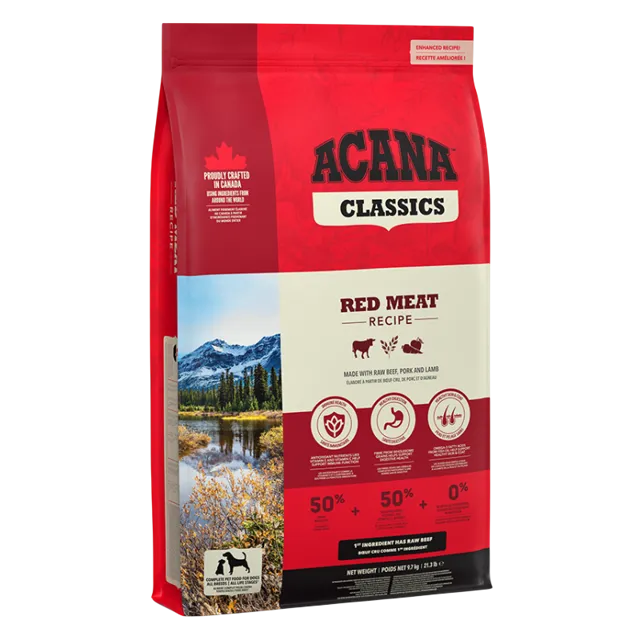
Acana Classics: Red Meat review
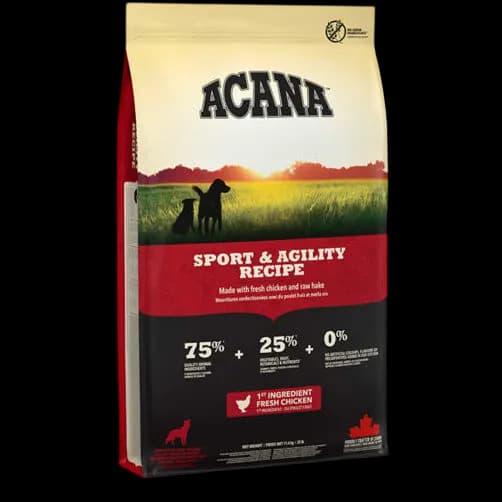
Acana Classics is the everyday tier from a brand built on meat heavy recipes, and it keeps the family shape. Each bag opens with a raw or fresh meat backed by a meal of the same family, both named and weighted. Pearled barley and oats go underneath, and a long run of whole fruit and vegetables finishes the list. The three varieties take different animals to an identical analysis, 27.0% protein and 16.0% fat, and all of them land in our Good band.
Our view
Likely to suit
Whether your dog leans towards poultry, red meat or fish, the same well made recipe is waiting behind each of the three bags.
- Dogs that get on well with grain, since pearled barley and oat groats are gentler starches than the wheat and maize many kibbles lean on
- Households feeding a puppy and an adult from the same bag, as all three recipes are written for every life stage
- Owners who want fruit and vegetables in whole form, from pumpkin and butternut squash through to kale and cranberries
- Dogs whose digestion needs a hand, with dried chicory root and a declared live probiotic on every label
- Anyone who likes to alternate flavours without changing anything else about the diet
Worth watching
A handful of details are worth knowing before you choose between the bags.
- Fish oil is on all three lists, and Wild Coast carries pork fat alongside its salmon and herring
- Barley and oats put gluten on the list, a detail to check if your dog is being kept off it
- Red Meat runs the highest calcium of the three at 1.82% of dry matter, worth weighing if a large breed puppy is eating from that bag while they grow
Written by our editorial team. Independent guidance, not veterinary advice.
How this scores
How we scoreThe Details
Dog fit
Whether your dog leans towards poultry, red meat or fish, the same well made recipe is waiting behind each of the three bags. A handful of details are worth knowing before you choose between the bags.
Dry
Puppy, Adult, Senior
Toy, Small, Medium, Large, Giant
Beef
The score, in context
All three varieties land in our Good band, level with the typical adult dry food. Transparency reads Outstanding on all three, which is the label earning its keep. The meats are named and weighted, the produce is itemised instead of lumped together, and the additive panel is printed in full down to the preservatives.
Value sits in step with the overall band, and nutritional balance reads Good because the analysis is solid without being striking. Carbohydrate comes in under what a typical dry food carries without going anywhere near low, and the same protein and fat figures appear on all three bags. What you get in return is consistency, which counts for a great deal in a food a dog eats twice a day for years.
What's in it
Ingredients, as declared: Raw beef (16%), lamb meal (15%), pearled barley, whole peas, oat groats, pork fat (8%), pork meal (8%), whole oats, chickpea fibre, raw pork (2%), fish oil (1%), potassium chloride, dried kelp, salt, dried chicory root, fresh whole pumpkin, fresh whole butternut squash, fresh whole carrots, fresh whole apples, fresh whole pears, fresh whole zucchini, fresh kale, fresh spinach, fresh turnip greens, fresh beet greens, whole cranberries, whole blueberries, whole saskatoon berries, turmeric, milk thistle, burdock root, lavender, marshmallow root, rosehips.
Named ingredients
Nutritional additives
Nutritional additives per 1kg: 3a890 Choline chloride (choline): 700 mg, 3a370 Taurine: 400 mg, 3b612 (Zinc: 88 mg), 3b407 (Copper: 5.5 mg), 3a821 Vitamin B1: 100 mg, 3a825i Vitamin B2:20 mg, 3a314 Niacin: 200 mg, 3a841 Calcium-D-pantothenate: 60 mg, 3a831 Vitamin B6: 35 mg, 3a316 Folic Acid: 7 mg, 3a835 Vitamin B12: 0.2 mg, 3a672a Vitamin A: 7500 IU, 3a671 Vitamin D3: 1000 IU, 3a700 Vitamin E: 375 IU, 3a300 Ascorbic acid: 0.15 mg. Additives per 1kg: Technological additives: 1b306(i) Tocopherol extract from vegetable oils: 110mg, 1a330 citric acid: 40 mg. Sensory additives: Rosemary extract: 75 mg. Zootechnical additives: 4b1707 Enterococcus faecium DSM 10663/NCIMB 10415: 1×10⁹ CFU.
Ingredient notes
Every recipe opens with a raw or fresh meat and backs it with a meal from the same family, which is the right way round. Prairie Poultry gives fresh chicken at 21% with chicken meal at 20%. Red Meat opens with raw beef at 16% and lamb meal at 15%, and Wild Coast puts raw salmon at 22% ahead of herring meal at 19%. The meal is the part carrying most of the finished kibble, because the raw share loses its water in the oven, and in each case that meal is named right down to the species.
Pearled barley, oat groats and whole oats supply the starch, with whole peas and chickpea fibre working alongside them. These are slower, gentler grains than the wheat and maize a kibble often reaches for, and barley in particular brings useful fibre with it. Carbohydrate lands between 36.3% and 36.9% of dry matter, under the 46.2% typical of adult dry food, and crude fibre reads a healthy 5.7%.
The produce list is long and mostly whole, running from pumpkin, butternut squash and carrots through apples and pears to kale, spinach and beet greens, then cranberries, blueberries and saskatoon berries. Most of it is seasoning at trace level, and the recipe does not depend on any of it. The entries doing real work are dried kelp, a natural iodine source, and dried chicory root, whose inulin feeds the friendly bacteria in the gut.
The additive panel is unusually forthcoming. Taurine is dosed at 400 mg per kilo on all three, and choline chloride at 700 mg in the poultry and red meat recipes and 350 mg in Wild Coast. A live probiotic culture of Enterococcus faecium is declared on every bag. Preservation is handled by tocopherol extract from vegetable oils, with rosemary extract behind it and nothing synthetic in sight.
Fish oil at 1% runs through the whole range as the omega 3 source. It is a genuinely good ingredient and the one you want for skin and joints. It does mean the poultry and red meat recipes carry fish as well, which is the detail to hold on to if fish is what you are trying to keep out.
How this variety differs
The busiest label of the three, with raw beef at 16%, lamb meal at 15%, pork meal at 8% and raw pork at 2%, and pork fat supplying the added fat. That mixture makes it the most varied bowl in the range and the least useful for narrowing a diet down to one animal. Calcium is the highest here at 1.82% of dry matter, which is the figure to weigh if a large breed puppy is being fed from this bag.
Price and value
Prairie Poultry is £5.88 a kilo, with Red Meat and Wild Coast at £6.70, and all three come in 2kg and 9.7kg bags.
As a guide, a 15kg adult dog in moderate condition works out at roughly 244 to 245 grams a day, which comes to between £1.43 and £1.64 a day depending on the bag. That takes a daily requirement of about 840 kcal, worked from the usual maintenance formula of 110 × bodyweight^0.75. The label's own table is more sparing, at 120 to 195 grams for a dog between 10kg and 20kg taking an hour or less of exercise. Let the waistline settle the difference between the two.
Nutritional analysis
Declared analysis
27%
16%
5%
8%
12%
Dry weight
30.7%
18.2%
5.7%
9.1%
36.3%
As-fed composition
Estimated breakdown of the finished product by ingredient category, from the declared ingredient list and ingoing weights. These are estimates, not measurements.
41%
46.6%
1.8%
9%
1.5%
Pricing & size
- Pack size
- 9.7kg, 2kg
- Retailer pricing
- Coming soon
Live retailer pricing is not yet available for this food. Prices, cost per day and where to buy will appear here once retailer data is live.
Ingredients and nutrition are taken from manufacturer data. Retailer pricing is not yet live for this food.
Related dog food guides
Ranked shortlists that include foods like this one.