
Skip to content
Off the Leash
Wonderdog High Gold – —

Sneyd's Wonderdog

Sneyd's Wonderdog Wonderdog High Gold review

19.7/100Poor
DryAdult

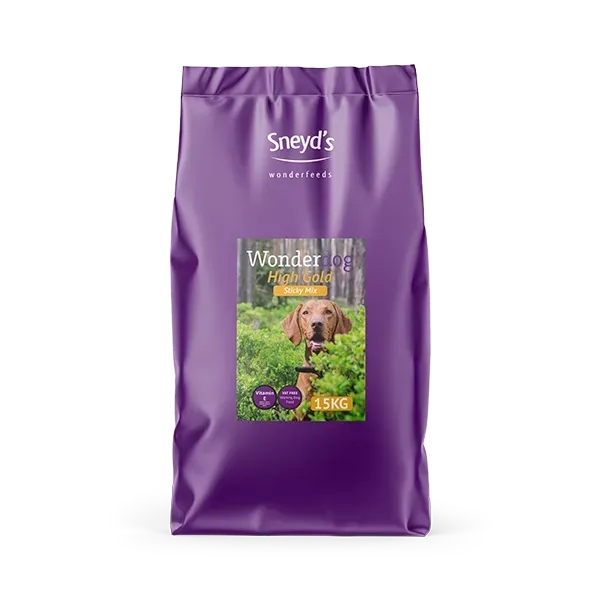
Wonderdog High Gold is a traditional working kennel biscuit and it makes no attempt to look like anything else. Categories do the talking on this label, not named ingredients: cereals first, then meat and animal derivatives. It does at least name the four animals behind that second entry as beef, chicken, lamb and pork. Fat is declared at 7%, which is genuinely light, and that shapes who the food is for. Our scoring reads it in the Poor band, a good way under the Good band an average adult dry food reaches.

Where to buy: coming soon
Live retailer pricing is coming soon. Once we have prices from UK retailers, the best price, cost per day and where to buy will appear here.

Our view

Likely to suit

If you keep working dogs and want a plain, light, old fashioned ration, this is exactly that and nothing more.

  • Kennels and working homes feeding several dogs on one recipe, as the guide covers 5kg terriers up to dogs over 31kg
  • Dogs carrying a little too much round the middle, since fat is declared at just 7%
  • Owners who want a simple everyday biscuit and no long list to study
  • Dogs whose stomachs have handled a mixed meat food happily for years

Worth watching

This label asks a bit of trust of you, so here is what it does and does not tell you.

  • Cereals and meat and animal derivatives name families of ingredients, so what sits inside them can shift from batch to batch
  • An exclusion trial cannot be run on a label this vague, and that matters when you are hunting a suspected trigger
  • Various sugars is declared on the list, so there is some sweetening in the mix
  • The plant side carries most of this food, with carbohydrate at 58.7% of dry matter against 46.2% typical
  • Fish oil at 0.25% is on the list, small though the amount is, so this is not a fish free food

Written by our editorial team. Independent guidance, not veterinary advice.

How this scores

How we score
19.7/100Poor
Protein and processingPoor
Nutritional balancePoor
TransparencyPoor
ValuePoor

The Details

Dog fit

If you keep working dogs and want a plain, light, old fashioned ration, this is exactly that and nothing more. This label asks a bit of trust of you, so here is what it does and does not tell you.

Food type

Dry

Life stage

Adult

Breed size

Toy, Small, Medium, Large, Giant

Main protein

Beef

The score, in context

Our reading puts this in the Poor band, and the reason is mostly what the label chooses not to say. The label works in family names: cereals, derivatives of vegetable origin, vegetable protein extracts, oils and fats. None of those names an ingredient, so there is no telling what goes into the bag from one month to the next, and protein and processing, nutritional balance and transparency all come back Poor. The analysis agrees in one place in particular: carbohydrate estimated at 58.7% of dry matter, against 46.2% for adult dry food generally, working from an assumed 8% moisture because the label declares none. An average adult dry food reaches our Good band. It is still a serviceable ration for a hardy dog in work. That is what it was built for, and it delivers.

What's in it

Ingredients, as declared: Cereals, Meat and Animal Derivatives (Beef, Chicken, Lamb & Pork), Derivatives of Vegetable Origin, Oils and Fats (0.25% fish oil), Various Sugars, Vegetable Protein Extracts, Minerals, Weetsweet.

Named ingredients

Cereals, Meat and Animal Derivatives (Beef, Chicken, Lamb & Pork), Derivatives of Vegetable Origin, Oils and Fats (0.25% fish oil), Various Sugars, Vegetable Protein Extracts, Minerals, Weetsweet.

Nutritional additives

Vitamin A 12,000IU/Kg, Vitamin D3 800IU/Kg, Vitamin E 60mg/kg, Iron (Iron (II) Sulphate Monohydrate) 80mg/kg, Zinc (Zinc Sulphate Monohydrate) 40mg, Manganese (Manganese Sulphate Monohydrate) 25mg/kg, Copper (Copper (II) Pentahydrate) 13mg/kg, Iodine (Calcium Iodate Anhydrous) 1.4mg/kg, Selenium (Sodium Selenite) 0.15mg/kg.

Ingredient notes

Cereals leads the list, and that single word covers wheat, maize, rice, barley and oats in any combination. It is not automatically a poor ingredient, since the term takes in the best grains as well as the worst. It does mean the market, not a fixed recipe, decides which grain ends up in the bag. None of that troubles a dog who has never had a problem with grain. If you are trying to puzzle a dog out, it is a wall.

Meat and animal derivatives is the second entry, and the bracket after it is the label's saving grace, naming beef, chicken, lamb and pork. At one end of the term is prime muscle meat, at the other the parts of a carcass that never see a butcher's counter, and nothing here says which end this is. Knowing the four species at least tells you what your dog is eating, which is more than most labels using this term bother to do.

Fat at 7% is the number that defines this food. That is light, and set against protein at 21% it makes a ration that fills a dog without loading them. The dog it suits is one carrying a little extra weight, not a hard running athlete. Both figures are gentle for a kibble: protein converts to 22.8% of dry matter and fat to 7.6%.

Various sugars appears midway down the list. Sugar is in a dog's food for the same reason it is in ours. Weetsweet follows the minerals and is a trade name the label never explains, so there is no saying what it brings. Neither entry is a danger at the levels a complete food uses, and both are the sort of thing a careful reader would rather see spelled out.

The oils and fats entry names one thing only, fish oil at 0.25%, which brings a little omega 3 along with it. The vitamin and trace element panel is the precise part of this label. Vitamin E is at 60mg per kilo, iron at 80mg, zinc at 40mg, manganese at 25mg, copper at 13mg, iodine at 1.4mg and selenium at 0.15mg. Vitamins A and D3 are dosed in print alongside them. Every single one carries an amount.

Price and value

Bags come in 2.5kg and 15kg, and there is a sample pack for a first go. A per kilo figure was not available for this one when we checked, so there is no daily figure to set beside it here.

On portions, the label asks 175 to 240 grams a day for a dog between 11kg and 20kg. A 15kg adult in moderate condition lands at around 261 grams, on an estimate of about 840 kcal a day (110 × bodyweight^0.75, the standard maintenance calculation).

Nutritional analysis

Declared analysis

Energy
322 kcal/100g

Estimated using Modified Atwater factors*

Protein

21%

Fat

7%

Fibre

3%

Ash

7%

Dry weight

Protein

22.8%

Fat

7.6%

Fibre

3.3%

Ash

7.6%

Carbs

58.7%

As-fed composition

Estimated breakdown of the finished product by ingredient category, from the declared ingredient list and ingoing weights. These are estimates, not measurements.

Meat

25.3%

Carbs

66.9%

Oils

5.4%

Other

2.4%

Pricing & size
Pack size
15 Kg, 2.5 Kg, Sample Pack
Retailer pricing
Coming soon

Live retailer pricing is not yet available for this food. Prices, cost per day and where to buy will appear here once retailer data is live.

Ingredients and nutrition are taken from manufacturer data. Retailer pricing is not yet live for this food.

Related dog food guides

Ranked shortlists that include foods like this one.
All reviews

Featured feeding accessories

All feeding accessories

Brackenwood

Slow Feeder Maze Bowl

Slows fast eaters and eases gulping at mealtimes.

From £12.99· 4 retailers
View

Tarn & Co

Raised Double Diner

Height-set stand for easier, tidier eating.

From £28.99· 3 retailers
View

Reviewed by Off the Leash Editorial

Last updated 28 August 2026