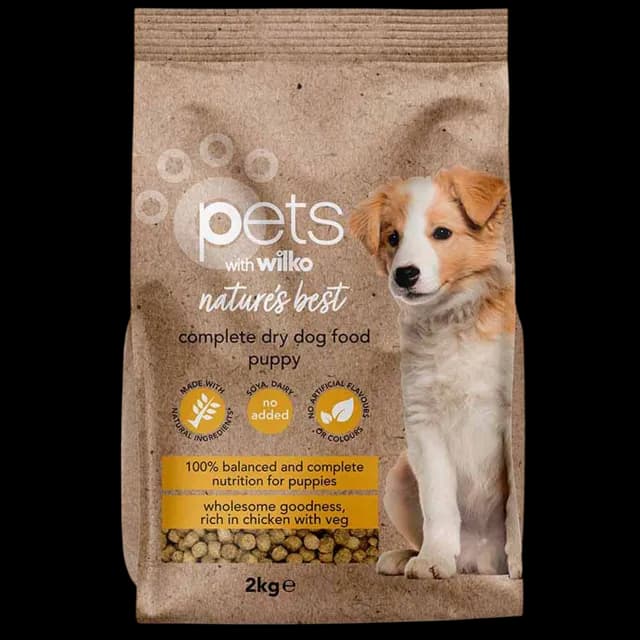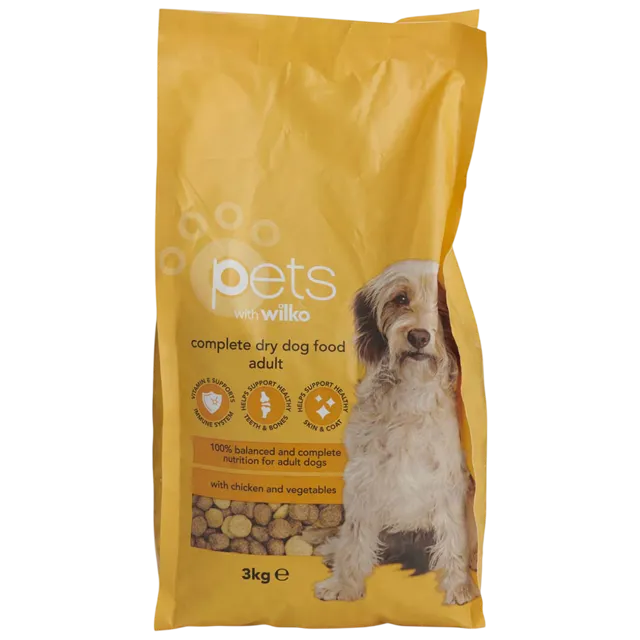




Wilko
Wilko Adult Complete Dry: Chicken with Vegetables review
An everyday kibble in two shapes, Wilko Adult Complete writes its label in categories where a reader wants ingredients. Cereals lead, meat and animal derivatives follow with 4% of the named meat declared inside them, and oils and fats, vegetables and minerals fill in the rest. The vitamin and mineral panel is dosed properly and the analysis is declared in full. Both recipes land in our Average band, and that verdict is about how little the label says. It is not a warning about the contents of the bag.
Our view
Likely to suit
Supermarket kibble has kept plenty of dogs going for years, and this label is worth a read before you add it to the trolley.
- Dogs who have never had a food sensitivity and do well on plain everyday kibble
- A household with dogs of several sizes in it, since the label's guide covers 5kg through to 70kg
- Quieter dogs who could do with losing a bit, with fat declared at 9%
- Owners of a dog that likes some variety in the bowl, since every bag holds two kibble shapes
- Owners who want the vitamin and mineral side dosed in print, which this panel does entry by entry
Worth watching
Before you buy, it helps to know how much this label keeps to itself.
- An elimination plan has nothing to work from here, with only 4% of the animal side named and the rest under meat and animal derivatives
- Oils and fats names neither the plant nor the animal behind it, and cereals does the same for the grain
- Carbohydrate is estimated at 55.9% of dry matter against the 46.2% typical for adult dry food, so starch carries most of the bowl
- Oxides and sulphates carry the trace minerals here, and a dog absorbs those slightly less well than chelates
Written by our editorial team. Independent guidance, not veterinary advice.
How this scores
How we scoreThe Details
Dog fit
Supermarket kibble has kept plenty of dogs going for years, and this label is worth a read before you add it to the trolley. Before you buy, it helps to know how much this label keeps to itself.
Dry
Adult
Toy, Small, Medium, Large, Giant
Chicken
The score, in context
Both recipes finish in our Average band, a step below the Good band the typical adult dry food occupies. What the label leaves unsaid accounts for nearly all of that step. Category names such as cereals, oils and fats and meat and animal derivatives can cover something perfectly decent or something very ordinary, and nothing on the outside tells you which. So we score what the label prints and do not assume the best of it. The declared analysis fills in the rest of the picture. Protein converts to 22.3% of dry matter and estimated carbohydrate to 55.9%, which puts the weight of the recipe on starch rather than on the animal. It is still a complete food, with the vitamin and mineral panel fully dosed behind it. Most dogs ask nothing more of a bag than that.
What's in it
Ingredients, as declared: Cereals, Meat and Animal Derivatives (4% Chicken in the Bone-shaped Kibble*), Oils and Fats, Vegetables (4% Peas in the Barrel-shaped Kibble), Minerals, Derivatives of Vegetable Origin (0.5% Beet Pulp in the Bone-shaped Kibble*), Yeasts. *Bone-shaped Kibble: typically 40% of the product. Barrel-shaped Kibble: typically 60% of the product.
Named ingredients
Nutritional additives
Vitamin A 17,000 IU, Vitamin D3 1,500 IU, Vitamin E 70mg, Iodine (Calcium Iodate Anhydrous) 2.5mg, Selenium (Sodium Selenite) 0.1mg, Copper (Copper (II) Sulphate Pentahydrate) 8mg, Iron (Iron (II) Sulphate Monohydrate) 60mg, Manganese (Manganese (II) Oxide) 50mg, Zinc (Zinc Oxide) 100mg.
Ingredient notes
Cereals sits first, and that one word is the biggest thing the label tells you and the least it could tell you at the same time. The term stretches across every grain from the best to the poorest, and because no type is named, the grain used can change from batch to batch. What it does establish is that grain, not meat, is the largest part of this recipe.
Meat and animal derivatives comes next, with 4% of it pinned to a named animal. The legal definition takes in the fleshy parts and processing derivatives of slaughtered warm-blooded land animals. That is broad enough to hold good material and ordinary material alike. A dog with no known trouble will very likely be fine on it. A dog whose diet needs a species ruled in or ruled out is a different matter, since there is nothing here to do that with.
The bag holds two kibbles. One shape, typically 40% of the product, carries the named meat and the beet pulp at 0.5%, and the barrel shape, typically 60%, carries the peas at 4%. It is a neat way of building a recipe and it gives the bowl a bit of textural interest, which some dogs care about more than owners expect.
The mineral and vitamin panel says more than the rest of the label put together. Vitamin E is dosed at 70mg, zinc at 100mg, iron at 60mg, manganese at 50mg and copper at 8mg, with iodine at 2.5mg and selenium at 0.1mg. The forms are the plain ones, zinc as an oxide and the others largely as sulphates, with sodium selenite for the selenium in place of a selenised yeast. What a complete food has to deliver is all there, and printed.
Calcium works out at 1.91% of dry matter, comfortably within adult territory. The analysis is declared right through, moisture at 6% included. That makes the dry matter column here a reading and not an assumption. Small things, but they are the things that let you compare one bag against another honestly.
How this variety differs
Here the named 4% is chicken, and it sits in a bone-shaped kibble rather than a clover-shaped one, with the peas in the barrel shape as before. The analysis, the energy figure and the additive panel are identical to the beef bag, which makes this simply the poultry option in a recipe that is otherwise the same food.
Price and value
Beef with Vegetables is £1.00 a kilo and Chicken with Vegetables is £1.33 a kilo, both sold in 3kg bags.
As a guide, a 15kg adult dog in moderate condition eats about 242 grams a day of either recipe, assuming around 840 kcal a day (110 × bodyweight^0.75, the standard maintenance estimate). That comes to £0.24 a day on the beef and £0.32 a day on the chicken. The label's own guide asks 180 to 360 grams for a dog between 10kg and 25kg. Your dog's shape is the better guide to where in that range to sit.
Nutritional analysis
Declared analysis
21%
9%
3.5%
8%
6%
Dry weight
22.3%
9.6%
3.7%
8.5%
55.9%
As-fed composition
Estimated breakdown of the finished product by ingredient category, from the declared ingredient list and ingoing weights. These are estimates, not measurements.
57.5%
30%
4.4%
5.7%
2.4%
Pricing & size
- Pack size
- 3kg
- Retailer pricing
- Coming soon
Live retailer pricing is not yet available for this food. Prices, cost per day and where to buy will appear here once retailer data is live.
Ingredients and nutrition are taken from manufacturer data. Retailer pricing is not yet live for this food.
Related dog food guides
Ranked shortlists that include foods like this one.