


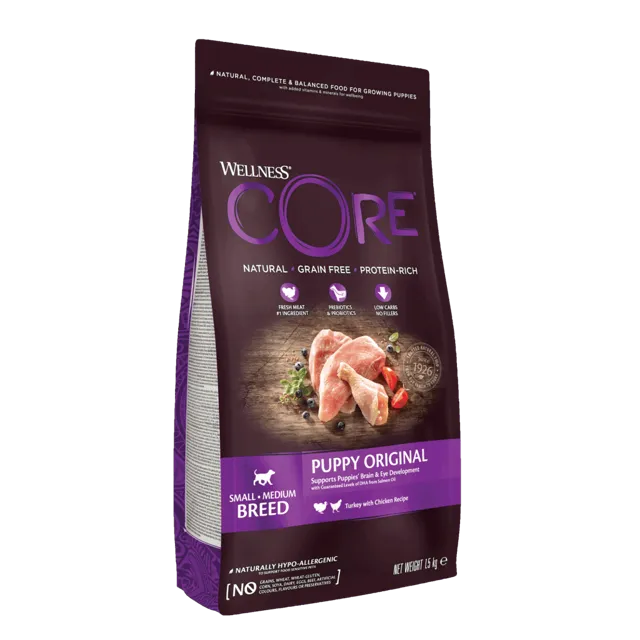

Wellness Core
Wellness Core Puppy review
Wellness Core Puppy is a grain free growth range of two recipes, and both build their meat the same way. A fresh version of the lead animal is paired with a dehydrated one, which is how the declared share survives into the finished kibble. Peas and potato do the binding, beet pulp at 4% brings a steady fibre, and both labels close with the same tail of chicory root, yeast extract, berries and a joint pair. The turkey and chicken bag reaches our Excellent band, with the Ocean Salmon recipe a step behind it in Good.
Our view
Likely to suit
This range gives you two clearly different bowls built to the same plan.
- Puppies of every size, as both bags are listed from the smallest breeds up to giant
- A home that keeps cereals out of the bowl, since peas and potato do the binding in both recipes
- Owners who want joint ingredients written into the recipe itself, with glucosamine and chondroitin sulphate named on each label
- Pups whose gut likes a prebiotic pairing, with dried chicory root and a yeast extract on both lists
- Owners feeding with the heart in mind, with taurine at 1500 mg/kg in each recipe
Worth watching
The two bags do not carry quite the same information, so a few points are worth checking before you settle on one.
- A calcium figure appears on only one of the labels, and that matters most for a pup destined to be big
- Potato protein sits among the meat entries on both recipes, a plant protein doing work you would rather see meat doing
- Fish runs through the whole range, which rules out both bags for a pup kept clear of it
- Both lists carry mixed herbs as a broad heading, which matters while you are still pinning down a pup's triggers
Written by our editorial team. Independent guidance, not veterinary advice.
How this scores
How we scoreThe Details
Dog fit
This range gives you two clearly different bowls built to the same plan. The two bags do not carry quite the same information, so a few points are worth checking before you settle on one.
Dry
Puppy
Toy, Small, Medium, Large, Giant
Turkey
The score, in context
The Ocean Salmon bag comes out in our Good band, level with the typical puppy dry food, while the turkey and chicken recipe pushes a band clear of it into Excellent. Transparency reads Outstanding on both labels, with nutritional balance Outstanding on the turkey and chicken bag and Excellent on the fish. The position is earned across the board, with nothing propped up in one place.
It is the build that earns the place. A lead meat is declared in two forms, the starch base stays modest for a kibble, and the supplement tail is written out in full. What stops either bag pressing higher is a set of smaller things, from a plant protein sitting high on the list to the calcium line that only one of the labels prints.
What's in it
Ingredients, as declared: Turkey 32% (Fresh Turkey 16%, Dehydrated Turkey 16%), Chicken 30% (Dehydrated Chicken 16%, Chicken Fat 8%, Chicken Gravy 6%), Peas, Potato Protein, Beet Pulp 4%, Linseed 3%, Dried Potatoes, Salmon Oil 1%, Lignocellulose, Carrots, Apples, Yeast Extract (source of mannan oligosaccharides) 0.5%, Dried Chicory Root (source of Fructo- oligo-saccharides and Inulin) 0.5%, Broccoli, Spinach, Tomatoes 0.01%, Blueberries 0.01%, Cranberries, Dried Peppermint, D-Glucosamine Hydrochloride 100 mg/kg, Chondroitin Sulphate 100 mg/kg, Yucca Schidigera, Mixed Herbs (Dried Rosemary, Dried Turmeric, Dried Citrus, Dried Eugenia).
Named ingredients
Nutritional additives
Vitamin A 14000 IU, Vitamin D3 1000 IU, Vitamin E 120 mg, Taurine 1500 mg, Zinc (Zinc sulphate, monohydrate) 100 mg, Iron (Ferrous sulphate, monohydrate) 100 mg, Copper (Cupric sulphate, pentahydrate) 7,5 mg, Manganese (Manganous sulphate, monohydrate) 5 mg, Iodine (Calcium iodate, anhydrous) 1,5 mg.
Ingredient notes
Both recipes use the same trick with their meat, and it is a good one. The lead animal appears twice, once fresh and once dehydrated. The dried form has already given up its water, so that half of the declared share reaches the finished kibble much as printed, with no shrinking in the oven.
Peas and dried potatoes do the binding across the range, so neither bag carries a cereal. Fibre on both lists is beet pulp at 4%, a gentle and well tolerated sort that most growing digestions handle without fuss. Potato protein appears on both lists too, and it is the one structural entry we would rather see lower down. Plant proteins are less digestible than the animal kind, and they are better topping up the amino acid picture than filling it out.
The gut and joint tail is common to both. Fructo-oligosaccharides and inulin come from dried chicory root, mannan-oligosaccharides from yeast extract. Together they are the standard prebiotic pairing, there to feed the helpful bacteria further along. Glucosamine hydrochloride and chondroitin sulphate follow, though at quite different levels in the two bags.
After that comes the garnish: broccoli, spinach, tomatoes, cranberries and blueberries in trace amounts, then yucca schidigera and a mixed herb blend of rosemary, turmeric, citrus and eugenia. Treat all of that as seasoning rather than substance. Mixed herbs is also the one broad heading on an otherwise itemised list, so a pup whose triggers are being pinned down deserves a note of it.
Both labels dose their added vitamins and trace elements in print, with vitamin A at 14000 IU and taurine at 1500 mg/kg on each. Zinc and iron come at 100 mg apiece, with smaller amounts of copper, manganese and iodine. The variety notes below carry the analysis, the calcium picture and the joint doses, which is where the two recipes genuinely part company.
How this variety differs
The turkey and chicken bag splits its meat across two birds. Turkey makes up 32% in fresh and dehydrated halves of 16% each, and chicken adds a further 30% as dehydrated chicken at 16%, chicken fat at 8% and chicken gravy at 6%. The fats are linseed at 3% and salmon oil at 1%, and lignocellulose brings a purified fibre that adds bulk and nothing much besides.
This is the fuller label of the two. Protein reads 37.0% and converts to 40.7% of dry matter, with fat at 17.0%, ash at 8.0% and moisture declared at 9.0%. The carbohydrate estimate is 27.6% of dry matter, against the 39.0% typical of a puppy dry food. Energy sits at 359 kcal per 100g. Calcium is printed here and converts to 1.98% of dry matter, a little above where large breed growth is usually pitched. Rearing a big pup on this as the everyday bowl is a conversation to have with your vet first. The joint pair comes in at 100 mg/kg of glucosamine hydrochloride and 100 mg/kg of chondroitin sulphate.
Price and value
Bag sizes across the range run from a kilo and a half up to ten kilos, depending which recipe you choose. The Ocean Salmon with White Fish bag works out at £3.50 a kilo.
Puppy rations are not a fixed number. They rise through the early months and then flatten off as the frame finishes. Let the chart on the bag and the feel of your pup's ribs decide the scoop, never habit.
Nutritional analysis
Declared analysis
37%
17%
3.8%
8%
9%
Dry weight
40.7%
18.7%
4.2%
8.8%
27.6%
As-fed composition
Estimated breakdown of the finished product by ingredient category, from the declared ingredient list and ingoing weights. These are estimates, not measurements.
56%
6%
28%
3.4%
1%
5.6%
Pricing & size
- Pack size
- 1,5 KG · 10 KG
- Retailer pricing
- Coming soon
Live retailer pricing is not yet available for this food. Prices, cost per day and where to buy will appear here once retailer data is live.
Ingredients and nutrition are taken from manufacturer data. Retailer pricing is not yet live for this food.
Related dog food guides
Ranked shortlists that include foods like this one.