


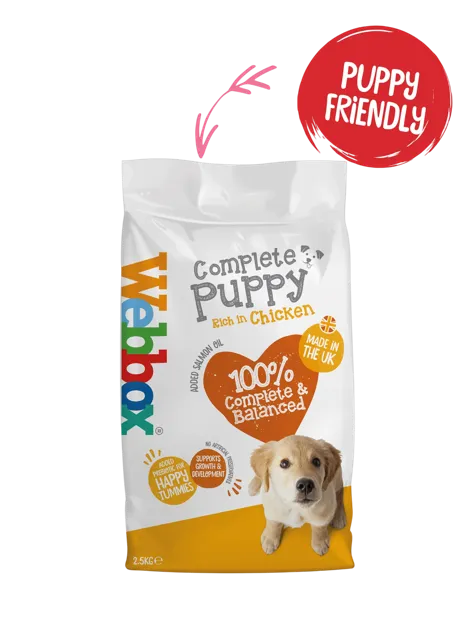

Webbox
Webbox Everyday Complete Dry Puppy review
Webbox Everyday Complete Dry Puppy is a growth kibble, and category terms do almost all of the describing. Cereals lead the list, meat and animal derivatives follow with chicken given at 21% inside them, and oils and fats carry 1% salmon oil. The declared analysis is generous on paper, with protein at 33.5% as fed. The same panel gives 28.0% moisture, which is high for a kibble, so read the as-fed figures and not a conversion of them. It sits in our Average band.
Our view
Likely to suit
Every household feeding a puppy has its own priorities, and there are a few this bag genuinely answers.
- Puppies of small and medium breeds, the sizes the feeding chart is written around
- Owners who want a joint entry named, with glucosamine declared at 0.006% inside the molluscs and crustaceans listing
- Puppies who like a fuller bowl, since at an estimated 314 kcal per 100g the measure runs larger than on the 376 kcal typical of puppy kibble
- Households who want one bag they can pick up alongside the weekly shopping
Worth watching
None of what follows should put you off the bag, but it is all better known before you fill the bowl.
- Cereals is the leading entry with no grain named, so a pup you are keeping off wheat or maize cannot be catered for from this list
- Meat and animal derivatives is the term used, with chicken named at 21%, so the rest of the animal material goes unnamed
- Colours are declared among the additives, which some owners would rather keep out of a growing pup's bowl
- Moisture is declared at 28.0%, well above what a kibble normally carries, so the printed as-fed figures cannot fairly be converted and set against another food's dry matter numbers
- No calcium figure is printed, and calcium is the line that governs how a skeleton is built, so a vet's view is worth having for a pup at the top of the medium range
Written by our editorial team. Independent guidance, not veterinary advice.
How this scores
How we scoreThe Details
Dog fit
Every household feeding a puppy has its own priorities, and there are a few this bag genuinely answers. None of what follows should put you off the bag, but it is all better known before you fill the bowl.
Dry
Puppy
Small, Medium
Chicken
The score, in context
We reward a label that spells out what is in the bag, and this one mostly gives groups. Every one of them is an umbrella heading: cereals, oils and fats, meat and animal derivatives, derivatives of vegetable origin and vegetable protein extracts. Each covers a wide span of possible quality, and none tells an owner which grain or which animal is going into the bowl. There is no way to check the recipe against a pup's needs. That is why the bag lands in our Average band while the middle of the puppy kibble field holds our Good band. Protein and processing and transparency both read Poor, even as nutritional balance reads Outstanding.
The declared moisture of 28.0% adds to it. A kibble is normally a tenth water or less, so a figure this high sits outside the usual range for the format. The analysis around it cannot be put on the same footing as other dry foods. Read the as-fed numbers as declared and treat any comparison with a fully declared kibble as unreliable. None of that says a pup will not do well on it, only that the label gives an owner very little to judge by. The named entries below are the parts worth holding on to.
What's in it
Ingredients, as declared: Cereals, Meat and Animal Derivatives (21% chicken), Oils and Fats (1% salmon oil), Vegetable Protein Extracts, Derivatives of Vegetable Origin, Minerals, Vegetables, Yeasts, Molluscs and Crustaceans (Glucosamine 0.006%)
Named ingredients
Nutritional additives
Antioxidants; Colours; Nutritional: Vitamin A 19000 IU/kg, Vitamin D3 1900 IU/kg, Vitamin E 110 mg/kg; Trace elements: Ferrous sulphate monohydrate 133 mg/kg, Copper sulphate pentahydrate 28 mg/kg, Manganese sulphate monohydrate 94 mg/kg, Zinc sulphate monohydrate 278 mg/kg, Calcium iodate 1.6 mg/kg, Sodium selenite 0.55 mg/kg
Ingredient notes
Everything after it takes its shape from cereals, which heads the list. That one word covers every grain there is, the ones a nutritionist would choose and the ones they would not. It also lets the grain change from batch to batch without the label changing. For a pup with a suspected grain sensitivity that is a real practical problem, because there is nothing here to test against.
Meat and animal derivatives covers the animal side, and the label does at least pin part of it down by giving chicken at 21%. That named share is the most useful figure on the list. What sits alongside it in the same entry is not described, so an owner avoiding a particular animal cannot rule this in or out. Oils and fats is the same story with a helpful exception: 1% of it is named as salmon oil, which is a decent source of marine omega 3 for a growing brain and coat.
Vegetable protein extracts and derivatives of vegetable origin follow, and both lift the protein and carbohydrate figures without saying what they came from. For a puppy, vegetable protein does not match meat protein, so the declared 33.5% protein is not the same 33.5% you would read on a label that names its meat throughout. Vegetables and yeasts sit behind them, again as groups with nothing named, though yeasts do bring B vitamins and palatability with them.
Molluscs and crustaceans closes the list with glucosamine given at 0.006%. Crustacean shell is the usual commercial source of glucosamine, so the entry is doing what it says. The share is a token gesture towards joints, well short of a dose that would be expected to act.
The additive panel is fully dosed, and it is the label at its best. Vitamin E comes in at 110 mg/kg with vitamins A and D3. Then zinc sulphate monohydrate at 278 mg/kg, ferrous sulphate monohydrate at 133 mg/kg and manganese sulphate monohydrate at 94 mg/kg. Copper sulphate pentahydrate at 28 mg/kg, calcium iodate at 1.6 mg/kg and sodium selenite at 0.55 mg/kg close it. Colours are declared in the same panel, and that is a matter of preference, not safety. Plenty of owners would rather a growth food went without them.
The analysis prints protein at 33.5%, fat at 20.0%, fibre at 2.0%, ash at 9.0% and moisture at 28.0%, all as fed. Keep that moisture figure in mind. At that level the conversion arithmetic that normally lets one kibble be compared with another does not hold, and the as-fed column is where to read this food. Energy of an estimated 314 kcal per 100g is below the 376 typical of puppy kibble, which simply means a larger scoop for the same growth. Calcium is not declared at all, and that number is worth asking the maker for on any food built for pups.
Price and value
£1.94 a kilo, sold as four 2.5kg bags.
No single daily amount holds for a puppy. What they need climbs with age and with the adult size they are growing towards, then settles once growth slows. Feed to the chart on the bag, and your pup's own shape can guide the rest. At the bottom the printed guide asks 30g a day for the smallest pups, and at the top of the range it covers, 505g.
Nutritional analysis
Declared analysis
Estimated using Modified Atwater factors*
33.5%
20%
2%
9%
28%
Dry weight
46.5%
27.8%
2.8%
12.5%
10.4%
As-fed composition
Estimated breakdown of the finished product by ingredient category, from the declared ingredient list and ingoing weights. These are estimates, not measurements.
26.4%
59.1%
1.8%
8.6%
4%
Pricing & size
- Pack size
- 4 Bags (4 x 2.5kg) - £19.40
- Retailer pricing
- Coming soon
Live retailer pricing is not yet available for this food. Prices, cost per day and where to buy will appear here once retailer data is live.
Ingredients and nutrition are taken from manufacturer data. Retailer pricing is not yet live for this food.
Related dog food guides
Ranked shortlists that include foods like this one.