



Wainwright's
Wainwright's Sensitive Mature Cans review
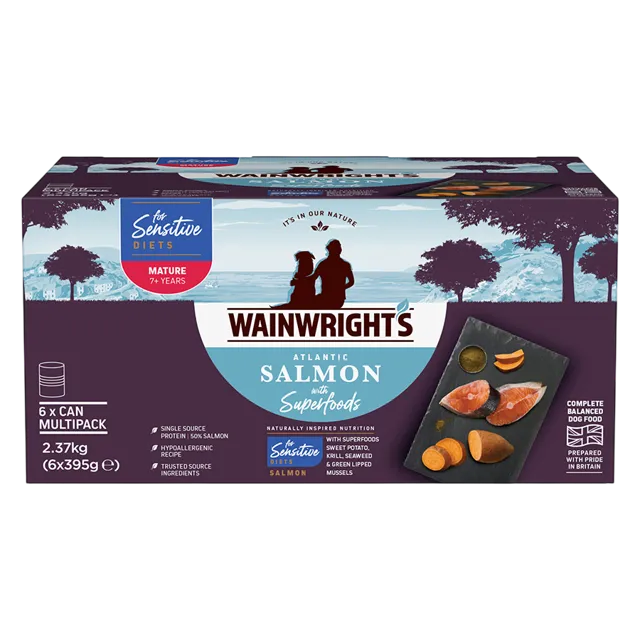
Wainwright's Sensitive Mature Cans take the brand's salmon recipe and rework it for an older dog. Salmon comes down to 50%, sweet potato takes on more of the tin, the fat drops, and glucosamine and chondroitin join the end of the list. It sits in our Good band, and it reads as a gentler, lighter version of the same idea.
Our view
Likely to suit
If your dog is slowing down and getting choosier about dinner, this is a tin written for exactly that stage.
- Senior dogs, the age group the whole recipe is put together for
- Dogs that find richer tins too much, since fat here converts to 36.0% of dry matter
- Owners who want a figure beside the meat, since salmon is printed at 50% of the tin
- Fish-fed dogs, since the only named meat is salmon and nothing poultry or red meat based appears
- Households that avoid grain, since the starch work falls entirely to sweet potato and peas
- Older dogs who drink too little, since moisture makes up three quarters of every tin
Worth watching
Read the small print before you switch your dog over, because a few entries repay it.
- Glucosamine at 0.004% and chondroitin at 0.002% are token amounts, and a dog already diagnosed with a joint problem still needs whatever the vet has prescribed
- Shellfish are on the list too, in krill meal and green lipped mussel, so a strict fish avoidance plan has to account for them
- Sweet potato does more work here than in most wet food, with carbohydrate converting to an estimated 22.0% of dry matter where the typical adult wet food runs at 15.8%
Written by our editorial team. Independent guidance, not veterinary advice.
How this scores
How we scoreThe Details
Dog fit
If your dog is slowing down and getting choosier about dinner, this is a tin written for exactly that stage. Read the small print before you switch your dog over, because a few entries repay it.
Wet
Adult, Senior
Toy, Small, Medium, Large, Giant
Salmon
The score, in context
Our Good band holds this tin, a step under the typical adult wet food, since wet scores well as a category. Protein and processing, nutritional balance and value all read Good, with transparency Outstanding. That is fair on a recipe that names and counts its meat, keeps its plant list to a handful of entries and never claims more than the label can show. The ceiling comes from the half of the tin that is not salmon, where dehydrated sweet potato at 5% rehydrates to the equivalent of 25% sweet potato and takes a real share of the recipe.
What's in it
Ingredients, as declared: Salmon (50%), Dehydrated Sweet Potato (5%)(equivalent to 25% Sweet Potato), Dehydrated Peas (1.3%)(equivalent to 4% Peas), Krill Meal (1%), Minerals, Salmon Oil (0.3%), Dried Seaweed (0.1%), Green Lipped Mussel (0.05%), Chicory Root Extract (0.05% as a source of Prebiotic Fructo-oligosaccharide), Yucca Extract (0.01%) Glucosamine (0.004%), Chondroitin (0.002%)
Named ingredients
Nutritional additives
Vitamins: Vitamin A 2,250IU, Vitamin E 26mg. Trace Elements: Zinc (as Zinc Sulphate Monohydrate) 24mg, Iron (as Iron (II) Sulphate Monohydrate) 12.5mg, Copper (as Copper (II) Sulphate Pentahydrate) 2.5mg, Manganese (as Manganous Sulphate Monohydrate) 2mg, Iodine (as Calcium Iodate Anhydrous) 0.45mg, Selenium (as Sodium Selenite) 0.04mg.
Ingredient notes
Salmon leads the list at a printed 50%, and it is the one meat named in the tin. Protein converts to 28.0% of dry matter and fat to 36.0%, a moderate pairing for a wet food and a sensible balance for a dog that has eased off the long walks.
Dehydrated sweet potato at 5% comes second and rehydrates to the equivalent of 25% sweet potato, with dehydrated peas at 1.3% behind it standing in for 4% peas. Sweet potato is a steady, gentle starch that older dogs handle well, though at this share it lifts estimated carbohydrate to 22.0% of dry matter.
Krill meal at 1%, salmon oil at 0.3%, dried seaweed at 0.1% and green lipped mussel at 0.05% make up the marine tail of the list. Seaweed carries iodine and a broad mineral spread, while krill and mussel bring the sort of oils that suit an older dog, though in quantities this small they season the recipe rather than dose it.
Glucosamine and chondroitin close the list at 0.004% and 0.002%. Makers reach for both once a food is pointed at older joints. Both are named, though the quantities are slight. Worth knowing about, not worth losing sleep over. Chicory root extract at 0.05% supplies a prebiotic and yucca extract at 0.01% helps with odour. Every added vitamin and trace element carries a figure beside it.
Price and value
The cans are 395g, sold in packs of 6, at £5.06 a kilo.
A 15kg adult dog in moderate condition would get through roughly 699 grams a day, which comes to £3.54, working from a daily requirement of about 840 kcal (110 × bodyweight^0.75, the standard maintenance estimate). For a dog of that weight the label prints 493.8 to 888.8 grams.
Nutritional analysis
Declared analysis
Estimated using Modified Atwater factors*
7%
9%
0.5%
3%
75%
Dry weight
28%
36%
2%
12%
22%
As-fed composition
Estimated breakdown of the finished product by ingredient category, from the declared ingredient list and ingoing weights. These are estimates, not measurements.
51%
25.3%
6.3%
7.2%
0.3%
9.8%
Pricing & size
- Pack size
- 6 x 395g - £11.99 (£5.06/kg)
- Retailer pricing
- Coming soon
Live retailer pricing is not yet available for this food. Prices, cost per day and where to buy will appear here once retailer data is live.
Ingredients and nutrition are taken from manufacturer data. Retailer pricing is not yet live for this food.
Related dog food guides
Ranked shortlists that include foods like this one.