

Wainwright's
Wainwright's Plant Powered with Insect & Superfoods Dry review
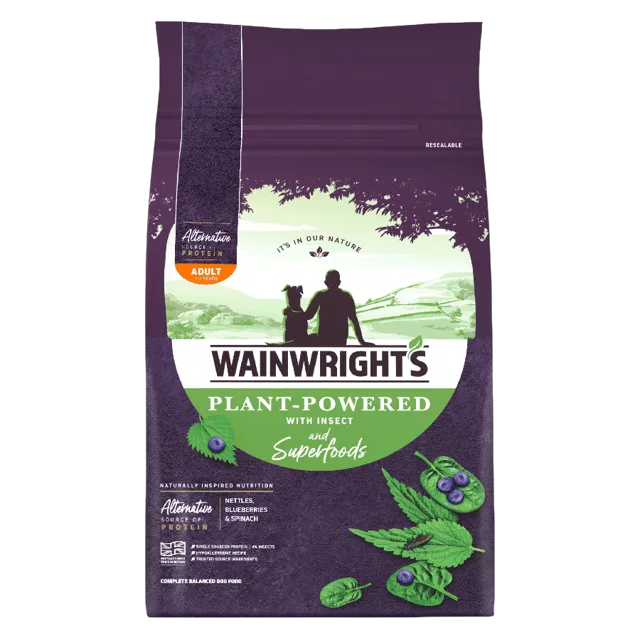
Wainwright's Plant Powered is a rice-based kibble that gets most of its protein from plants and the rest from insect meal at 4%. It is written for owners weighing up the footprint of the bowl, and for dogs that have reacted to one meat after another. Potato protein and maize gluten meal top up the protein line, taurine and methionine are dosed to cover what a low meat recipe can leave short, and a tail of berries and herbs follows. Our scoring puts it in the Average band, which is a fair reading of an unusual food doing something conventional kibble does not attempt.
Our view
Likely to suit
When the list of meats to try has run out, this recipe takes an entirely different road.
- Dogs that have reacted to the familiar meats, with insect meal the one animal protein on the list
- Owners thinking about the environmental side of feeding, with insect meal standing in for conventional meat
- Dogs that need the amino acid gaps covered, with taurine at 500 mg and methionine at 1000 mg dosed in print
- Adult dogs of any size, as the label's guide runs from the smallest adult all the way up to 70kg
- Households after something genuinely novel for a dog bored of everything else in the cupboard
Worth watching
A few honest points sit behind the plant powered name.
- Insect meal is 4% of the recipe, so despite the animal entry this is a mostly plant fed bowl
- Maize gluten meal is third on the list and is there to lift the protein line, a job a dog's digestion handles better when meat does it
- Rice heads the list and maize follows, a point for households that keep grain out
- Glucosamine and chondroitin are made from animal material, so the food is not vegetarian despite the name on the front
Written by our editorial team. Independent guidance, not veterinary advice.
How this scores
How we scoreThe Details
Dog fit
When the list of meats to try has run out, this recipe takes an entirely different road. A few honest points sit behind the plant powered name.
Dry
Adult
The score, in context
This one takes our Average band. The median adult dry food is a step higher, in Good. The reason is plain in the first few ingredients. Rice, potato protein and maize gluten meal all come before the insect meal, so most of the protein here is plant protein. A dog digests that less completely than animal protein, and its amino acid spread is less useful. Protein and processing and nutritional balance read Poor as a result, while transparency reads Excellent. The recipe deserves credit for answering its own problem in the open: taurine at 500 mg and methionine at 1000 mg are added back. The mineral panel is dosed generously and calcium works out at 1.01% of dry matter. Taken as a novel protein option, it works.
What's in it
Ingredients, as declared: Rice, Potato Protein, Maize Gluten Meal, Beet Pulp (5%), Dried Peas (5%), Rapeseed Oil, Insect Meal (4%), Vegetable Stock, Minerals, Whole Linseed (0.5%), Seaweed Meal (0.5%), Chicory Root Extract (as a source of prebiotic FOS) (0.1%), Dried Spinach (0.05%, equivalent to 0.45% Spinach), Dried Blueberry (0.05%, equivalent to 0.3% Blueberries), Dried Nettle (0.05%), Dried Parsley, Dried Rosemary, Yucca Extract (0.04%), Glucosamine (0.02%), Chondroitin (0.015%), Turmeric, Dried Spearmint.
Named ingredients
Nutritional additives
Vitamin A 40,000IU, Vitamin D₃ 2,500IU, Vitamin E 125mg, Taurine 500mg. Amino Acids: Methionine 1000mg. Trace Elements: Iodine (as Calcium Iodate Anhydrous) 1.5mg, Selenium (as Sodium Selenite) 0.15mg, Copper (as Copper (II) Sulphate Pentahydrate) 7.5mg, Iron (as Iron (II) Sulphate Monohydrate) 75mg, Manganese (as Manganous Sulphate Monohydrate) 50mg, Zinc (as Zinc Sulphate Monohydrate) 100mg. Technological Additives: Antioxidants
Ingredient notes
The protein comes from four places and only one of them is an animal. Potato protein and maize gluten meal are both concentrated plant proteins used to lift the protein line, dried peas at 5% add a little more, and insect meal at 4% is the animal contribution. Protein reads 24.0% on the panel, a respectable figure for a kibble. The source mix is the part to understand. Plant proteins are less digestible for a dog than meat, and they are usually short of one or two amino acids that meat supplies easily.
Insect protein itself is the interesting part, and it is well regarded. It is genuinely novel to almost every dog, and that is exactly the point when the shortlist of untried meats has run out. It is also produced with a fraction of the land and feed that livestock needs. At 4% it is a small share of this recipe rather than its engine, so read the food as a plant recipe with an insect element instead of an insect food.
Rice leads the list and beet pulp at 5% supplies fibre. The prebiotic is chicory root extract at 0.1%, feeding the bacteria further along the gut. Carbohydrate lands at 55.5%, or 56.1% of dry matter, where 46.2% is typical for adult dry food. That is what happens when cereal and plant proteins carry a recipe between them.
Taurine at 500 mg and methionine at 1000 mg are the two additions that show the formulator understood the brief. Methionine is one of the amino acids plant proteins tend to run short on, and taurine is the one most often watched in diets built on something other than meat. Seeing both dosed in print is reassuring on a recipe of this kind.
The mineral panel is generous and printed in full. Zinc comes at 100 mg, iron at 75 mg, manganese at 50 mg, copper at 7.5 mg, iodine at 1.5 mg and selenium at 0.15 mg per kilo. Vitamins A and D3 are declared, with vitamin E at 125 mg. Calcium converts to 1.01% of dry matter, a comfortable adult level.
The superfoods are a short tail: dried spinach at 0.05%, shown as the equivalent of 0.45% of fresh spinach, dried blueberry at 0.05% standing for 0.3% of fresh, then nettle, parsley, rosemary, turmeric and spearmint. Yucca extract at 0.04% is there for household reasons. The plant omega 3 comes from whole linseed at 0.5%, and seaweed meal at 0.5% carries iodine. Two entries stay vague, a vegetable stock and a line that simply reads minerals, which is the small print you would want opened up.
One oddity on the panel is worth flagging: moisture is declared at 1.0%, far drier than a finished kibble normally is. Take it at face value and the as fed and dry matter columns barely move apart, which is why the two sets of figures on this page look so close to each other.
Price and value
£6.50 a kilo in the 2kg bag and £4.58 a kilo in the 12kg.
Feeding a 15kg adult dog in moderate condition works out at roughly 249 grams a day, assuming around 840 kcal a day (110 × bodyweight^0.75, the standard maintenance estimate), or £1.14 a day. For a dog of 12kg to 25kg the bag's own table asks 180 to 315 grams. Start there and let the waistline guide the rest.
Nutritional analysis
Declared analysis
24%
8%
4%
7.5%
1%
Dry weight
24.2%
8.1%
4%
7.6%
56.1%
As-fed composition
Estimated breakdown of the finished product by ingredient category, from the declared ingredient list and ingoing weights. These are estimates, not measurements.
4%
6%
79.2%
0.7%
4.6%
5.5%
Pricing & size
- Pack size
- 2kg - £12.99 (£6.50/kg) · 12kg - £54.99 (£4.58/kg)
- Retailer pricing
- Coming soon
Live retailer pricing is not yet available for this food. Prices, cost per day and where to buy will appear here once retailer data is live.
Ingredients and nutrition are taken from manufacturer data. Retailer pricing is not yet live for this food.
Related dog food guides
Ranked shortlists that include foods like this one.