



Virbac
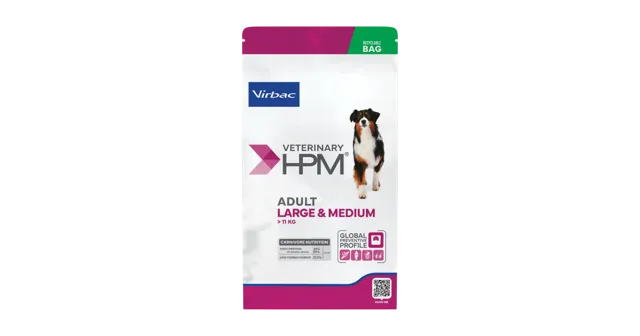
Virbac Veterinary HPM Adult Large & Medium review
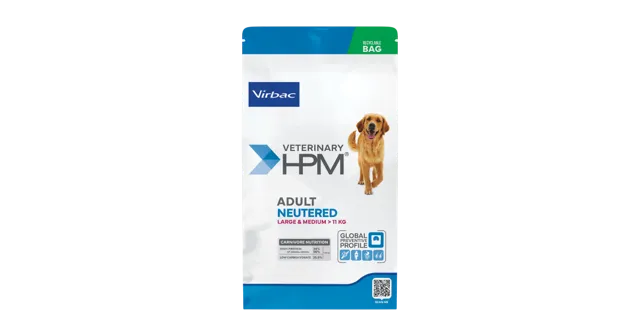
Virbac Veterinary HPM Adult Large & Medium is a high protein kibble sold through vet practices and built around a low starch idea. Protein is declared at 34.0% with estimated carbohydrate at 29.6% of dry matter, a long way under what dry food usually carries. The fibre side is unusually well thought out, with psyllium, prebiotic FOS and an inactivated bacterial culture all present. It lands in our Good band, held there by a list that names families of animal instead of species.
Our view
Likely to suit
You get a meatier, lower starch bowl for a big dog here, and it is a serious attempt at one.
- Medium and large adult dogs, the sizes the kibble and the feeding table are drawn up for
- Owners who want protein high and starch low, with protein at 37.4% of dry matter and carbohydrate estimated at 29.6%
- Dogs kept off fish, since the ingredients list holds no fish and no fish oil
- Dogs with unpredictable digestions, with psyllium husk, beet pulp and prebiotic FOS behind an inactivated Lactobacillus culture
- Owners who prefer buying through their vet practice, with three bag sizes on the shelf
Worth watching
There are a few habits on this label to understand before you commit.
- The animal entries stop at poultry, never chicken, duck or turkey, which leaves an elimination plan aimed at one bird without an anchor
- Hydrolysed pork sits in the recipe, which counts if pig is off your dog's list
- Lignocellulose is purified plant fibre, in for bulk with little nourishment in it
- Rice makes this a cereal-containing recipe, worth knowing if your dog does better without grain
Written by our editorial team. Independent guidance, not veterinary advice.
How this scores
How we scoreThe Details
Dog fit
You get a meatier, lower starch bowl for a big dog here, and it is a serious attempt at one. There are a few habits on this label to understand before you commit.
Dry
Adult
Medium, Large
Poultry
The score, in context
Two readings pull in opposite directions here, and the Good band is where they meet. On the analysis this is one of the meatier, lower starch kibbles you will find. Protein converts to 37.4% of dry matter and estimated carbohydrate to 29.6%, against the 46.2% typical for adult dry food. On the ingredients list, though, almost every animal entry is a family rather than a species: dehydrated poultry proteins, poultry fats, hydrolysed pork and poultry proteins. We give credit to a label that names its animals, and this one does not. The typical adult dry food shares the Good band with it, which rather undersells how differently the two arrive there. Read this as a strong recipe written in vague language, and not as a weak one.
What's in it
Ingredients, as declared: Dehydrated poultry proteins; Rice; Poultry Fats; Peas; Hydrolysed pork and poultry proteins; Lignocellulose; Minerals; Dried (sugar) beetpulp; Linseed,Fructo-oligosaccharides; Psylliumfibre (Plantago (L.) spp.); Inactivated brewer's yeast; Inactivated Lactobacillus helveticus.
Named ingredients
Nutritional additives
| Item | Value | |---|---| | Vitamin A (IU/kg) | 11000 | | Vitamin D3 (IU/kg) | 1100 | | Vitamin E (mg/kg) | 590 | | Vitamin B1 thiamine) (mg/kg) | 3.8 | | Vitamin B2 (riboflavine) (mg/kg) | 11 | | Vitamin B3 (PP. niacine. nicotinic ac) (mg/kg) | 30 | | Vitamin B5 (pantothenic ac) (mg/kg) | 26 | | Vitamin B6 (pyridoxine) (mg/kg) | 3 | | Vitamin B9 (folic ac) (mg/kg) | 0.48 | | Vitamin B12 (cobalamine) (mg/kg) | 0.062 | | Choline (mg/kg) | 3000 | | Taurine (mg/kg) | 1500 | | Copper (mg/kg) | 18 | | Iron (mg/kg) | 260 | | Iodine (mg/kg) | 2.6 | | Manganese (mg/kg) | 26 | | Selenium (mg/kg) | 0.4 | | Zinc (mg/kg) | 160 |
Ingredient notes
Dehydrated poultry proteins lead the list, and dehydrated is the important word. Its water is already gone, and the entry keeps its weight in the finished kibble as fresh meat never does. That is why the analysis reads as strongly as it does, with protein at 37.4% of dry matter. What it does not do is name the bird. The word stretches over chicken, turkey, duck and goose alike. Which one it is may change from batch to batch with nothing on the label changing.
Rice is the only cereal here and there is markedly less starch in this recipe than a dry food usually carries, with estimated carbohydrate landing at 29.6% of dry matter. Rice is easy on most digestions and a sensible cereal to pick. Peas follow, adding a little plant protein and some micronutrients alongside their own starch.
Hydrolysed pork and poultry proteins are proteins broken down into smaller fragments, used partly for palatability and partly because smaller fragments are less likely to provoke a reaction. It is a technique borrowed from sensitivity diets and it works well, but it does mean pork is in this recipe and that the poultry stays unnamed even at this level of the list.
The fibre blend is the most carefully constructed part of the recipe. Psyllium husk is a soluble fibre that firms a loose stool and softens a hard one. Dried beet pulp gives a mix of soluble and insoluble, and FOS is a prebiotic that the large intestine's bacteria live on. Inactivated brewer's yeast brings B vitamins with it. The list closes with an inactivated Lactobacillus helveticus culture, offering bacterial fragments that survive a bag far better than live cultures do.
Lignocellulose is where a careful reader will stop. It is a purified plant fibre, produced as a by-product of milling and used to bulk a food out with almost no energy attached. As fibre it does its job, and in a recipe built to hold carbohydrate down it has a clear purpose. It is a refined ingredient all the same, and there is no getting round that.
The supplement panel is generous where it counts: taurine at 1500 mg per kilo, choline at 3000 mg, vitamin E at 590 mg, zinc at 160 mg and iron at 260 mg. Taurine at that level is a deliberate addition and nothing accidental, and it is a reassuring thing to see on a food aimed at big dogs. Calcium converts to 1.43% of dry matter, a comfortable adult level for a large frame.
Price and value
£5.67 a kilo, sold in 3kg, 7kg and 12kg bags.
As a guide, a 15kg adult dog in moderate condition eats about 227 grams a day. That assumes around 840 kcal a day (110 × bodyweight^0.75, the standard maintenance estimate) against the declared 370 kcal per 100g, and works out at £1.29 a day. The label's own table puts an active dog of that weight on 230 grams, near enough the same answer.
Nutritional analysis
Declared analysis
34%
17%
5%
8%
9%
Dry weight
37.4%
18.7%
5.5%
8.8%
29.6%
As-fed composition
Estimated breakdown of the finished product by ingredient category, from the declared ingredient list and ingoing weights. These are estimates, not measurements.
60.6%
39.4%
Pricing & size
- Pack size
- 3 kg (£22.95), 7 kg (£43.00), 12 kg (£68.00)
- Retailer pricing
- Coming soon
Live retailer pricing is not yet available for this food. Prices, cost per day and where to buy will appear here once retailer data is live.
Ingredients and nutrition are taken from manufacturer data. Retailer pricing is not yet live for this food.
Related dog food guides
Ranked shortlists that include foods like this one.