



Tesco
Tesco Tender Pate Trays review
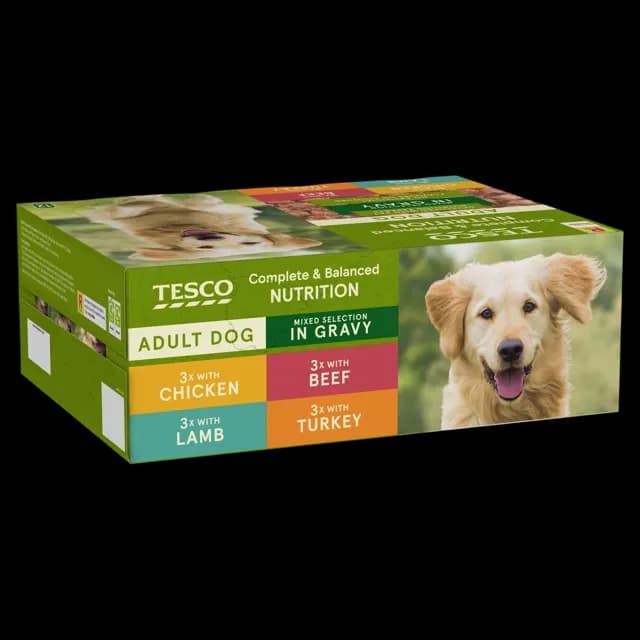
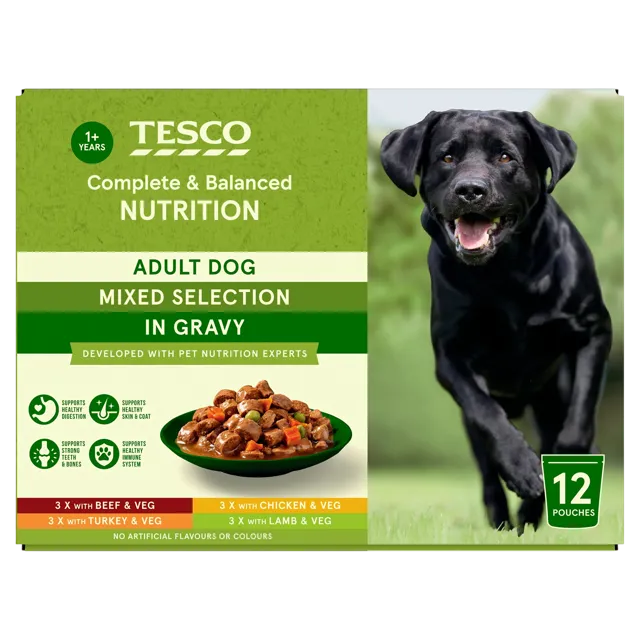
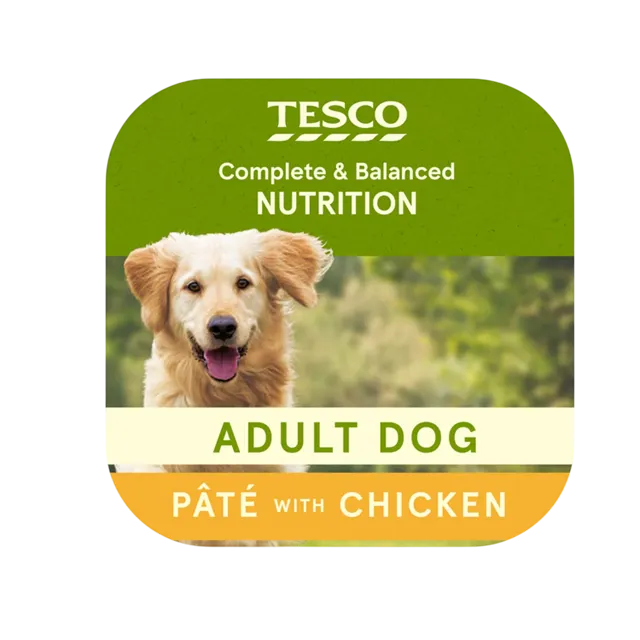
Tesco Tender Pate Trays are 300g trays of smooth pate built on meat and animal derivatives at 60%, with chicken named at 4% of the tray. Minerals, various sugars, a trace of chicory and unnamed oils and fats complete a list of five entries. That 60% is a genuinely high animal share, and the protein figure behind it is strong for food fed from a tray. The tray still finishes in our Average band, and the meat side of the label is what holds it there.
Our view
Likely to suit
Some dogs stop enjoying dinner when it becomes work, and a pate takes the work out of it.
- A dog whose teeth are worn or missing, because there is nothing here to chew
- Eaters that pick the chunks out and leave the rest, because there is nothing to sort through here
- Owners shopping on a declared animal share, since the front of the pack puts it at 60% of the tray
- Dogs that need to take on more water, with moisture declared at 82.0%
- Adult dogs of every build, as the same tray is put to toy breeds through to giants
- Owners who mix a spoonful of wet into a dry bowl, which a soft pate does easily
Worth watching
A short label leaves a lot unsaid, so it is worth knowing what is missing from this one.
- Chicken is named at 4% and the remaining animal content could be any warm-blooded species, so the tray cannot support an elimination diet
- Oils and fats carry no source, which leaves the type of fat open and free to change between batches
- Various sugars are on the list
- The added panel prints vitamin D3 as its only vitamin, which is a shorter list of extras than many wet foods carry
- A large dog gets through several trays a day, because at 82 kcal per 100g these are lighter than the 97 typical of adult wet food
Written by our editorial team. Independent guidance, not veterinary advice.
How this scores
How we scoreThe Details
Dog fit
Some dogs stop enjoying dinner when it becomes work, and a pate takes the work out of it. A short label leaves a lot unsaid, so it is worth knowing what is missing from this one.
Wet
Adult
Toy, Small, Medium, Large, Giant
Chicken
The score, in context
Our Average band is where this tray sits, and the pillar readings pull in two directions: nutritional balance comes back Outstanding and transparency Excellent, while protein and processing settles at Average. The label explains the split neatly: 60% of the tray is animal content, a high share by any measure. Only 4% of it is tied to a species, so most of what your dog eats has to be taken on trust.
For us this is a strong field, and the typical adult wet food reaches our Excellent band. The distance here comes from the meat itself, and the analysis is not what separates them. The analysis is genuinely decent: protein converts to 50.0% of dry matter, a strong figure for anything this wet, and estimated carbohydrate to 11.7%, comfortably under the 15.8% typical.
What's in it
Ingredients, as declared: Meat and Animal Derivatives (60% including Chicken 4%), Minerals, Various Sugars, Derivatives of Vegetable Origin (0.1% Chicory), Oils and Fats.
Named ingredients
Nutritional additives
_Nutritional additives per kg:_ Vitamin D3 140 IU, Zinc (Zinc Sulphate Monohydrate) 12 mg, Manganese (Manganese (II) Oxide) 1 mg, Copper (Copper (II) Sulphate Pentahydrate) 0.5 mg, Iodine (Calcium Iodate Anhydrous) 0.3 mg.
Ingredient notes
Meat and animal derivatives at 60% is the headline and the puzzle. The term takes in the fleshy parts of slaughtered warm-blooded land animals and everything that comes of processing the carcass. That covers material at both ends of the scale, and careful makers use it as readily as careless ones. At 60% of a tray it is doing more than most supermarket wet foods commit to, and the protein figure suggests the material behind it is real meat rather than mostly gel and water. What you cannot know is which animals, or which parts of them, or whether that changed last month.
Chicken is the one species pinned down, at 4%. That is enough to justify the wording on the front and not enough to build an avoidance plan on, which is worth being straight about.
Oils and fats is the other broad heading here. The label never says whether that fat came from an animal or from seeds. Fat converts to 25.0% of dry matter, a moderate level that will suit a dog who does better away from richer dinners.
The rest is short. Palatability is what the various sugars are there for. Chicory at 0.1% brings a little inulin, a prebiotic fibre that the bacteria lower down the gut can live on. The added panel is dosed in print, with vitamin D3 at 140 IU, zinc at 12 mg, manganese at 1 mg, copper at 0.5 mg and iodine at 0.3 mg per kilo. Calcium converts to 1.67% of dry matter, a comfortable adult level.
The label also prints its energy at 82 kcal per 100g. That single figure is what turns portioning from guesswork into arithmetic, and plenty of wet labels still leave it off.
Price and value
£1.97 a kilo, sold in 300g trays.
As a guide, feeding a 15kg adult dog in moderate condition comes to about £2.02 a day, or roughly 1024 grams, assuming around 840 kcal a day (110 × bodyweight^0.75, the standard maintenance estimate). That is a little over three trays a day if the pate is fed on its own, and far fewer if it goes over a dry meal.
Nutritional analysis
Declared analysis
9%
4.5%
0.4%
2%
82%
Dry weight
50%
25%
2.2%
11.1%
11.7%
As-fed composition
Estimated breakdown of the finished product by ingredient category, from the declared ingredient list and ingoing weights. These are estimates, not measurements.
42.8%
17%
24.6%
2.8%
12.8%
Pricing & size
- Pack size
- 300g e
- Retailer pricing
- Coming soon
Live retailer pricing is not yet available for this food. Prices, cost per day and where to buy will appear here once retailer data is live.
Ingredients and nutrition are taken from manufacturer data. Retailer pricing is not yet live for this food.
Related dog food guides
Ranked shortlists that include foods like this one.