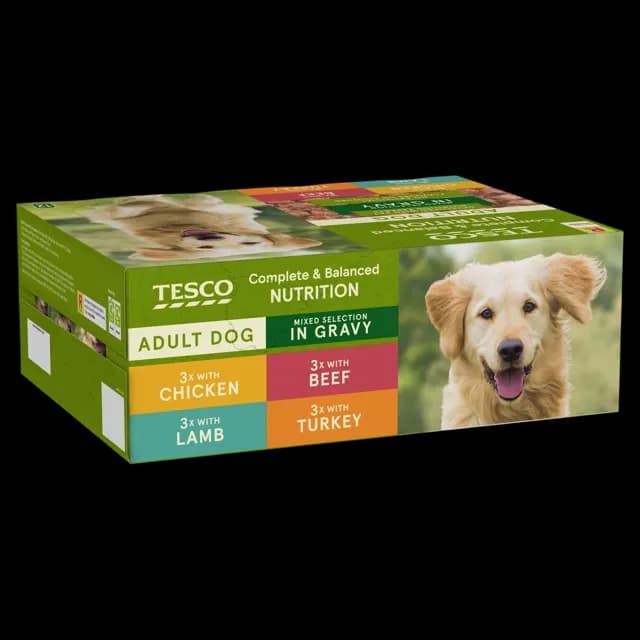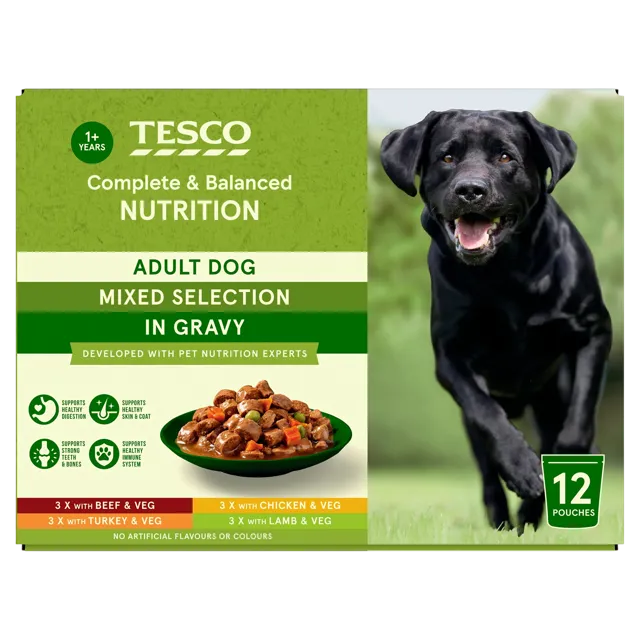


Tesco
Tesco Puppy Pouches Mixed Selection review
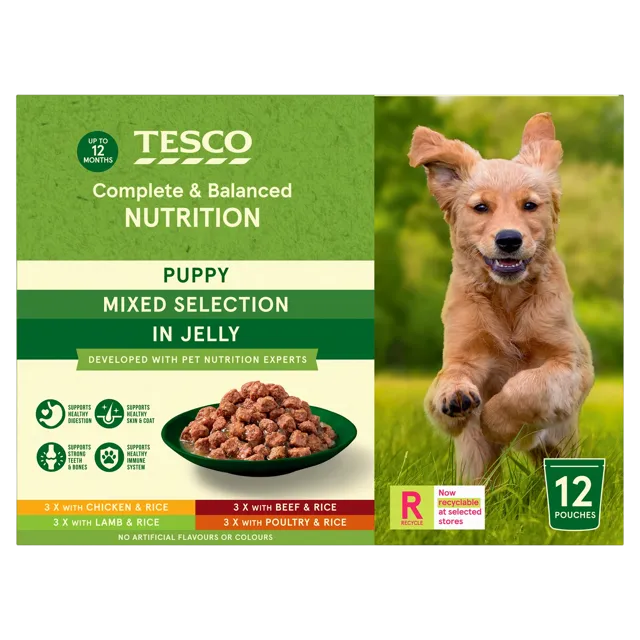
Tesco Puppy Pouches come as a mixed box of four jelly recipes, each built on meat and animal derivatives at 39% with one named meat accounting for 4% of that. In a growth food calcium matters more than any other figure, and this one is good: 1.58% of dry matter, well within what a growing skeleton needs. Protein converts to 42.1% of dry matter as well. The rest of the label is written in categories instead of named ingredients, and the pouches land in our Average band.
Our view
Likely to suit
You get a different flavour from one meal to the next here, which young dogs tend to appreciate more than we do.
- Owners who check the calcium line before anything else, with it converting to 1.58% of dry matter and landing inside the growth range
- Fussy young eaters, with lamb, poultry, beef and chicken recipes arriving in the same box
- Households that want a wet food which portions itself, since each pouch is a single serving
- Pups who need to take water in with their food, with moisture declared at 81.0%
Worth watching
The way this label is written puts a few limits on what you can use it for.
- Only the named 4% in each recipe can be tied to an animal, everything else being meat and animal derivatives
- Various sugars appear on all four recipes, and a growing dog has no nutritional need of added sugar
- A pup avoiding one particular meat cannot reliably be kept clear of it here, because the umbrella term may cover species the pack never mentions
- These run at 96 kcal per 100g against the 106 typical of a puppy wet food, and the daily pouch count climbs with it
Written by our editorial team. Independent guidance, not veterinary advice.
How this scores
How we scoreThe Details
Dog fit
You get a different flavour from one meal to the next here, which young dogs tend to appreciate more than we do. The way this label is written puts a few limits on what you can use it for.
Wet
Puppy
Toy, Small, Medium, Large, Giant
Lamb
The score, in context
The pouches land in our Average band, and wet puppy food is a category whose typical example reaches our Excellent band, so this sits a good way off the middle of its field. Nutritional balance reads Outstanding and transparency Excellent, while protein and processing reads Poor, which tells you where the weight of the problem falls: on the make up of the meat, not the numbers.
The numbers themselves are better than the band alone suggests. Protein converts to 42.1% of dry matter. Calcium is declared and lands in range for growth, and carbohydrate is estimated at only 8.0% of dry matter against the 13.6% typical. Read those alongside the notes below and the picture is fuller than a single band word can be.
What's in it
Ingredients, as declared: With Lamb & Rice in Jelly: Meat and Animal Derivatives (39%, including 4% Lamb), Cereals (1.5% Uncooked Rice, equivalent to 4% Cooked Rice), Oils and Fats, Minerals, Derivatives of Vegetable Origin (0.08% Chicory), Various Sugars. With Poultry & Rice in Jelly: Meat and Animal Derivatives (39%, including 4% Poultry), Cereals (1.5% Uncooked Rice equivalent to 4% Cooked Rice), Oils and Fats, Minerals, Derivatives of Vegetable Origin (0.08% Chicory), Various Sugars. With Beef & Rice in Jelly: Meat and Animal Derivatives (39%, including 4% Beef), Cereals (1.5% Uncooked Rice, equivalent to 4% Cooked Rice), Oils and Fats, Minerals, Derivatives of Vegetable Origin (0.08% Chicory), Various Sugars. With Chicken & Rice in Jelly: Meat and Animal Derivatives (39%, including 4% Chicken), Cereals (1.5% Uncooked Rice equivalent to 4% Cooked Rice), Oils and Fats, Minerals, Derivatives of Vegetable Origin (0.08% Chicory), Various Sugars.
Named ingredients
Nutritional additives
_Nutritional additives per kg (the panels say "for all varieties"):_ Vitamin D₃ 140 IU, Vitamin E 12mg, Iodine (Calcium Iodate Anhydrous) 0.3mg, Zinc (Zinc Sulphate Monohydrate) 12mg. _Technological additives per kg:_ Cassia Gum 1.7g. _The record's `nutrition` field lists these as well:_ Vitamin D3 140 IU, Vitamin E 12 mg, Iodine (Calcium Iodate Anhydrous) 0.3 mg, Zinc (Zinc Sulphate Monohydrate) 12 mg, Cassia Gum 1640 mg
Ingredient notes
All four recipes share one frame. Meat and animal derivatives makes up 39% of each pouch, and within that a single meat is named and quantified at 4%: lamb in one, poultry in another, then beef and chicken. Under European labelling that umbrella term covers the fleshy parts of any warm blooded land animal along with its by-products. It takes in everything from good muscle meat to the plainest by-product on the line, and the pack never says which. Poultry is a second umbrella of its own, since it may be chicken, turkey or duck on any given production run.
Cereals contribute 1.5% uncooked rice, which the label helpfully explains is equivalent to 4% cooked. Rice is one of the gentler grains for a young digestion. At 1.5% it does very little beyond adding a small amount of digestible energy. Derivatives of vegetable origin brings 0.08% chicory, a natural source of inulin that acts as a prebiotic, though at that inclusion it is more of a gesture than a working dose.
Various sugars is the entry worth pausing on. Sugar is added to pet food for the same reason it is added to ours, and while the quantity in a jelly pouch is modest, it is an ingredient a puppy has no requirement for. Cassia gum at 1.7g per kilo is the thickener that sets the jelly, and it is doing a technical job rather than a nutritional one.
The analysis is where this label does better than expected. Protein converts to 42.1% of dry matter and fat to 36.8%, a rich, meaty looking profile, with carbohydrate estimated at just 8.0% of dry matter. Ash converts to 10.5%. Unusually for a label written this loosely, calcium is declared, converting to 1.58% of dry matter. That sits inside the range growth needs, and it holds up for a bigger breed pup as much as a small one. Getting calcium wrong is the classic failure in puppy feeding. Having it printed, and in range, counts as a real point in this food's favour.
The added vitamin panel is thin, with vitamin D3 at 140 IU and vitamin E at 12mg per kilo alongside iodine at 0.3mg and zinc at 12mg. There is no vitamin A on it, and no iron, no copper and no manganese either. For a food carrying a growing dog through its first year, that is less than you would hope to see printed.
Price and value
£2.49 a kilo, in boxes of 12 x 100g pouches.
The label's own guide works from the weight a pup is expected to reach, not the weight they are now. For one heading towards 10kg it runs from 600g a day up to 800g a day across the growth period. That is the whole point about puppy portions: the figure keeps moving, so read the chart again at every weigh in.
Nutritional analysis
Declared analysis
8%
7%
0.5%
2%
81%
Dry weight
42.1%
36.8%
2.6%
10.5%
8%
As-fed composition
Estimated breakdown of the finished product by ingredient category, from the declared ingredient list and ingoing weights. These are estimates, not measurements.
75%
25%
Pricing & size
- Pack size
- 12 x 100g ℮
- Retailer pricing
- Coming soon
Live retailer pricing is not yet available for this food. Prices, cost per day and where to buy will appear here once retailer data is live.
Ingredients and nutrition are taken from manufacturer data. Retailer pricing is not yet live for this food.
Related dog food guides
Ranked shortlists that include foods like this one.