

Skinner's
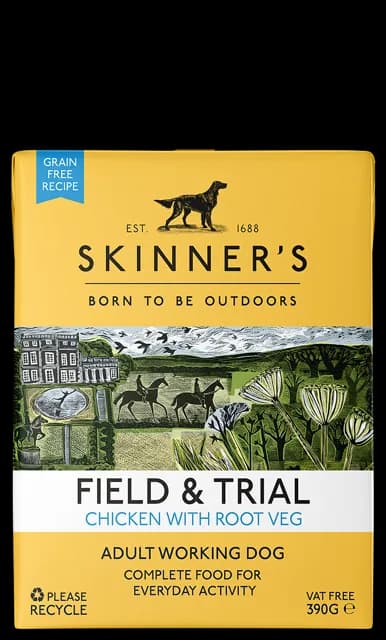
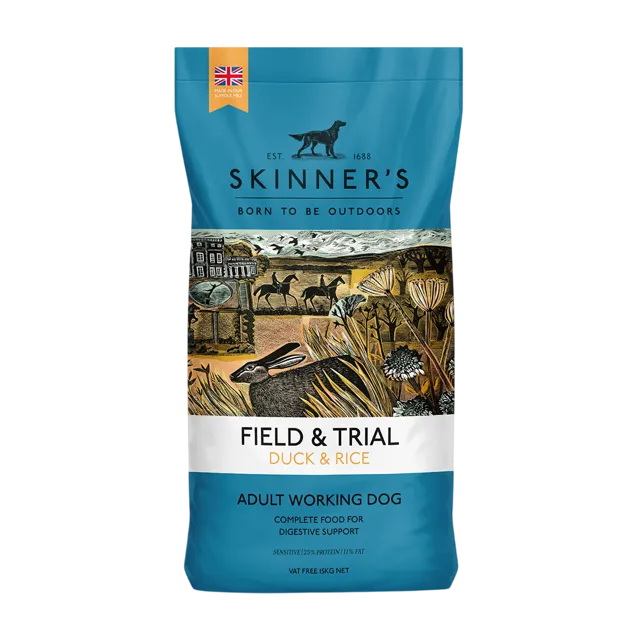
Skinner's Field & Trial Adult: Duck & Rice review
Skinner's Field & Trial Adult is the kibble a great many British working dogs have grown up on, and the recipes read like it. Brown rice leads every bag at between 37.8% and 40.8%, and a single meat meal follows at 26% or more. The bottom of each list is unusually specific for a working ration, with the prebiotics, seaweed and joint entries printed to the milligram. Four of the five settle into our Good band. The chicken sits a step below them in Average.
Our view
Likely to suit
If your dog works and swims and never sits down, this range was written with that dog in front of it.
- Working dogs and busy pets alike, since the whole range is built for animals on their feet all day
- Owners who want the joint entries quantified, at glucosamine 350mg/kg and chondroitin sulphate 150mg/kg on every label
- Dogs that thrive on rice, which carries the starch in all five recipes
- A dog gone off chicken, since duck, lamb, salmon and turkey are all built the same way
- Owners who like a named meat meal, which four of the five bags give them
Worth watching
Read these points off the labels before you pick a bag.
- Poultry fat is in the chicken, duck, lamb and turkey recipes, so none of those four holds to one animal protein
- Brown rice sits above the meat on every list, and cereal carries the bigger share of the bowl
- The chicken variety describes its meat as poultry meal at a minimum of 95% chicken, which leaves a small share unnamed
- The herb blend is declared as a blend rather than by name, so a dog with a known plant sensitivity is guessing
Written by our editorial team. Independent guidance, not veterinary advice.
How this scores
How we scoreThe Details
Dog fit
If your dog works and swims and never sits down, this range was written with that dog in front of it. Read these points off the labels before you pick a bag.
Dry
Adult
Toy, Small, Medium, Large, Giant
Duck
The score, in context
Four of these bags come out in our Good band, the same place most of the adult dry shelf sits, while the chicken reads Average. The distance is real but it is no mystery. The chicken declares the biggest meat share at 27.5% and the lightest ash at 6.0%, yet protein and processing reads Poor on that bag where its siblings read Average. Transparency is Outstanding across all five, and value moves with each bag's own placing. The other four are the same food built around a different animal, and for the dog each one is aimed at they do the same honest job.
What's in it
Ingredients, as declared: Brown rice 39.8%, Duck meat meal 26%, Naked oats, Peas, Whole linseed, Beet pulp, Poultry fat, Vitamins & minerals, Herb blend 750mg/kg, MOS 500mg/kg, FOS 500mg/kg, Glucosamine 350mg/kg, Chondroitin sulphate 150mg/kg, Seaweed 150mg/kg, Yucca 100mg/kg
Named ingredients
Nutritional additives
_Nutritional additives per kg:_ | Additive | Amount | | --- | --- | | vitamin A | 13000iu | | vitamin D3 | 2000iu | | vitamin E (as all rac-alphatocopherol acetate) | 310mg | | taurine | 100mg | _Trace Elements per kg:_ | Trace element | Amount | | --- | --- | | iron (as iron (II) sulphate monohydrate) | 26.7mg | | iron (as iron (II) chelate of protein hydrolysates) | 13.3mg | | iodine (as calcium iodate anhydrous) | 1.5mg | | copper (as copper (II) sulphate pentahydrate) | 3.3mg | | copper (as copper (II) chelate of hydrolysates) | 1.7mg | | manganese (as manganese (II) oxide) | 16.7mg | | manganese (as manganese chelate of protein hydrolysates) | 8.3mg | | zinc (as zinc oxide) | 100mg | | zinc (as zinc chelate of protein hydrolysates) | 30mg | | selenium (as organic selenium) | 0.1mg | | Tocopherol extracts from vegetable oils (vitamin E) | — | | contains antioxidants and preservatives
Ingredient notes
Rice first, then meat, is the order on every one of these labels, and there is no dressing that up. Brown rice runs from 37.8% in the chicken to 40.8% in the turkey, with the meat meal behind it at between 26% and 27.5%. Meat meal is worth understanding before you judge that, though. Rendering and drying have already happened to it. The declared percentage is therefore a percentage of the finished kibble, not a wet weight that shrinks in the oven, and it carries protein far more densely than fresh meat at the same figure.
Protein lands between 22.8% and 27.2% of dry matter across the five, with estimated carbohydrate between 48.4% and 52.4% against the 46.2% typical for adult dry food. That is the shape of a working ration. Steady energy in quantity, in a bowl a hard-going dog can get through.
Naked oats sit behind the rice in every recipe, a hull-less oat carrying more protein and oil than the ordinary kind, with peas, beet pulp and lucerne appearing in various combinations to handle the fibre. Whole linseed runs through the range as the plant omega 3 source.
The far end of these lists is the part to enjoy. Glucosamine at 350mg/kg and chondroitin sulphate at 150mg/kg are printed with their amounts, as are MOS and FOS at 500mg/kg each, seaweed at 150mg/kg and yucca at 100mg/kg. Printing the numbers is what separates a supplement that is doing something from a word on a bag, and Skinner's prints them.
The herb blend at 750mg/kg is the one entry left vague, since a blend could be anything from parsley to nettle and the label does not say. At that level it will not swing the nutrition either way. The vitamin and trace element panel makes up for it in detail. Zinc, iron, copper and manganese are each declared twice: once as an oxide or sulphate, once as a chelate. A chelate is the form most dogs absorb more readily, and taurine is dosed at 100mg/kg.
Poultry fat supplies the added fat in the chicken, duck, lamb and turkey recipes, which is the usual partner to a meat meal and does the job well. It does mean bird appears in the lamb and the duck bags. The salmon is the variety that keeps to one animal protein, since vegetable oil stands in for the poultry fat, and that makes it the one to pick for an elimination diet.
How this variety differs
Duck meat meal at 26% over brown rice at 39.8%, the only bag in the range where the meat is named as duck. For a dog who has gone off the commoner birds, duck makes a useful change, though poultry fat still appears further down the list.
Price and value
Per kilo, the chicken is £2.59, the lamb £2.75, the salmon £3.13, the duck £3.15 and the turkey £3.59. Every variety comes in 2.5kg and 15kg bags.
As a guide, a 15kg adult dog in moderate condition eats about 235 to 241 grams a day, assuming around 840 kcal a day (110 × bodyweight^0.75, the standard maintenance estimate). That lands between £0.62 and £0.85 a day depending on the bag. Skinner's own guide asks 150 to 260 grams for a dog of 10kg to 20kg and assumes a dog in work, so a pet on shorter walks will want the lower end of it.
Nutritional analysis
Declared analysis
25%
11%
3%
5.5%
8%
Dry weight
27.2%
12%
3.3%
6%
51.5%
As-fed composition
Estimated breakdown of the finished product by ingredient category, from the declared ingredient list and ingoing weights. These are estimates, not measurements.
26%
67.4%
0.1%
1.3%
5.3%
Pricing & size
- Pack size
- 2.5kg, 15kg
- Retailer pricing
- Coming soon
Live retailer pricing is not yet available for this food. Prices, cost per day and where to buy will appear here once retailer data is live.
Ingredients and nutrition are taken from manufacturer data. Retailer pricing is not yet live for this food.
Related dog food guides
Ranked shortlists that include foods like this one.