



Sausage Dog Sanctuary Food
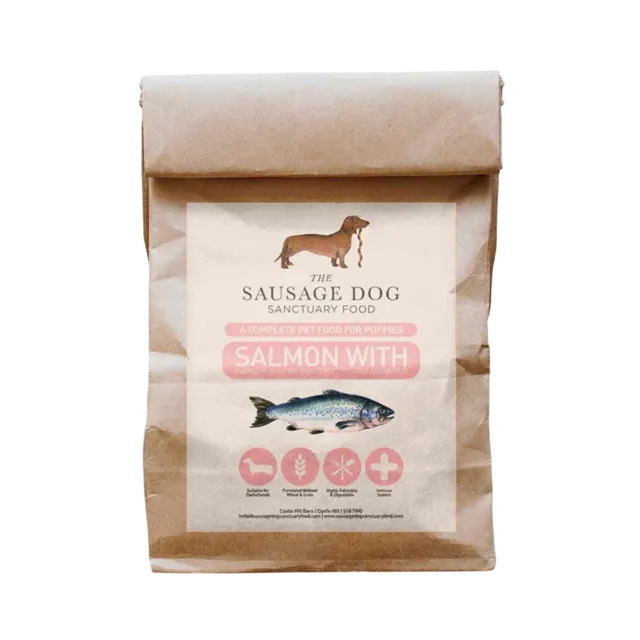
Sausage Dog Sanctuary Food Grain-Free Puppy: Salmon With Haddock, Blue Whiting, Sweet Potato & Asparagus review
Flavour
Sausage Dog Sanctuary Food Grain-Free Puppy is a small breed growth range built to one plan across three recipes. Each declares 60% meat or fish, broken out on the label into freshly prepared and dried portions with a stock behind them, and there is no cereal, just sweet potato and potato throughout. Doses are printed against the joint and prebiotic supplements, and all three recipes finish in our Good band.
Our view
Likely to suit
If you are raising a small breed pup and would rather pick the protein than take what you are given, this range makes that easy.
- Small breed puppies, the size this whole range is built around
- Grain-free households, since sweet potato and potato do the binding in all three recipes
- Owners who want joint support quantified, with glucosamine at 170 mg/kg, methylsulfonylmethane at 170 mg/kg and chondroitin sulphate at 125 mg/kg in every recipe
- Pups with unsettled digestion, where FOS at 96 mg/kg and MOS at 24 mg/kg sit alongside added nucleotides
- Owners keeping poultry out of the bowl, who have an all fish recipe to turn to without leaving the range
Worth watching
A few things about how these labels are written are worth knowing before you choose one.
- None of the three prints a calcium figure, the number a growth food is judged on, and the maker is worth a call if your pup will grow big
- Vitamins and minerals are given as two bare words with no additive panel published, so the doses behind them cannot be checked
- More than one animal goes into every recipe, which rules all three out for a strict single protein plan
- The omega 3 supplement is left unsourced, a fair question to put to the maker when a pup must stay clear of fish
Written by our editorial team. Independent guidance, not veterinary advice.
How this scores
How we scoreThe Details
Dog fit
If you are raising a small breed pup and would rather pick the protein than take what you are given, this range makes that easy. A few things about how these labels are written are worth knowing before you choose one.
Dry
Puppy
Small
Salmon
The score, in context
All three of these recipes read in our Good band, with barely anything between them. The typical puppy dry food belongs to the Good band as well, and the three sit close together at the upper end of it, the chicken recipe furthest along.
Transparency reads Outstanding across the three, and value sits on Good with protein and processing beside it. Nutritional balance is the only pillar that moves, Good on the duck and Average on the other two, so this is a range built to one standard.
What's in it
Ingredients, as declared: Salmon, Haddock & Blue Whiting 60% (Freshly Prepared Salmon 21%, Dried Salmon 16%, Freshly Prepared Blue Whiting 11%, Freshly Prepared Haddock 10% & Salmon Stock 2%), Sweet Potato (20%), Potato, Beet Pulp, Peas (6%), Linseed, Omega 3 Supplement, Minerals, Vitamins, Vegetable Stock, Asparagus (0.2%), Glucosamine (170 mg/ kg), Methylsulfonylmethane (170 mg/kg), Chondroitin Sulphate (125 mg/kg), Nucleotides, FOS (96 mg/kg), MOS (24 mg/kg)
Named ingredients
Nutritional additives
inline in ingredients — the composition lists only a bare "Minerals, Vitamins"; no separate additives panel is published.
Ingredient notes
Every recipe here opens on the same structure: a named meat or fish block declared at 60%, then split into freshly prepared and dried portions with a stock behind them. That split is worth understanding. Freshly prepared meat still holds its water and gives most of it up in the oven. The dried portion has already parted with its own. That is why the dried figures matter more in the finished kibble than their size suggests.
In all three the starch begins with sweet potato and continues with potato, and no cereal appears on the labels. Beet pulp supplies a steady, well tolerated fibre alongside, and peas appear in all three in quantities that vary by recipe.
The fats a growing coat and brain need come from linseed and an omega 3 supplement. That supplement is not sourced on the label. The poultry recipes name no fish in their meat blocks, so a household keeping a pup strictly away from fish should confirm where those omegas come from.
The joint pack runs across the whole range at the same quantities, and they are printed rather than implied: glucosamine at 170 mg/kg, methylsulfonylmethane at 170 mg/kg and chondroitin sulphate at 125 mg/kg. Starting joint support young makes obvious sense for a long backed breed, and these are quantities that do something rather than decorate the list.
Gut support comes from fructooligosaccharides at 96 mg/kg and mannanoligosaccharides at 24 mg/kg, with added nucleotides behind them. The pairing is prebiotic, food for the good bacteria lower down.
Where these labels run short is the mineral end. Vitamins and minerals appear as two bare words with nothing published behind them, and no calcium figure is given at all. For a pup that will finish small, that gap matters less than it would for a big one. Calcium governs how a skeleton is put together, and printing it would settle the question for every buyer at once.
Each recipe closes with a short run of named extras, from carrot and asparagus through to camomile and dill. Read them as trimming. These recipes stand on the meat and fish that head each list.
How this variety differs
The fish recipe keeps birds out altogether. Salmon fills most of the 60%, 21% of it freshly prepared and 16% dried. Blue whiting at 11% and haddock at 10% are both freshly prepared, and salmon stock at 2% finishes it. Three species of fish go into it. Sweet potato sits at 20%, peas at 6% and a token 0.2% of asparagus closes the recipe.
Protein reads 27.0% and fat 13.0%, matching the chicken recipe, while energy is estimated at 347 kcal per 100g, the gentlest in the range. It finishes level with its two siblings in our reading.
Price and value
£6.17 to £6.33 a kilo depending on the recipe, sold in 2kg, 6kg and 12kg bags.
No daily amount stays fixed while a dog is growing, so set the portion from the bag's chart and from the shape of your pup between ribs and hips as the weeks pass.
Nutritional analysis
Declared analysis
Estimated using Modified Atwater factors*
27%
13%
3.5%
8%
8%
Dry weight
29.3%
14.1%
3.8%
8.7%
44.1%
As-fed composition
Estimated breakdown of the finished product by ingredient category, from the declared ingredient list and ingoing weights. These are estimates, not measurements.
55.6%
10.3%
32%
2.2%
Pricing & size
- Pack size
- 2KG, 6KG, 12KG
- Retailer pricing
- Coming soon
Live retailer pricing is not yet available for this food. Prices, cost per day and where to buy will appear here once retailer data is live.
Ingredients and nutrition are taken from manufacturer data. Retailer pricing is not yet live for this food.
Related dog food guides
Ranked shortlists that include foods like this one.