



Sainsbury's
Sainsbury's Nature's Goodness Sensitive Dry review
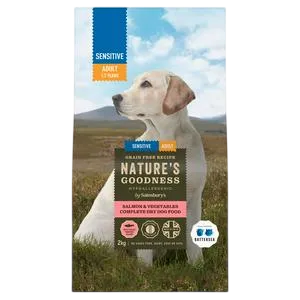
Sainsbury's Nature's Goodness Sensitive is a salmon and potato kibble that takes its Sensitive name more literally than most. Salmon is the only animal anywhere in the recipe, declared at 30% and split between meal and freshly prepared. Potato and sweet potato supply the starch, with no grain on the label, and digestion is looked after by beet pulp and a dosed prebiotic. That single protein build lands it in our Good band, where the typical adult dry food sits too.
Our view
Likely to suit
If your dog does best when the menu stays simple, this label keeps things unusually tidy for a supermarket shelf.
- Dogs with unsettled stomachs or itchy reactions to the common meats, because no animal but salmon appears anywhere here
- Owners feeding grain free, since sweet potato and potato carry what starch there is
- Owners who want digestive support spelled out, since the prebiotic carries a printed dose and beet pulp brings gentle fibre
- Adult dogs of any build, from toys to giants, since the feeding table covers the whole spread
Worth watching
There are a few practical things to know before you order the first bag.
- Salmon plus salmon oil means fish runs right through the recipe, so a dog kept off fish needs another bag
- A larger dog will empty the one bag size quickly, since 2kg is all that is offered
- Grain free is not low carb here, with carbohydrate estimated at 46.2% of dry matter, level with the typical dry food
Written by our editorial team. Independent guidance, not veterinary advice.
How this scores
How we scoreThe Details
Dog fit
If your dog does best when the menu stays simple, this label keeps things unusually tidy for a supermarket shelf. There are a few practical things to know before you order the first bag.
Dry
Adult
Toy, Small, Medium, Large, Giant
Salmon
The score, in context
This lands in our Good band, and so does the typical adult dry food. Within that, transparency reads Outstanding and protein and processing Good, with nutritional balance at Average, which is the pattern of a modest recipe that is straight about what it contains. For a sensitivity food, that straightness is worth more than a richer label that leaves you guessing.
What's in it
Ingredients, as declared: Salmon (30%) (Salmon Meal 21%, Freshly Prepared Salmon* 9%), Sweet Potato*, Potato*, Dried Peas* (6%), Salmon Oil* (5%), Dried Beet Pulp*, Vegetable Gravy, Linseed* (2%), Minerals, Yeast Products (0.2%, as a source of Prebiotic MOS), Dried Cranberry*, Dried Blueberry*, Marigold Flower*, Turmeric*, Dried Spearmint. *Natural ingredients
Named ingredients
Nutritional additives
Vitamin A 17000 IU/kg, Vitamin D3 750 IU/kg, Vitamin E 70mg/kg, Iodine (Calcium Iodate Anhydrous) 1mg/kg, Copper (Copper (II) Sulphate Pentahydrate) 5mg/kg, Iron (Iron (II) Sulphate Monohydrate) 60mg/kg, Manganese (Manganese (II) Oxide) 50mg/kg, Zinc (Zinc Oxide) 75mg/kg.
Ingredient notes
Salmon leads the label at 30%, split as 21% salmon meal and 9% freshly prepared. Meal has a poorer reputation than it deserves. It is fish with the water already taken out, which packs more protein into each gram than fresh fish does, and this one is named to the species. Salmon and nothing else came from an animal here, and for a sensitivity recipe that is more useful still, since plenty of foods wearing the Sensitive name never quite manage it.
The energy comes from sweet potato and potato, backed by dried peas at 6%, and no grain appears on the label. What that buys is worth pinning down. Carbohydrate still converts to an estimated 46.2% of dry matter, level with the typical adult dry food, so the grain-free label is about the ingredients and not the carbohydrate share.
Salmon oil at 5% and linseed at 2% look after the fats, and the pairing leans firmly towards omega 3. In a food aimed at delicate stomachs and itchy skin, that is exactly the fat you want.
The digestive support is quiet but genuine. Dried beet pulp brings the gentle, well-tolerated fibre that firms stools. Prebiotic MOS comes from yeast products at 0.2%, and that figure is printed on the label. Halfway down the list sits the vegetable gravy, the palatant, and being vegetable it smuggles no second animal into the bowl.
The closing run of cranberry, blueberry, marigold, turmeric and spearmint is garnish rather than substance. The added vitamin and mineral panel, though, is fully dosed in print, from vitamin A at 17000 IU/kg down to zinc at 75 mg/kg, which is more declaration than many short labels bother to give.
Price and value
£3.45 a kilo, sold in a 2kg bag.
As a guide, feeding works out at around £0.79 a day for a 15kg adult dog in moderate condition, roughly 228 grams, assuming about 840 kcal a day (110 × bodyweight^0.75, the standard maintenance estimate). For the smallest dogs the label's own table starts at 30 grams a day and climbs to 560 grams for a 50kg dog.
Nutritional analysis
Declared analysis
25.5%
13%
3%
8%
Dry weight
27.7%
14.1%
3.3%
8.7%
46.2%
As-fed composition
Estimated breakdown of the finished product by ingredient category, from the declared ingredient list and ingoing weights. These are estimates, not measurements.
30%
6%
51.6%
5%
7.4%
Pricing & size
- Pack size
- 2kg
- Retailer pricing
- Coming soon
Live retailer pricing is not yet available for this food. Prices, cost per day and where to buy will appear here once retailer data is live.
Ingredients and nutrition are taken from manufacturer data. Retailer pricing is not yet live for this food.
Related dog food guides
Ranked shortlists that include foods like this one.