



Sainsbury's
Sainsbury's Complete Nutrition Worker Dry review
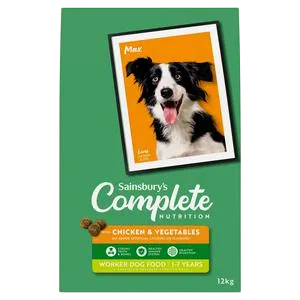
Dogs that burn through their food are the point of Sainsbury's Complete Nutrition Worker. Fat is declared at 11.0% and converts to 12.0% of dry matter, the most generous figure in this line. The panel is the shortest of the lot: cereals, an animal block with chicken named at 4%, oils and fats, dried peas and minerals. It falls into our Poor band, and much of that comes down to what the panel leaves unsaid, including any figure at all for the size of the animal block.
Our view
Likely to suit
If your dog works hard or simply never seems to stop, the fat here is set higher than in an everyday adult bag.
- Working dogs and hard-running dogs whose energy needs outrun a standard adult recipe
- Multi-dog households that get through food quickly and want one recipe covering all of them
- Dogs with hearty appetites and no known food sensitivities to work around
- Owners who want a straightforward high fat kibble without a long list to read on the back
Worth watching
This one asks a little more of you as a label reader.
- The animal block carries no percentage on the panel, only the 4% chicken named inside it
- Cereals is left unspecified, so the grain in the recipe cannot be identified from the pack
- Carbohydrate is estimated at 53.7% of dry matter, above the 46.2% typical of adult dry food
- Fat at 12.0% of dry matter suits a dog in work and will put condition on a dog that is resting between seasons
Written by our editorial team. Independent guidance, not veterinary advice.
How this scores
How we scoreThe Details
Dog fit
If your dog works hard or simply never seems to stop, the fat here is set higher than in an everyday adult bag. This one asks a little more of you as a label reader.
Dry
Adult
Toy, Small, Medium, Large, Giant
Chicken
The score, in context
This food lands in our Poor band, some way below the Good band that holds the typical adult dry food. What drives it is disclosure. The panel gives a figure for the chicken and a figure for the peas, and none at all for the meat and animal derivatives block sitting between them. That leaves the animal share of the recipe unreadable from the pack. Put cereals and oils and fats around that, neither of them named to a source, and there is very little here a careful reader can check. The analysis itself is ordinary, and nothing worse than that. A working dog fed on it will get the energy it came for.
What's in it
Ingredients, as declared: Cereals, Meat and Animal Derivatives 4% Chicken), Oils and Fats, Vegetables (0.5% Dried Peas equivalent to 4% Peas), Minerals.
Named ingredients
Nutritional additives
Vitamin A 17000 IU, Vitamin D3 1500 IU, Vitamin E 70mg, Iodine (Calcium Iodate Anhydrous) 2.5mg, Selenium (Sodium Selenite) 0.1mg, Copper (Copper (II) Sulphate Pentahydrate) 8mg, Iron (Iron (II) Sulphate Monohydrate) 60mg, Manganese (Manganese (II)Oxide) 50mg, Zinc (Zinc Oxide) 100mg.
Ingredient notes
The ingredients panel runs to five entries: cereals, meat and animal derivatives with chicken at 4%, oils and fats, vegetables as 0.5% dried peas, and minerals. Read from the top that puts grain at the base with the animal content second, but no percentage is printed against the animal block itself, so exactly how far second it comes is left open.
The words meat and animal derivatives are a legal category. They are not a description. It takes in the fleshy parts and by-products of warm blooded land animals, from good material to poor, and it names no species. For a working dog with a cast iron stomach that will rarely matter. It matters a great deal when one particular meat is being kept out of a dog's bowl.
Oils and fats is working harder here than in the rest of the range. Fat is declared at 11.0% as fed, converting to 12.0% of dry matter on the 8% moisture a kibble usually carries. The term covers animal and plant fats alike and names neither. This is still the entry that gives the recipe its working character, since fat is the densest energy a dog can eat.
Protein reads 21.0%, or 22.8% of dry matter, and the rest of the panel gives fibre at 3.3%, ash at 8.2% and estimated carbohydrate at 53.7% on the same basis. Energy comes out at 339 kcal per 100g. Protein at 22.8% of dry matter is middling for a dog in genuine work. A hard season is a reason to raise the portion, not to lean on the bowl as it stands.
Vitamins A, D3 and E are dosed at 17000 IU, 1500 IU and 70mg, with zinc at 100mg, iron at 60mg, manganese at 50mg and copper at 8mg. Selenium comes as sodium selenite and iodine as calcium iodate, both of them the standard mineral salt forms.
Price and value
£0.75 a kilo, sold in a 12kg bag.
As a guide, a 15kg adult dog in moderate condition eats about 248 grams a day, coming to roughly £0.19 a day. The day rate rests on around 840 kcal a day (110 × bodyweight^0.75, the standard maintenance estimate). In real work a dog will need more than that. The pack's own guide asks 195 to 445 grams for a dog of 10kg to 30kg, and on a busy week the top of that range is the part to look at.
Nutritional analysis
Declared analysis
21%
11%
3%
7.5%
Dry weight
22.8%
12%
3.3%
8.2%
53.7%
As-fed composition
Estimated breakdown of the finished product by ingredient category, from the declared ingredient list and ingoing weights. These are estimates, not measurements.
4%
56%
14.2%
18.2%
7.7%
Pricing & size
- Pack size
- 12kg
- Retailer pricing
- Coming soon
Live retailer pricing is not yet available for this food. Prices, cost per day and where to buy will appear here once retailer data is live.
Ingredients and nutrition are taken from manufacturer data. Retailer pricing is not yet live for this food.
Related dog food guides
Ranked shortlists that include foods like this one.