Skip to content
Off the Leash
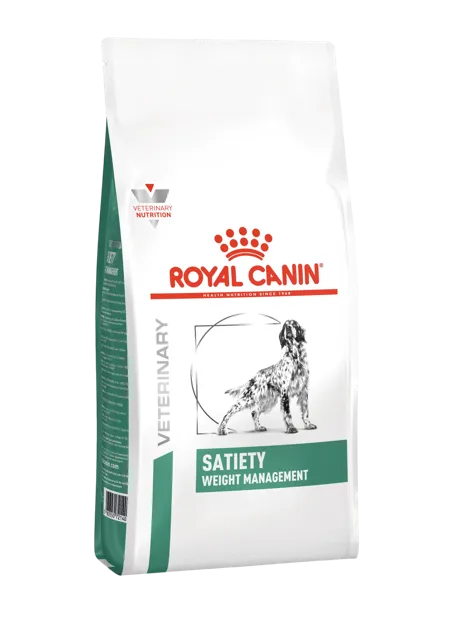
Royal Canin Veterinary Diet Satiety Weight Management – —

Royal Canin

Royal Canin Veterinary Diet Satiety Weight Management review

We don't put a score on this food. It is a veterinary diet, formulated for a diagnosed condition and meant to be fed on a vet's advice. Your vet has seen your dog and we have not, so a number from us could only pull you towards their advice or away from it, and neither of those is ours to do. What follows is what the label declares, what the analysis works out at, and where to buy it, with no judgement attached to any of it.

Royal Canin sells this one through its Veterinary Diet range as Satiety Weight Management, a dry diet the maker builds around a heavy fibre load for dogs being taken through a supervised weight loss programme.

DryAdultSenior
Where to buy: coming soon
Live retailer pricing is coming soon. Once we have prices from UK retailers, the best price, cost per day and where to buy will appear here.

The Details

Dog fit
Food type

Dry

Life stage

Adult, Senior

Breed size

Small

Main protein

Poultry

What's in it

Ingredients, as declared: Vegetable fibres, dehydrated poultry protein, wheat gluten*, manioc (tapioca), maize gluten, hydrolysed animal proteins, wheat, maize, animal fats, beet pulp, fish oil, minerals, psyllium husks and seeds, soya oil, fructo-oligosaccharides, glucosamine from fermentation, marigold meal, hydrolysed cartilage (source of chondroitin).

Named ingredients

Vegetable fibres, dehydrated poultry protein, wheat gluten*, manioc (tapioca), maize gluten, hydrolysed animal proteins, wheat, maize, animal fats, beet pulp, fish oil, minerals, psyllium husks and seeds, soya oil, fructo-oligosaccharides, glucosamine from fermentation, marigold meal, hydrolysed cartilage (source of chondroitin).

Nutritional additives

Additives (per kg)**: Nutritional additives: Vitamin A: 19000 IU, Vitamin D3: 1000 IU, Iron (3b103): 35 mg, Iodine (3b201, 3b202): 3.5 mg, Copper (3b405, 3b406): 11 mg, Manganese (3b502, 3b504): 46 mg, Zinc (3b603, 3b605, 3b606): 137 mg, Selenium (3b801, 3b811, 3b812): 0.06 mg - Preservatives - Antioxidants.

What's on the label

Vegetable fibres take first place on the list, ahead of dehydrated poultry protein, with wheat gluten third. Manioc, given here under its other name of tapioca, and maize gluten follow, so the top of this label is mostly plant fractions with a dried poultry protein set among them.

Poultry names the whole bird family and not one bird in it. Further down the animal entries read as hydrolysed animal proteins, animal fats and hydrolysed cartilage. None of those say what they came from. Fish oil is the single animal ingredient whose origin is plain on the page. An owner tracking one particular meat will want to know that before starting.

Crude fibre is declared at 17.0% and converts to 18.5% of dry matter. Fibre at that level is the mechanism a satiety diet works through, filling the bowl without bringing energy along with it, so it is the intended build rather than an oddity. Behind the leading vegetable fibres come beet pulp and then psyllium husks and seeds. They add to what those fibres are already doing, and fructo-oligosaccharides sit further down.

Protein is printed at 30.0%, which comes out at 32.6% of dry matter, and fat at 9.5%, or 10.3% dried down. The carbohydrate estimate lands at 32.3% of dry matter and the energy figure is 256 kcal per 100g. Fat that low with fibre that high gets a dog through a full portion on less energy. Whether those proportions belong in your dog's plan is settled with the vet who put him on it.

Glucosamine from fermentation and hydrolysed cartilage, named as the chondroitin source, close the ingredient list, both without a percentage beside them. The nutritional additives do carry doses per kilo. Vitamin A is at 19000 IU and vitamin D3 at 1000 IU. The trace minerals run zinc at 137 mg, manganese at 46 mg, iron at 35 mg, copper at 11 mg, iodine at 3.5 mg and selenium at 0.06 mg. Preservatives and antioxidants appear as headings with nothing named under them.

There is no printed table behind the portion figures here. They are worked from the food's energy value, and on that basis a 15kg dog eats somewhere around 328 grams a day. The amount fed is the treatment itself on a weight loss diet. Go by the number your vet writes down.

Price and where to buy

It is sold in 1.5kg, 6kg and 12kg bags.

Nutritional analysis

Declared analysis

Energy
256 kcal/100g
Protein

30%

Fat

9.5%

Fibre

17%

Ash

5.8%

Dry weight

Protein

32.6%

Fat

10.3%

Fibre

18.5%

Ash

6.3%

Carbs

32.3%

As-fed composition

Estimated breakdown of the finished product by ingredient category, from the declared ingredient list and ingoing weights. These are estimates, not measurements.

Meat

33.5%

Carbs

32.7%

Veg

26.3%

Oils

1.1%

Other

6.5%

Pricing & size
Pack size
1.5 kg, 6 kg, 12 kg
Retailer pricing
Coming soon

Live retailer pricing is not yet available for this food. Prices, cost per day and where to buy will appear here once retailer data is live.

Ingredients and nutrition are taken from manufacturer data. Retailer pricing is not yet live for this food.

Related dog food guides

Ranked shortlists that include foods like this one.
All reviews

Featured feeding accessories

All feeding accessories

Brackenwood

Slow Feeder Maze Bowl

Slows fast eaters and eases gulping at mealtimes.

From £12.99· 4 retailers
View

Tarn & Co

Raised Double Diner

Height-set stand for easier, tidier eating.

From £28.99· 3 retailers
View

Reviewed by Off the Leash Editorial

Last updated 24 August 2026