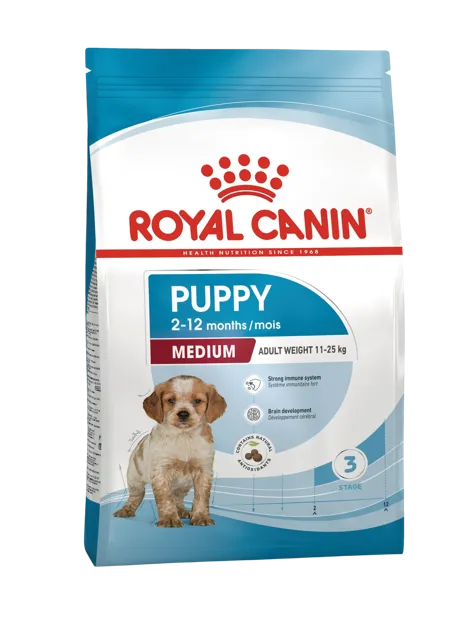


Royal Canin
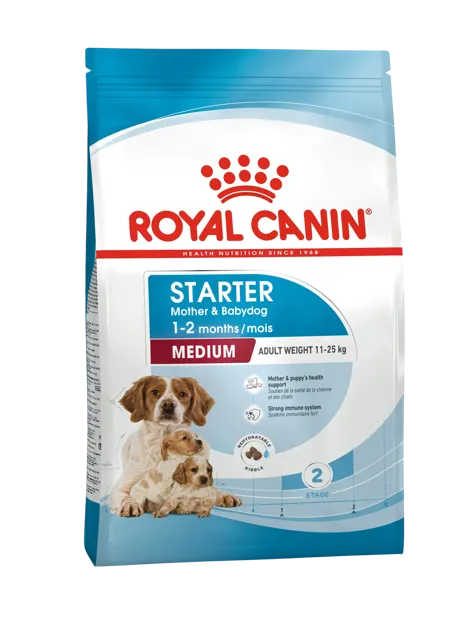
Royal Canin Medium Starter review
Royal Canin Medium Starter is a notably rich recipe with a narrow brief. Protein reaches 32.6% of dry matter, fat 23.9% and energy 422 kcal per 100g. DHA from algal oil, butyric acid salt and hydrolysed yeast support a gut that is only just learning to handle solid food. The name and the feeding brackets both point at the very beginning of a medium breed dog's life rather than at an adult routine. It reads Average against our general scale, which is measuring it on ground it was never built to compete on.
Our view
Likely to suit
If you are bringing a litter or a single puppy through weaning, this bag is written for exactly that stretch.
- Medium breed puppies at the very start of solid food, which is where both the name and the feeding brackets point
- Owners who want DHA in the recipe from the first meal, supplied here by algal oil
- Small stomachs that need a great deal from very little, since the food carries 422 kcal per 100g
- Households raising a litter, with hydrolysed yeast at 0.30% and butyric acid salt included for a developing gut
Worth watching
This is a specialist food, so a few points deserve to be clear before you buy it.
- Calcium is not declared anywhere on the label, and calcium is the single figure that matters most on a food for growing dogs
- The recipe is very rich, at 23.9% fat on a dry matter basis, so it is not one to leave down for an adult dog to help themselves to
- Not one animal entry carries a name: the dehydrated poultry protein, the animal fats, the hydrolysed animal proteins
- A household steering clear of wheat gluten or soya oil should know that both appear on this list
Written by our editorial team. Independent guidance, not veterinary advice.
How this scores
How we scoreThe Details
Dog fit
If you are bringing a litter or a single puppy through weaning, this bag is written for exactly that stretch. This is a specialist food, so a few points deserve to be clear before you buy it.
Dry
Puppy, Adult
Medium
Poultry
The score, in context
Against our general adult scale this comes out in the Average band, below the Good band the typical adult dry food occupies, and the comparison is a little unfair on both sides. A starter recipe is deliberately dense in protein, fat and minerals in a way no adult maintenance food would be, so the analysis reads oddly against the category. Protein sits at 32.6% of dry matter, fat at 23.9%, ash at 9.0% and estimated carbohydrate down at 33.1% against a 46.2% norm. What genuinely holds the reading back is the same thing as elsewhere in this range. None of the meat, the fat or the hydrolysed protein names an animal. Calcium goes undeclared too, on a food whose job is building a skeleton.
What's in it
Ingredients, as declared: Dehydrated poultry protein, rice, animal fats, wheat gluten*, maize, beet pulp, hydrolysed animal proteins, minerals, soya oil, fish oil, fructo-oligo-saccharides, hydrolysed yeast (source of manno-oligo-saccharides and betaglucans) (0.30%), algal oil Schizochytrium sp. (source of DHA), butyric acid salt, marigold meal.
Named ingredients
Nutritional additives
Additives (per kg): Nutritional additives: Vitamin A: 18500 IU, Vitamin D3: 1200 IU, Iron (3b103): 40 mg, Iodine (3b201, 3b202): 4 mg, Copper (3b405, 3b406): 12 mg, Manganese (3b502, 3b504): 52 mg, Zinc (3b603, 3b605, 3b606): 131 mg, Selenium (3b801, 3b811, 3b812): 0.07 mg - Technological additives: Clinoptilolite of sedimentary origin: 10 g - Preservatives - Antioxidants.
Ingredient notes
Dehydrated poultry protein leads with rice second and animal fats third, a rich and simple opening. Protein converts to 32.6% of dry matter and fat to 23.9%, both well above what an adult kibble carries, and the estimated carbohydrate of 33.1% is correspondingly low. This is a food designed to deliver a great deal of nutrition in a very small volume, which is exactly what a stomach the size of a plum needs.
The early life thinking sits in the smaller entries. Algal oil supplies DHA, the omega 3 usually singled out for brain and eye development in young animals, and this source is grown, not fished. Butyric acid salt is a short chain fatty acid that the cells lining the gut use as fuel, hydrolysed yeast at 0.30% supplies manno-oligosaccharides and betaglucans, and fructo-oligosaccharides sit alongside them. Clinoptilolite, a sedimentary mineral clay, is dosed at 10 g per kilo among the technological additives.
Ash at 9.0% of dry matter is high, which is what you expect when a recipe carries the minerals a growing skeleton needs. The declared additives cover vitamin A at 18500 IU and vitamin D3 at 1200 IU. Zinc runs at 131 mg, manganese at 52 mg, iron at 40 mg, copper at 12 mg, iodine at 4 mg and selenium at 0.07 mg per kilo. Calcium is the one figure missing. On a food for growth an owner wants that number most, particularly at the larger end of the medium breeds, where keeping the rate of bone growth steady is the whole game.
The animal ingredients follow the house pattern and name nothing. Dehydrated poultry protein could be any domestic bird, animal fats are simply animal, and hydrolysed animal proteins are broken down small for digestibility and palatability. That is sensible in a weaning food and no use at all as a way of knowing what your dog is eating. Fish oil is in there too, so the recipe is not fish free.
Rice is the main cereal and a gentle one, with maize behind it and wheat gluten in fourth place. Wheat gluten is there as a concentrated protein rather than as a bulking agent, though it is still wheat. Beet pulp does the fibre work at a low 1.4% of dry matter, which suits a young gut that does not want much bulk in the way of its calories.
Price and value
£5.67 a kilo, sold in 4kg and 15kg bags.
As a guide, and only as a reference point, 199 grams a day would cover a 15kg dog in moderate condition at an assumed 840 kcal a day (110 × bodyweight^0.75, the standard maintenance estimate). That works out at £1.13 a day. A puppy on this food is fed to a growth schedule, so follow the label's own age based guide and use that figure only for comparison.
Nutritional analysis
Declared analysis
30%
22%
1.3%
8.3%
8%
Dry weight
32.6%
23.9%
1.4%
9%
33.1%
As-fed composition
Estimated breakdown of the finished product by ingredient category, from the declared ingredient list and ingoing weights. These are estimates, not measurements.
41.7%
47.3%
9.4%
1.7%
Pricing & size
- Pack size
- 4 kg, 15 kg
- Retailer pricing
- Coming soon
Live retailer pricing is not yet available for this food. Prices, cost per day and where to buy will appear here once retailer data is live.
Ingredients and nutrition are taken from manufacturer data. Retailer pricing is not yet live for this food.
Related dog food guides
Ranked shortlists that include foods like this one.