



Royal Canin
Royal Canin Mini Sterilised Care review
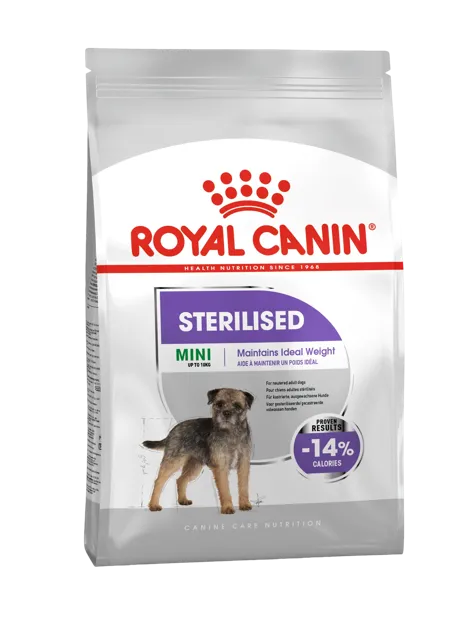
Royal Canin Mini Sterilised Care answers the appetite that so often arrives after neutering, in a kibble sized for a small mouth. Maize opens the list with dehydrated poultry protein second, protein is held up at 30% while fat is kept to 13%, crude fibre reaches 6.6%, and L-carnitine is dosed at 200 mg per kilo. It falls into our Average band on the strength of its unnamed ingredients, which is a separate matter from how a neutered small dog will get along with it.
Our view
Likely to suit
What a dog needs after neutering changes long before what they ask for does, and that gap is what this bag is written into.
- Neutered small breed dogs whose weight has begun to creep, with fat held at 13% and protein kept up at 30%
- Owners reading for L-carnitine, which is printed here with a 200 mg per kilo dose against it
- Dogs that need a filling bowl on fewer calories, since crude fibre at 6.6% does that bulking work
- Owners who would rather not switch food when their dog crosses into old age, since the bag spans both stages
Worth watching
Before you commit to a bag, give a few entries on this list a proper read.
- A good share of the bowl is cereal, with maize first on the list and wheat third
- Poultry covers the meat here without naming the bird, so it will not settle a question about chicken
- The protein figure gets help from a vegetable protein isolate and from maize gluten, neither of which is meat
- If your dog's bowl has to stay fish free, note the fish oil in the small print
- With no moisture on the pack, the dry matter figures lean on the 8% usual for a kibble
Written by our editorial team. Independent guidance, not veterinary advice.
How this scores
How we scoreThe Details
Dog fit
What a dog needs after neutering changes long before what they ask for does, and that gap is what this bag is written into. Before you commit to a bag, give a few entries on this list a proper read.
Dry
Adult, Senior
Small
Poultry
The score, in context
This one lands in our Average band, a tier under the typical adult dry food in our Good band. Every reason is printed on the label. Maize leads, wheat is third, and the protein figure is helped along by a vegetable protein isolate and by maize gluten as much as by the poultry, none of which is pinned to a species. Set against that, the panel reads well for the job it is doing. Protein converts to 32.6% of dry matter while fat stays down at 14.1%, and estimated carbohydrate works out at 40.2%, comfortably under the 46.2% typical of adult dry food.
What's in it
Ingredients, as declared: maize, dehydrated poultry protein, wheat, hydrolysed animal proteins, maize gluten, vegetable fibres, vegetable protein isolate*, animal fats, beet pulp, yeasts and parts thereof, fish oil, soya oil, psyllium husks and seeds, fructo-oligo-saccharides, minerals, borage oil, marigold extract (source of lutein).
Named ingredients
Nutritional additives
Additives (per kg): Nutritional additives: Vitamin A: 22000 IU, Vitamin D3: 1000 IU, E1 (Iron): 40 mg, E2 (Iodine): 4 mg, E4 (Copper): 12 mg, E5 (Manganese): 52 mg, E6 (Zinc): 156 mg, E8 (Selenium): 0.07 mg - L-carnitine: 200 mg. Technological additives: Clinoptilolite of sedimentary origin: 5 g - Preservatives - Antioxidants.
Ingredient notes
Maize first and dehydrated poultry protein second is the order to notice. Maize is a workmanlike cereal that most dogs digest without any fuss. The dehydrated poultry behind it came with its water already removed, and it holds its position through to the finished kibble. Together the two produce a panel protein of 30%, which is generous for a food with the calories pulled back.
Fibre is the trick this recipe uses. Crude fibre reaches 6.6% on the back of psyllium husks, beet pulp and vegetable fibres. That bulk is what stops a reduced portion feeling like a punishment to a dog whose appetite has grown since the operation. Psyllium in particular is a soluble fibre with a settling effect on digestion.
L-carnitine is dosed at 200 mg per kilo. It is an amino acid, and its part is moving fat into cells that can burn it for fuel. That is why it turns up on recipes written for dogs whose energy needs have dropped away from their appetite.
The finishing touches are small but real. Fish oil covers the long chain omega 3s, borage oil supplies gamma linolenic acid, marigold extract adds lutein, and yeast products with fructo-oligo-saccharides look after the gut. Zinc is dosed at 156 mg per kilo and manganese at 52 mg.
Where this label goes quiet is on species. The poultry has no bird against it. The animal fats go unnamed too, as do the hydrolysed animal proteins. The plant side adds protein as well, with a vegetable protein isolate alongside maize gluten. For a dog with no known food sensitivity none of that will ever matter. For a dog whose reactions you are trying to trace, it leaves too little to go on.
Price and value
Sold in 3kg and 8kg bags, at £7.12 a kilo.
As a guide, a 15kg adult dog in moderate condition would eat about 243 grams a day, assuming about 840 kcal a day (110 × bodyweight^0.75, the standard maintenance estimate). That comes to £1.73 a day. A small breed dog eats well under that, so treat the daily figure as a comparison point and portion to the dog.
Nutritional analysis
Declared analysis
30%
13%
6.6%
5.4%
Dry weight
32.6%
14.1%
7.2%
5.9%
40.2%
As-fed composition
Estimated breakdown of the finished product by ingredient category, from the declared ingredient list and ingoing weights. These are estimates, not measurements.
33.9%
59.9%
4.2%
1.3%
0.6%
Pricing & size
- Pack size
- 3 kg, 8 kg
- Retailer pricing
- Coming soon
Live retailer pricing is not yet available for this food. Prices, cost per day and where to buy will appear here once retailer data is live.
Ingredients and nutrition are taken from manufacturer data. Retailer pricing is not yet live for this food.
Related dog food guides
Ranked shortlists that include foods like this one.