


Skip to content
Off the Leash
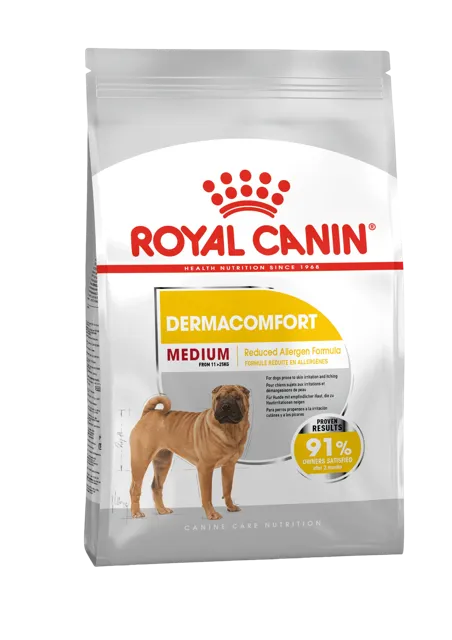
Royal Canin Medium Dermacomfort – —

Royal Canin

Royal Canin Medium Dermacomfort review

32.9/100Average
DryAdultSenior

Royal Canin Medium Dermacomfort is built for the medium breed dog whose skin will not settle. It is an unusual label for a kibble, with rice and a vegetable protein isolate leading and no named meat appearing anywhere. The skin work is done by a stack of oils, borage for GLA, fish oil for EPA and DHA and flax seed, over a mineral panel that takes zinc to 150 mg per kilo. It reads Average on our scale. Leaving the animal ingredients unnamed will do that, and the reading says nothing about whether the food does the job it is for.

Where to buy: coming soon
Live retailer pricing is coming soon. Once we have prices from UK retailers, the best price, cost per day and where to buy will appear here.

Our view

Likely to suit

When your dog scratches through more of the evening than they sleep, the bowl is a reasonable place to start looking.

  • Medium breed dogs with itchy, unsettled skin, the audience this recipe is written for
  • Owners who want the skin nutrients in print, with zinc at 150 mg per kilo and borage oil in the list as a GLA source
  • Dogs that have reacted to common meats, since no named animal protein appears on this list at all
  • Dogs with a dull, tired coat, helped along by fat at 18.7% of dry matter plus flax seed and fish oil

Worth watching

A recipe this specific comes with a few things you should know before the first bowl.

  • Fish oil is part of the omega package, so this is not a fish free food despite the absence of any fish meat
  • A strict elimination trial calls for a vet designed diet, because the hydrolysed animal proteins and animal fats here name no species
  • The protein leans heavily on plant sources such as the vegetable protein isolate and maize gluten, which is deliberate here but worth knowing
  • Wheat sits third on the list, which a wheat sensitive dog's owner will want to weigh up

Written by our editorial team. Independent guidance, not veterinary advice.

How this scores

How we score
32.9/100Average
Protein and processingPoor
Nutritional balanceAverage
TransparencyAverage
ValueAverage

The Details

Dog fit

When your dog scratches through more of the evening than they sleep, the bowl is a reasonable place to start looking. A recipe this specific comes with a few things you should know before the first bowl.

Food type

Dry

Life stage

Adult, Senior

Breed size

Medium

Main protein

Fish

The score, in context

Dermacomfort takes the Average band on our scale, one step under the Good band that the middle of the adult dry shelf holds. The arithmetic behind that is unusual for this brand. It is not the carbohydrate, which at 46.9% of dry matter is all but level with the 46.2% typical for the category. It is that the recipe declares almost no animal ingredient at all: the protein is largely plant, and the two animal entries name nothing. Against a general nutrition scale that reads as a thin label. Read as a skin diet, it is a deliberate design, and keeping named meats out of it is the entire point.

What's in it

Ingredients, as declared: rice, vegetable protein isolate*, wheat, animal fats, maize gluten, husked oats, maize, minerals, hydrolysed animal proteins, soya oil, beet pulp, fish oil, flax seeds, fructo-oligo-saccharides, borage oil, marigold extract (source of lutein).

Named ingredients

Rice, vegetable protein isolate*, wheat, animal fats, maize gluten, husked oats, maize, minerals, hydrolysed animal proteins, soya oil, beet pulp, fish oil, flax seeds, fructo-oligo-saccharides, borage oil, marigold extract (source of lutein).

Nutritional additives

Additives (per kg): Nutritional additives: Vitamin A: 29500 IU, Vitamin D3: 800 IU, E1 (Iron): 67 mg, E2 (Iodine): 5.5 mg, E4 (Copper): 13 mg, E5 (Manganese): 67 mg, E6 (Zinc): 150 mg, E8 (Selenium): 0.17 mg - Preservatives - Antioxidants.

Ingredient notes

Rice leads, and rice is about the most benign cereal a kibble can be built on, easily digested and rarely the cause of anything. Second comes a vegetable protein isolate, a concentrated plant protein. With maize gluten, husked oats and maize behind them, they take the recipe's protein to 26.4% of dry matter without a named animal contributing much of it.

That absence is the design rather than an accident. Common animal proteins are the usual suspects when a dog's skin flares, so a recipe meant to calm skin often does its protein work with plants. This one goes further than most, with no meat named anywhere on it. The animal contributions are animal fats, hydrolysed animal proteins and fish oil, none of them a meat. The trade is straightforward. A dog gets less complete protein from plants than from meat. Building a food this way asks more of the formulation to make the amino acids add up.

The oils are where the real work is done. Borage oil supplies gamma-linolenic acid, the omega 6 usually chosen when skin is irritated. Fish oil brings EPA and DHA from the other direction, flax seeds add the plant form of omega 3, and marigold extract contributes lutein. Total fat sits at 18.7% of dry matter, on the rich side for an everyday adult food, and a good deal of that richness is doing coat work.

The trace mineral panel is generous: zinc at 150 mg, manganese at 67 mg, iron at 67 mg, copper at 13 mg, iodine at 5.5 mg and selenium at 0.17 mg per kilo. Vitamin A comes in at 29500 IU and vitamin D3 at 800 IU. Skin leans on zinc harder than on any other mineral, so lifting it on a recipe with this name is exactly the right instinct.

Two label habits are worth calling out plainly, because they cut both ways. The animal fats keep the food palatable and the hydrolysed animal proteins supply what plants cannot. Neither entry says which animal was involved. Hydrolysed protein in particular is broken into pieces small enough that most immune systems ignore them. That is useful on a skin food and unhelpful if you are trying to prove exactly what your dog reacts to. Calcium is not declared either, a gap on any label, though a modest one on a food written for adults.

Price and value

£5.27 a kilo, sold in 3kg and 12kg bags.

As a guide, about 222 grams a day covers a 15kg dog in moderate condition, on an assumed requirement of 840 kcal a day (110 × bodyweight^0.75, the standard maintenance estimate). That gives a day rate of £1.17. The bag's own table is leaner, asking 182 grams for a 15kg dog and 267 grams for a 25kg one, so begin where the label says and adjust by feel.

Nutritional analysis

Declared analysis

Energy
378 kcal/100g

Estimated using Modified Atwater factors*

Protein

24%

Fat

17%

Fibre

1.4%

Ash

5.9%

Moisture

9%

Dry weight

Protein

26.4%

Fat

18.7%

Fibre

1.5%

Ash

6.5%

Carbs

46.9%

As-fed composition

Estimated breakdown of the finished product by ingredient category, from the declared ingredient list and ingoing weights. These are estimates, not measurements.

Meat

1.3%

Carbs

74.9%

Veg

16.2%

Oils

6.4%

Other

1.2%

Pricing & size
Pack size
3 kg, 12 kg
Retailer pricing
Coming soon

Live retailer pricing is not yet available for this food. Prices, cost per day and where to buy will appear here once retailer data is live.

Ingredients and nutrition are taken from manufacturer data. Retailer pricing is not yet live for this food.

Related dog food guides

Ranked shortlists that include foods like this one.
All reviews

Featured feeding accessories

All feeding accessories

Brackenwood

Slow Feeder Maze Bowl

Slows fast eaters and eases gulping at mealtimes.

From £12.99· 4 retailers
View

Tarn & Co

Raised Double Diner

Height-set stand for easier, tidier eating.

From £28.99· 3 retailers
View

Reviewed by Off the Leash Editorial

Last updated 28 August 2026