

Royal Canin
Royal Canin Maxi Puppy Chunks In Gravy review
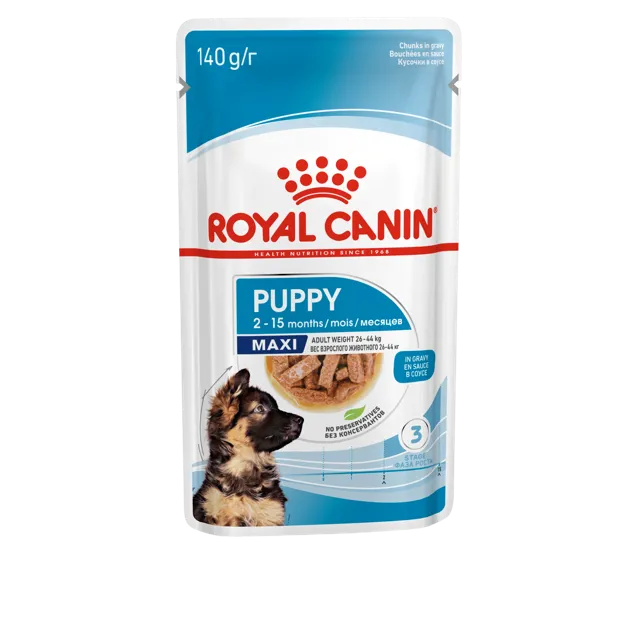
Royal Canin Maxi Puppy Chunks in Gravy is a large breed growth food portioned into 140g servings, chunks in gravy for pups who eat more happily from a wet bowl. The analysis is respectable, with protein converting to 40.9% of dry matter and fat to 24.6%, but the recipe is declared in seven category terms with not one animal or grain named. That leaves it in our Average band.
Our view
Likely to suit
Some pups simply eat better from a wet bowl, and a big one in the middle of growth needs to be eating well.
- Large breed puppies who take to wet food more readily than they take to kibble
- Owners who want a meat-led analysis, with protein converting to 40.9% of dry matter
- Households that top up a dry diet, since 79.7% declared moisture brings water into the same bowl
- Pups fed little and often, with each serving sealed at 140g
- Puppies who need richness while they grow, with fat converting to 24.6% of dry matter
Worth watching
This is a label that keeps almost everything to itself, and that is the part to weigh up.
- Category terms are all this list gives, with no named ingredient anywhere, so there is no telling which animals or grains are in the gravy from one batch to the next
- That openness rules the food out for any pup on an elimination diet or avoiding a particular protein
- Large breed growth leans on calcium harder than on anything else, and no figure is printed here, so ask the maker for it
- At an estimated 85 kcal per 100g against the 106 typical of a puppy wet food, a big pup works through a lot of servings to meet their needs
- Carbohydrate converts to an estimated 18.7% of dry matter where the typical puppy wet food sits at 13.6%, so there is a heavier cereal hand here than the format usually takes
Written by our editorial team. Independent guidance, not veterinary advice.
How this scores
How we scoreThe Details
Dog fit
Some pups simply eat better from a wet bowl, and a big one in the middle of growth needs to be eating well. This is a label that keeps almost everything to itself, and that is the part to weigh up.
Wet
Puppy
The score, in context
Our Average band is where this one lands, and much of the distance up to the Excellent band a typical puppy wet food reaches is a transparency distance. Seven ingredients, seven umbrella terms, and none of them tells you what is actually in the serving. Nutritional balance reads Outstanding, and protein and processing and transparency both read Average.
The analysis tells a friendlier story than the list does. Protein at 40.9% of dry matter with fat at 24.6% gives the proportions of a proper meat-based wet food, and a pup eating it is getting a genuine plateful of protein. Our reading marks the label, and this label has chosen to say very little.
What's in it
Ingredients, as declared: Meat and animal derivatives, cereals, vegetable protein extracts, oils and fats, derivatives of vegetable origin, minerals, yeasts.
Named ingredients
Nutritional additives
Additives (per kg): Nutritional additives: Vitamin D3: 150 IU, Iron (3b103): 5 mg, Iodine (3b202): 0.34 mg, Copper (3b405, 3b406): 2.7 mg, Manganese (3b502, 3b503, 3b504): 1.4 mg, Zinc (3b603, 3b605, 3b606): 14 mg - Technological additives: Clinoptilolite of sedimentary origin: 2 g.
Ingredient notes
The whole recipe is seven words long: meat and animal derivatives, cereals, vegetable protein extracts, oils and fats, derivatives of vegetable origin, minerals and yeasts. Each of those is a legal grouping wide enough to shelter excellent material and ordinary material alike. Nothing on the pack tells you which one is in front of you. Large manufacturers often write this way to keep a recipe flexible between batches. That is a commercial convenience, not a nutritional one.
Meat and animal derivatives sitting first does mean meat leads by weight, and the analysis backs that up, with protein converting to 40.9% of dry matter. What the term will not tell you is which warm-blooded animals contributed, or which parts of them.
Cereals in second place is the starch, unnamed in the same way. Carbohydrate works out at an estimated 18.7% of dry matter, against the 13.6% typical of a puppy wet food. The grain hand here is heavier than the format usually takes. Vegetable protein extracts follow, which means part of that strong protein reading is plant rather than animal.
Fat converts to 24.6% of dry matter from the oils and fats entry, a good level for a growing pup, though the source is left open like everything else. Fibre lands at 5.9% of dry matter, higher than most wet foods carry, and ash at 9.9% points to a solid mineral load even though no calcium percentage is printed to break it down.
The added panel is short for a growth food. It runs to vitamin D3 at 150 IU per kg, zinc at 14 mg, iron at 5 mg, copper at 2.7 mg and iodine at 0.34 mg. Clinoptilolite at 2 g sits among the technological additives. Energy is our estimate at 85 kcal per 100g, since the pack carries no declaration of its own.
Price and value
£8.79 a kilo, sold as a 10 x 140g pack.
A growing pup's daily need shifts with every fortnight, so the number of servings follows the feeding table on the pack rather than any fixed figure. Weigh what goes into the bowl for the first week or so and you will quickly get the measure of it.
Nutritional analysis
Declared analysis
Estimated using Modified Atwater factors*
8.3%
5%
1.2%
2%
79.7%
Dry weight
40.9%
24.6%
5.9%
9.9%
18.7%
As-fed composition
Estimated breakdown of the finished product by ingredient category, from the declared ingredient list and ingoing weights. These are estimates, not measurements.
37.7%
14.7%
41.1%
4.1%
2.3%
Pricing & size
- Pack size
- 10x140 g
- Retailer pricing
- Coming soon
Live retailer pricing is not yet available for this food. Prices, cost per day and where to buy will appear here once retailer data is live.
Ingredients and nutrition are taken from manufacturer data. Retailer pricing is not yet live for this food.
Related dog food guides
Ranked shortlists that include foods like this one.