



Royal Canin
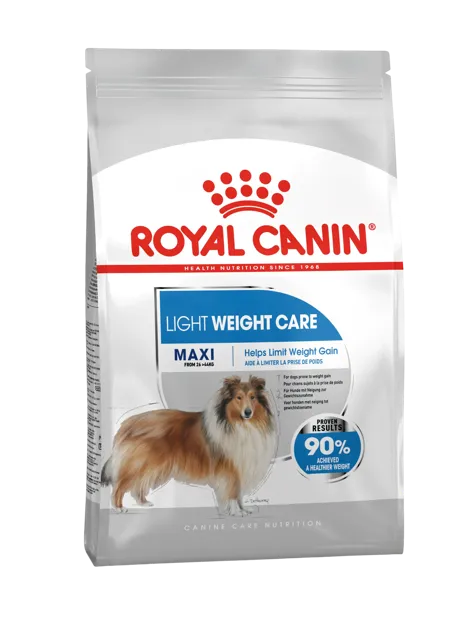
Royal Canin Maxi Light Weight Care review
Royal Canin Maxi Light Weight Care is this range's answer to a large dog carrying more than they should, and it commits to the job properly rather than trimming a general recipe. Crude fibre is declared at 11.4%, fat is held down to 11.0%, energy comes in at 320 kcal per 100g and L-carnitine is dosed at 200 mg per kilo. Dehydrated poultry proteins lead the list with vegetable fibres immediately behind them, and glucosamine and chondroitin are included for the joints all that weight has been leaning on. It lands in our Average band, which is a story about naming rather than about the diet's design.
Our view
Likely to suit
If your big dog has been quietly outgrowing their collar, this is the shape of food built to answer it.
- Large and giant breed adults who need to lose weight without losing the volume of their bowl, with crude fibre at 11.4%
- Owners of a slowing or neutered dog whose appetite has not slowed at anything like the same rate
- Dogs on a reduced ration who still need their protein held up, declared at 27.0% against fat of 11.0%
- Older dogs as well as adults, with glucosamine and chondroitin listed for joints that have been under load
- Households that want the weight work supported in the additives, with L-carnitine at 200 mg per kilo
Worth watching
A few things about how this food achieves its lightness are worth knowing in advance.
- Cellulose powder is one of the fibre sources, an all but indigestible bulking fibre that adds volume with almost no energy behind it
- No single bird stands behind the poultry, and no species stands behind the fats or the hydrolysed proteins
- Maize, maize flour, maize gluten, barley, wheat gluten and wheat all appear, so cereal is doing plenty of the carrying
- Fish oil is in the recipe here, so this one is not fish free
- A fibre level this high shows up in the stools, so allow for a little extra while a dog settles in
Written by our editorial team. Independent guidance, not veterinary advice.
How this scores
How we scoreThe Details
Dog fit
If your big dog has been quietly outgrowing their collar, this is the shape of food built to answer it. A few things about how this food achieves its lightness are worth knowing in advance.
Dry
Adult, Senior
Giant
Poultry
The score, in context
This comes out Average, one rung under the Good band where most of the adult dry shelf clusters. The reduced-energy design is not what puts it there. Protein holds up at 29.3% of dry matter while fat drops to 12.0% and estimated carbohydrate reaches 40.3%, below the 46.2% typical for adult dry food. That is very much the balance a slimming food wants. The list pulls the reading down instead: an unnamed bird, unnamed fats, maize gluten and wheat gluten lifting the protein figure, and cellulose powder standing in for whole-food fibre. That is what protein and processing and transparency are reading when they both come out Average. For an owner whose problem is a big dog and a vanishing waistline, the food still does the thing it was bought to do.
What's in it
Ingredients, as declared: Dehydrated poultry proteins, vegetable fibres, maize, barley, maize flour, maize gluten, wheat gluten*, hydrolysed animal proteins, wheat, animal fats, beet pulp, cellulose powder, fish oil, minerals, yeasts products, fructo-oligosaccharides, psyllium husks and seeds, soya oil, glucosamine from fermentation, marigold meal, hydrolysed cartilage (source of chondroitin). *L.I.P.: protein selected for its very high digestibility.
Named ingredients
Nutritional additives
Additives (per kg): Nutritional additives: Vitamin A: 21000 IU, Vitamin D3: 900 IU, Iron (3b103): 46 mg, Iodine (3b201, 3b202): 3.9 mg, Copper (3b405, 3b406): 10 mg, Manganese (3b502, 3b504): 49 mg, Zinc (3b603, 3b605, 3b606): 133 mg, Selenium (3b801, 3b811, 3b812): 0.09 mg, L-carnitine: 200 mg - Technological additives: Clinoptilolite of sedimentary origin: 5 g - Preservatives - Antioxidants.
Ingredient notes
Dehydrated poultry proteins lead and vegetable fibres come straight after them, and that pairing tells you the whole strategy in two lines. Meat first keeps the protein figure up at 27.0% as fed while the calories come down, and fibre in second place fills the bowl with material that carries very little energy. Poultry is the usual catch-all word here, wide enough for goose, duck, turkey or chicken alike.
Fibre here is not one ingredient but a small committee. Vegetable fibres and beet pulp handle the everyday work, and the psyllium husks and seeds bring a soluble fibre that swells with water. The gut's own bacteria are fed by fructo-oligo-saccharides. Cellulose powder is the blunt instrument that gets crude fibre all the way to 11.4%. Cellulose is close to indigestible, which is exactly why a light food uses it. It is a processed bulking fibre, not something out of the vegetable drawer.
The energy side has been pulled down from both directions. Fat is held to 11.0% as fed and 12.0% of dry matter, low for a dry food, and the finished energy is 320 kcal per 100g. The practical effect is that a dog on a reduced ration still gets a bowl worth eating. L-carnitine at 200 mg per kilo sits behind that. It is an amino acid derivative, and weight recipes use it for its part in getting fatty acids to where they are burned.
Protein comes from more than the bird. Maize gluten and wheat gluten both appear, and each adds plant protein to the declared total. A dog puts less of that to work than it would the animal equivalent. The wheat gluten carries the maker's own note that it is selected for very high digestibility, which is a fair claim for that ingredient, though it stays a plant protein whatever the processing. Barley and maize fill in the rest of the plant side.
The joint pair is glucosamine and chondroitin. The glucosamine is made by fermentation here, not taken from crustacean shells, and the chondroitin comes from hydrolysed cartilage. Neither carries a dose, so treat them as background support for a heavy frame. Fish oil supplies the omega 3s, and marigold meal brings the lutein.
The added nutrition is dosed line by line. Zinc sits at 133 mg, manganese at 49 mg and iron at 46 mg, with copper at 10 mg, iodine at 3.9 mg and selenium at 0.09 mg per kilo. Vitamin A at 21000 IU and vitamin D3 at 900 IU sit above those. Clinoptilolite is present at 5 g per kilo as a processing aid. It is a complete panel, which matters more than usual on a food a dog eats less of.
Price and value
£5.26 a kilo, sold in a 12kg bag.
As a guide, a 15kg adult dog in moderate condition would need around 262 grams a day, coming to £1.38, on about 840 kcal a day (110 × bodyweight^0.75, the standard maintenance estimate). A dog eating this food is likely to be much bigger and on a deliberate reduction. Set the amount against the weight you are aiming for, not the weight on the scales today.
Nutritional analysis
Declared analysis
27%
11%
11.4%
5.5%
8%
Dry weight
29.3%
12%
12.4%
6%
40.3%
As-fed composition
Estimated breakdown of the finished product by ingredient category, from the declared ingredient list and ingoing weights. These are estimates, not measurements.
40.8%
43.2%
15.2%
0.5%
0.4%
Pricing & size
- Pack size
- 12 kg
- Retailer pricing
- Coming soon
Live retailer pricing is not yet available for this food. Prices, cost per day and where to buy will appear here once retailer data is live.
Ingredients and nutrition are taken from manufacturer data. Retailer pricing is not yet live for this food.
Related dog food guides
Ranked shortlists that include foods like this one.