



Royal Canin
Royal Canin Maxi Joint Care Adult review
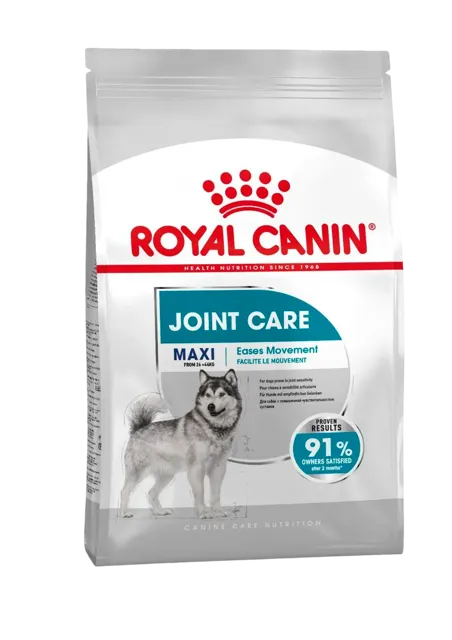
Royal Canin Maxi Joint Care Adult is written for the biggest dogs in the house and for the part of them that tends to give out first. Hydrolysed collagen is declared at 0.84%, chondroitin comes in on hydrolysed cartilage, and green tea extract is dosed at 2.5 g per kilo as a source of polyphenols. Around those sits a maize-led recipe with dehydrated poultry protein second, crude fibre lifted to 6.3% to keep a large appetite occupied, and energy held at 352 kcal per 100g. Our reading puts it in the Average band, following the label's vagueness rather than its intent.
Our view
Likely to suit
You tend to notice it on the stairs first with a giant breed, and the bowl is a sensible place to start helping.
- Large and giant breed adults whose joints are showing their mileage, with hydrolysed collagen declared at 0.84% and chondroitin from hydrolysed cartilage
- Seniors as much as adults, since the bag is written for both stages
- Owners of a big dog who needs to stay lean, with crude fibre at 6.3% and fat held to 15.0%
- Households that like an antioxidant with a printed dose, here green tea extract at 2.5 g per kilo
- Heavy dogs who eat quickly, as a fibre level this high gives a bowl more staying power
Worth watching
A handful of label facts sit behind the joint headline and are worth reading first.
- Glucosamine does not appear on the ingredients list, so the joint support here rests on collagen and chondroitin instead
- Maize leads the recipe with wheat, maize flour and maize gluten behind it, so cereal carries most of the bulk
- The pack leaves moisture out, so the dry matter figures here work off the usual 8% for a kibble
- The poultry protein gets no bird against it, and the animal fats do not name their animal either
- Fish oil is among the ingredients, and that rules out a fish-free diet
Written by our editorial team. Independent guidance, not veterinary advice.
How this scores
How we scoreThe Details
Dog fit
You tend to notice it on the stairs first with a giant breed, and the bowl is a sensible place to start helping. A handful of label facts sit behind the joint headline and are worth reading first.
Dry
Adult, Senior
Giant
Poultry
The score, in context
This finishes in our Average band, one rung under the Good band that holds the typical adult dry food. Most of that distance is about naming. Maize is the first thing in the bag. Poultry names a family of birds, never a single one of them, and the fats and hydrolysed proteins arrive with no species either. The analysis itself is decent for a food of this kind, with protein at 28.3% of dry matter, fat at 16.3% and estimated carbohydrate at 41.8%, under the 46.2% typical of adult dry food. Crude fibre is unusually high at 6.8% of dry matter. Read as a joint food for a giant breed who eats it happily, it does what it set out to do.
What's in it
Ingredients, as declared: maize, dehydrated poultry protein, wheat, animal fats, vegetable fibres, vegetable protein isolate*, maize flour, rice, hydrolysed animal proteins, maize gluten, beet pulp, fish oil, yeasts and parts thereof, minerals, soya oil, hydrolysed collagen (0.84%), marigold extract (source of lutein), hydrolysed cartilage (source of chondroitin).
Named ingredients
Nutritional additives
Additives (per kg): Nutritional additives: Vitamin A: 16500 IU, Vitamin D3: 1000 IU, E1 (Iron): 42 mg, E2 (Iodine): 4.2 mg, E4 (Copper): 13 mg, E5 (Manganese): 55 mg, E6 (Zinc): 141 mg, E8 (Selenium): 0.08 mg - Technological additives: Clinoptilolite of sedimentary origin: 10 g - Sensory additives: green tea extract (source of polyphenols): 2.5 g - Preservatives - Antioxidants.
Ingredient notes
Maize takes the first position, with dehydrated poultry protein behind it and then wheat, maize flour and rice further down. That makes this a cereal-led recipe, which is the honest description of the first few lines. In second place, dehydrated poultry protein is still doing real work, because the water came out of it before it went into the mix. The plant side is still the larger half of this bowl.
The joint story is the reason the bag exists and it is worth reading precisely. Hydrolysed collagen is declared at 0.84%, and collagen supplies the amino acids that cartilage and connective tissue are actually built from. Hydrolysed cartilage brings chondroitin, which is the more familiar joint ingredient of the two. Glucosamine, the third name most owners look for, is not on this list at all, so the support here is a pair rather than the usual set. Neither of the two carries a printed dose.
Fibre is the quiet feature. Vegetable fibres appear high on the list with beet pulp below them, taking crude fibre to 6.3% as fed and 6.8% of dry matter, which is well above what a general adult food would carry. On a dog large enough to eat a great deal in one sitting, that extra bulk is doing a job worth having, and beet pulp in particular is a reliable friend to stool quality.
Green tea extract is dosed at 2.5 g per kilo, which is a real quantity, and it is there for its polyphenols. Lutein comes from marigold extract, the omega 3s from fish oil, and the smaller entries finish with yeasts and parts thereof. Halfway down come vegetable protein isolate and maize gluten. Both use plant protein to raise the declared figure, and a dog handles that less well than meat.
Each added mineral carries its own figure. Zinc is at 141 mg, manganese at 55 mg and iron at 42 mg, with copper at 13 mg, iodine at 4.2 mg and selenium at 0.08 mg per kilo. Vitamin A at 16500 IU and vitamin D3 at 1000 IU sit over them. Clinoptilolite comes in at 10 g per kilo, a sedimentary clay that does its work during manufacture. Moisture is the one number the pack leaves out. Everything in the dry matter column here is therefore built on an assumed 8%.
Price and value
£6.03 a kilo, sold in a 10kg bag.
As a guide, a 15kg adult dog in moderate condition would take about 239 grams a day, working out at £1.44, on roughly 840 kcal a day (110 × bodyweight^0.75, the standard maintenance estimate). The dogs on this label are far bigger, and its own table asks 360 grams for a 26kg dog and 534 grams at 44kg.
Nutritional analysis
Declared analysis
26%
15%
6.3%
6.3%
Dry weight
28.3%
16.3%
6.8%
6.8%
41.8%
As-fed composition
Estimated breakdown of the finished product by ingredient category, from the declared ingredient list and ingoing weights. These are estimates, not measurements.
26.1%
60.6%
6.8%
5.5%
1.1%
Pricing & size
- Pack size
- 10 kg
- Retailer pricing
- Coming soon
Live retailer pricing is not yet available for this food. Prices, cost per day and where to buy will appear here once retailer data is live.
Ingredients and nutrition are taken from manufacturer data. Retailer pricing is not yet live for this food.
Related dog food guides
Ranked shortlists that include foods like this one.