

Royal Canin
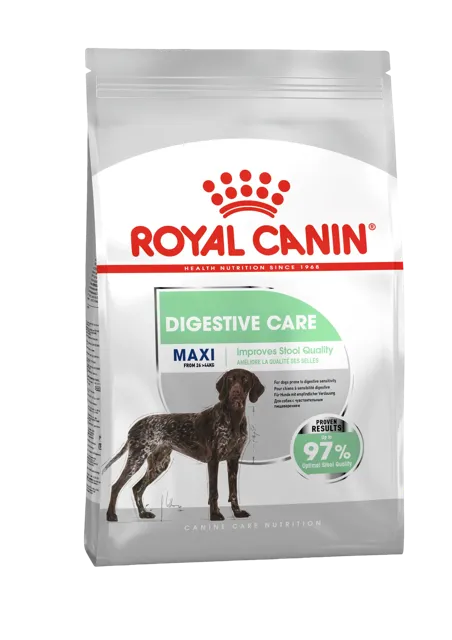
Royal Canin Maxi Digestive Care review
Royal Canin Maxi Digestive Care is a large-breed kibble written for dogs whose stomach is the weak link in an otherwise sturdy animal. Dehydrated poultry protein leads with rice second. The fibre work is spread over beet pulp and vegetable fibres, with psyllium husks and seeds behind them. Hydrolysed animal proteins are there partly because hydrolysis makes protein easier to handle. Fat runs generously at 18.0% for 377 kcal per 100g, and glucosamine and chondroitin come along for the joints. It comes out in our Average band, because so much of the recipe arrives without a species attached.
Our view
Likely to suit
If your big dog's digestion is the thing you quietly plan the day around, this recipe puts most of its design effort exactly there.
- Large adult dogs with unsettled digestion, where rice, beet pulp and psyllium husks do the steadying
- Owners feeding an older large dog, since the bag covers adult and senior alike
- Dogs who do better on a smaller, denser bowl, with fat declared at 18.0% and 377 kcal per 100g
- Big dogs beginning to feel their joints, with glucosamine and chondroitin both listed
- Households wanting the skin extras included as well, with fish oil, borage oil and marigold extract on the label
Worth watching
A few details sit behind the digestive headline and are worth reading before you commit.
- Poultry is a family, not a species, so from one batch to the next the bird might be chicken, turkey, duck or goose
- Glucosamine is drawn from hydrolysed crustaceans, which matters in a household that keeps shellfish away
- Wheat flour, wheat, barley and maize gluten all appear, so cereal takes a fair share of the load
- The recipe carries fish oil, so it is not fish free
- A rich food suits a dog who is genuinely burning it, so portions want watching on one that mostly supervises the garden
Written by our editorial team. Independent guidance, not veterinary advice.
How this scores
How we scoreThe Details
Dog fit
If your big dog's digestion is the thing you quietly plan the day around, this recipe puts most of its design effort exactly there. A few details sit behind the digestive headline and are worth reading before you commit.
Dry
Adult, Senior
Poultry
The score, in context
Our scoring puts this one in the Average band while the ordinary adult dry food reads Good, and nearly all of the distance between them comes off the ingredients list. The analysis is where the food is at its best. Protein converts to 30.8% of dry matter, fat to 19.8% and estimated carbohydrate to 39.6%, comfortably under the 46.2% typical of adult dry food. That shape is genuinely good for a dry recipe. Set against that, the meat is named by family rather than by animal, the fats and the hydrolysed proteins are unnamed, and maize gluten helps top up the protein figure. A settled dog eating this happily is not being let down by any of it. The label simply tells a careful reader less than they would like to know.
What's in it
Ingredients, as declared: dehydrated poultry protein, rice, wheat flour, animal fats, vegetable protein isolate*, wheat, hydrolysed animal proteins, barley, maize gluten, vegetable fibres, beet pulp, fish oil, soya oil, minerals, psyllium husks and seeds, borage oil, marigold extract (source of lutein), hydrolysed crustaceans (source of glucosamine), hydrolysed cartilage (source of chondroitin).
Named ingredients
Nutritional additives
Additives (per kg): Nutritional additives: Vitamin A: 19000 IU, Vitamin D3: 800 IU, E1 (Iron): 38 mg, E2 (Iodine): 3.8 mg, E4 (Copper): 12 mg, E5 (Manganese): 50 mg, E6 (Zinc): 133 mg, E8 (Selenium): 0.06 mg - Technological additives: Clinoptilolite of sedimentary origin: 10 g - Preservatives - Antioxidants.
Ingredient notes
Dehydrated poultry protein leads and rice follows, which is a sensible opening pair for a food about digestion. Rice is the cereal that gives most dogs the least trouble. Putting the dried meat first means most of the protein declared on the pack is already in the kibble, not waiting for the water to be cooked out. The word poultry is doing the usual work of covering several birds at once, so the species can move between production runs without the pack changing.
The digestive machinery is the reason to buy this bag and it is spread through the list rather than bolted on. Vegetable fibres and beet pulp handle bulk and stool quality, and psyllium husks and seeds add a soluble fibre that holds water in the gut. Hydrolysed animal proteins arrive in pieces small enough to be absorbed with very little work. Crude fibre finishes at 2.9%, which is moderate, so the emphasis here is on the type of fibre and not the quantity of it.
Wheat flour, wheat, barley and maize gluten fill out the plant side. Barley is the most useful of them. It cooks down easily and carries fibre and trace minerals with it. Maize gluten is the one to note. Its job is to push up the protein number with plant protein, and a dog makes less of that than of the animal sort. Vegetable protein isolate does something similar higher up the list.
Fat is where this recipe is generous, at 18.0% as fed and 19.8% of dry matter, which is what carries the energy to 377 kcal per 100g. Fish oil and soya oil sit inside that total, with borage oil below them as a source of gamma-linolenic acid and marigold extract as a source of lutein. It is a well-rounded set of oils for a food that is not sold on skin at all.
The joint entries are the same pair the maker uses across its large-breed shelf: hydrolysed crustaceans for glucosamine and hydrolysed cartilage for chondroitin. Neither carries a printed dose, so think of them as general support. If shellfish is kept out of your kitchen, note the crustacean origin.
The added nutrition is fully dosed and easy to read. Zinc comes in at 133 mg, manganese at 50 mg and iron at 38 mg, with copper at 12 mg, iodine at 3.8 mg and selenium at 0.06 mg per kilo. Vitamin A at 19000 IU and vitamin D3 at 800 IU sit above them. Clinoptilolite at 10 g per kilo is a mineral clay used in manufacture. The preservatives and antioxidants are declared as categories with no names, which is common practice throughout this part of the market.
Price and value
£5.25 a kilo, sold in a 12kg bag.
As a guide, feeding a 15kg adult dog in moderate condition works out at roughly 223 grams a day and £1.17, on about 840 kcal a day (110 × bodyweight^0.75, the standard maintenance estimate). The dogs this bag is written for are heavier by a good margin, so scale the amount up and let the waistline settle where it finally lands.
Nutritional analysis
Declared analysis
Estimated using Modified Atwater factors*
28%
18%
2.9%
6%
9%
Dry weight
30.8%
19.8%
3.2%
6.6%
39.6%
As-fed composition
Estimated breakdown of the finished product by ingredient category, from the declared ingredient list and ingoing weights. These are estimates, not measurements.
40.9%
48.8%
4.5%
5.5%
0.2%
Pricing & size
- Pack size
- 12 kg
- Retailer pricing
- Coming soon
Live retailer pricing is not yet available for this food. Prices, cost per day and where to buy will appear here once retailer data is live.
Ingredients and nutrition are taken from manufacturer data. Retailer pricing is not yet live for this food.
Related dog food guides
Ranked shortlists that include foods like this one.