


Skip to content
Off the Leash
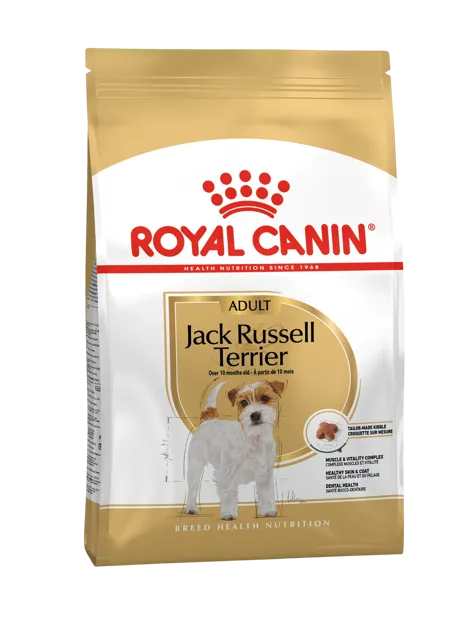
Royal Canin Jack Russell Adult – —

Royal Canin

Royal Canin Jack Russell Adult review

44.5/100Average
DryAdultSenior

Royal Canin Jack Russell Adult is a small breed kibble that opens with dehydrated poultry proteins and declares protein at 30.0%. The detail setting it apart is pentasodium triphosphate at 0.35%, a mineral salt included to slow tartar forming on the teeth, which is a thoughtful thing to find on a food written for a terrier. It sits in our Average band, held there by the two plant glutens behind the headline protein and by a label that never names a bird.

Where to buy: coming soon
Live retailer pricing is coming soon. Once we have prices from UK retailers, the best price, cost per day and where to buy will appear here.

Our view

Likely to suit

Terriers keep their teeth busy their whole lives, and this recipe has something specific to say about that.

  • Adult and senior Jack Russells and other small terriers, the size the portions are written for
  • Owners who think about tartar, with pentasodium triphosphate declared at 0.35% in the mineral entry
  • Small dogs with an appetite for protein, declared at 30.0% and converting to 32.6% of dry matter
  • Households that keep shellfish away from the dog, since the glucosamine here is produced by fermentation

Worth watching

Read these few label facts before the bag joins the regular shopping.

  • Cereal supplies part of the declared protein here, with wheat, wheat gluten and maize gluten all on the list
  • An elimination trial has nothing to work from, since no species is named against the poultry proteins, the animal fats or the hydrolysed proteins
  • Fish oil is among the ingredients, a line to spot if you avoid fish for your dog
  • For a dog who does better with more bulk in the bowl, crude fibre is low here at 1.3%

Written by our editorial team. Independent guidance, not veterinary advice.

How this scores

How we score
44.5/100Average
Protein and processingAverage
Nutritional balanceGood
TransparencyPoor
ValueAverage

The Details

Dog fit

Terriers keep their teeth busy their whole lives, and this recipe has something specific to say about that. Read these few label facts before the bag joins the regular shopping.

Food type

Dry

Life stage

Adult, Senior

Breed size

Small

Main protein

Poultry

The score, in context

Our scoring settles this in the Average band, below the Good band where the typical adult dry food sits. On paper the analysis is decent: protein converts to 32.6% of dry matter, fat to 17.4% and estimated carbohydrate to 42.0%, under the 46.2% typical. The band reflects where that protein comes from and how little the label commits to. Wheat gluten and maize gluten both contribute protein, no animal entry names a species, and transparency reads Poor with protein and processing at Average, though nutritional balance comes back Good.

Moisture is another figure the label leaves out. The dry matter maths rests on the usual 8% for a kibble. The front of the bag promises an everyday small breed food with a dental idea built in, and that is what you get.

What's in it

Ingredients, as declared: Dehydrated poultry proteins, rice, maize, wheat, wheat gluten*, animal fats, hydrolysed animal proteins, beet pulp, maize gluten, minerals (including pentasodium triphosphate (0.35%)), fish oil, soya oil, yeasts products, fructo-oligosaccharides, yeasts (source of manno-oligosaccharides), borage oil (0.1%), marigold meal, glucosamine from fermentation, hydrolysed cartilage (source of chondroitin). *L.I.P.: protein selected for its very high digestibility.

Named ingredients

Dehydrated poultry proteins, rice, maize, wheat, wheat gluten*, animal fats, hydrolysed animal proteins, beet pulp, maize gluten, minerals (including pentasodium triphosphate (0.35%)), fish oil, soya oil, yeasts products, fructo-oligosaccharides, yeasts (source of manno-oligosaccharides), borage oil (0.1%), marigold meal, glucosamine from fermentation, hydrolysed cartilage (source of chondroitin). *L.I.P.: protein selected for its very high digestibility.

Nutritional additives

Additives (per kg): Nutritional additives: Vitamin A: 29550 IU, Vitamin D3: 800 IU, Iron (3b103): 40 mg, Iodine (3b201, 3b202): 4 mg, Copper (3b405, 3b406): 12 mg, Manganese (3b502, 3b504): 52 mg, Zinc (3b603, 3b605, 3b606): 137 mg, Selenium (3b801, 3b811, 3b812): 0.08 mg - Technological additives: Clinoptilolite of sedimentary origin: 10 g - Preservatives - Antioxidants.

Ingredient notes

Dehydrated poultry proteins lead, and protein is declared at 30.0%, converting to 32.6% of dry matter. That is a strong figure for a small breed kibble, though not all of it is coming from the bird.

Rice, maize and wheat follow in the top four, with wheat gluten fifth and maize gluten a little further down. Both glutens are concentrated cereal proteins used to lift an analysis. A dog makes more of protein from an animal than of protein from a grain, so read the headline as a combined figure.

Pentasodium triphosphate, declared at 0.35% within the minerals, is the entry that makes this recipe specific. It is a mineral salt included to slow the build-up of tartar as the dog chews. Dental trouble is common enough in the small breeds for that to be a genuinely useful inclusion rather than a marketing line.

Joint support comes from glucosamine made by fermentation, so no shellfish is involved anywhere, with chondroitin from hydrolysed cartilage alongside it. Gamma-linolenic acid comes from borage oil at 0.1%, marigold meal adds a plant antioxidant, and the marine omega 3s arrive with the fish oil.

The gut side is handled by fructo-oligo-saccharides and beet pulp, with yeasts supplying manno-oligosaccharides, though crude fibre still finishes low at 1.3%. Doses are printed against the trace minerals too, zinc at 137 mg, copper at 12 mg and selenium at 0.08 mg per kilo.

The recurring limitation on this style of label is that nothing animal is named. Chicken, turkey or duck could all be the poultry here. The fats and hydrolysed proteins could come from anything at all. Most terriers will never give it a thought. It only becomes a live issue when you need a label that can help you pin down what your dog reacts to.

Price and value

£6.98 a kilo, sold in 1.5kg, 3kg and 7.5kg bags.

The standard comparison takes a 15kg adult in moderate condition needing about 840 kcal a day (110 × bodyweight^0.75), which comes to roughly 212 grams and £1.48 a day. A Jack Russell is a fraction of that dog, and the label asks 92 grams a day for a 6kg terrier at low activity. The smallest bag goes a good deal further than the figures above suggest.

Nutritional analysis

Declared analysis

Energy
395.3 kcal/100g
Protein

30%

Fat

16%

Fibre

1.3%

Ash

6.1%

Dry weight

Protein

32.6%

Fat

17.4%

Fibre

1.4%

Ash

6.6%

Carbs

42%

As-fed composition

Estimated breakdown of the finished product by ingredient category, from the declared ingredient list and ingoing weights. These are estimates, not measurements.

Meat

38.7%

Carbs

57.8%

Oils

2.8%

Other

0.8%

Pricing & size
Pack size
1.5 kg, 3 kg, 7.5 kg
Retailer pricing
Coming soon

Live retailer pricing is not yet available for this food. Prices, cost per day and where to buy will appear here once retailer data is live.

Ingredients and nutrition are taken from manufacturer data. Retailer pricing is not yet live for this food.

Related dog food guides

Ranked shortlists that include foods like this one.
All reviews

Featured feeding accessories

All feeding accessories

Brackenwood

Slow Feeder Maze Bowl

Slows fast eaters and eases gulping at mealtimes.

From £12.99· 4 retailers
View

Tarn & Co

Raised Double Diner

Height-set stand for easier, tidier eating.

From £28.99· 3 retailers
View

Reviewed by Off the Leash Editorial

Last updated 28 August 2026