


Skip to content
Off the Leash
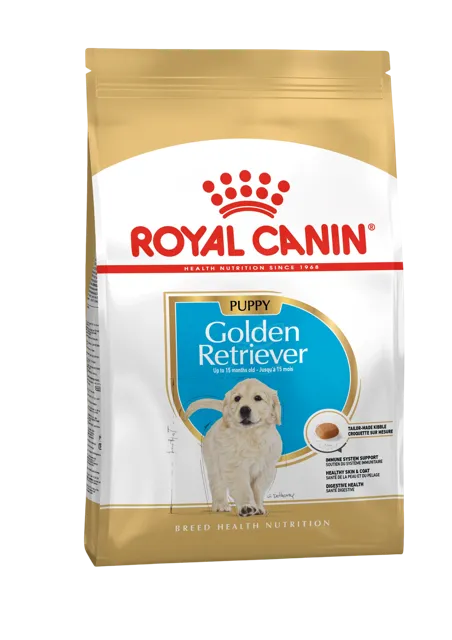
Royal Canin Golden Retriever Puppy – —

Royal Canin

Royal Canin Golden Retriever Puppy review

44.2/100Average
DryPuppy

Royal Canin Golden Retriever Puppy is a breed-targeted growth kibble, with dehydrated poultry protein at the front and rice, maize and wheat behind it. Fibre is unusually generous for a puppy food at 4.1% of dry matter, borage oil and a marigold extract source of lutein sit at the tail, and the glucosamine comes from hydrolysed crustaceans. The label prints no calcium figure, and the recipe falls in our Average band.

Where to buy: coming soon
Live retailer pricing is coming soon. Once we have prices from UK retailers, the best price, cost per day and where to buy will appear here.

Our view

Likely to suit

If a food written for one breed appeals to you, this is that idea in a bag.

  • Owners drawn to a recipe aimed at a single breed, not at large puppies in general
  • Pups whose coats their owners fuss over, with borage oil at 0.1% supplying gamma-linolenic acid alongside fish oil
  • Households wanting joint ingredients from the start, with glucosamine from hydrolysed crustaceans and chondroitin from hydrolysed cartilage on the list
  • Puppies who do better with more fibre in the bowl, declared at 3.7% as fed and converting to 4.1% of dry matter
  • Owners looking for a gentler energy density, at an estimated 360 kcal per 100g where the typical puppy dry food runs at 376

Worth watching

Read these entries closely before your pup goes onto this bag.

  • For a breed that finishes large, calcium is the figure you most want, and no percentage is printed, so put it to the maker
  • Vegetable protein isolate and hydrolysed animal proteins both leave their source open, which makes this a difficult recipe for an exclusion diet
  • A grain-avoiding household will want to know up front that wheat sits high on this list
  • The glucosamine here is drawn from hydrolysed crustaceans, worth a note in a home managing a shellfish sensitivity
  • A pup sensitive to either soya or fish needs flagging here, since the list carries soya oil and fish oil

Written by our editorial team. Independent guidance, not veterinary advice.

How this scores

How we score
44.2/100Average
Protein and processingAverage
Nutritional balanceGood
TransparencyPoor
ValueAverage

The Details

Dog fit

If a food written for one breed appeals to you, this is that idea in a bag. Read these entries closely before your pup goes onto this bag.

Food type

Dry

Life stage

Puppy

Main protein

Poultry

The score, in context

We put this one in the Average band, a rung under the Good band a typical puppy dry food occupies. The distance comes from construction rather than from anything alarming: the meat is named by category, a vegetable protein isolate carries part of the protein load, and wheat sits high on the list. Nutritional balance reads Good, protein and processing reads Average and transparency reads Poor.

Breed-specific recipes are a real idea, and plenty of owners have raised contented retrievers on this bag. Our reading grades the label in front of us, which on protein at 31.9% of dry matter and carbohydrate at 38.3% is unremarkable rather than troubling.

What's in it

Ingredients, as declared: dehydrated poultry protein, rice, maize, vegetable protein isolate*, wheat, animal fats, vegetable fibres, hydrolysed animal proteins, beet pulp, fish oil, minerals, soya oil, fructo-oligo-saccharides (0.34%), psyllium husks and seeds, hydrolysed yeast (source of manno-oligo-saccharides), hydrolysed crustaceans (source of glucosamine), borage oil (0.1%), yeasts extracts (source of betaglucans), marigold extract (source of lutein), hydrolysed cartilage (source of chondroitin).

Named ingredients

Dehydrated poultry protein, rice, maize, vegetable protein isolate*, wheat, animal fats, vegetable fibres, hydrolysed animal proteins, beet pulp, fish oil, minerals, soya oil, fructo-oligo-saccharides (0.34%), psyllium husks and seeds, hydrolysed yeast (source of manno-oligo-saccharides), hydrolysed crustaceans (source of glucosamine), borage oil (0.1%), yeasts extracts (source of betaglucans), marigold extract (source of lutein), hydrolysed cartilage (source of chondroitin).

Nutritional additives

ADDITIVES (per kg): Nutritional additives: Vitamin A: 26500 IU, Vitamin D3: 700 IU, Vitamin E: 780 mg - E1 (Iron): 38 mg, E2 (Iodine): 3.8 mg, E4 (Copper): 12 mg, E5 (Manganese): 49 mg, E6 (Zinc): 130 mg, E8 (Selenium): 0.08 mg - Technological additives: Clinoptilolite of sedimentary origin: 10 g - Sensory additives: Yucca extract: 125 mg - Preservatives - Antioxidants.

Ingredient notes

Dehydrated poultry protein at the front is dried meat, so what it contributes to the finished kibble is close to its declared share. Poultry as a term covers any farmed bird. Looser still are the hydrolysed animal proteins further down. Investigating a suspected food sensitivity on this list is awkward work.

Rice and maize carry the base with wheat behind them, and vegetable protein isolate sits fourth. That last one is concentrated plant protein with no plant named. Keep it in mind when you look at protein converting to 31.9% of dry matter, because a share of that figure comes from the vegetable side and not from the bird.

Fibre is the number that stands out. Declared at 3.7% and converting to 4.1% of dry matter, it runs higher than most growth kibbles, carried by vegetable fibres, beet pulp and psyllium husks. Retriever pups are famously enthusiastic at the bowl, and a meal that feels fuller is a sensible answer to that.

Some thought has gone into the closing entries. Borage oil at 0.1% is among the better sources of gamma-linolenic acid and turns up in coat-focused recipes for good reason, marigold extract brings lutein, and yeast extracts supply betaglucans. Glucosamine arrives from hydrolysed crustaceans and chondroitin from hydrolysed cartilage, neither with a dose printed beside it.

Fish oil sits mid-list as the omega 3 source, and fructo-oligo-saccharides at 0.34% pair with a hydrolysed yeast source of manno-oligo-saccharides on the digestive side. Calcium gets no number anywhere on this label. A large breed puppy owner looks for that figure first, and without it no claim about bone growth stands.

The analysis is otherwise fully declared, protein at 29.0%, fat at 16.0%, fibre at 3.7%, ash at 7.4% and moisture at 9.0%, so the dry matter column rests on printed numbers. Energy is the exception, since the label carries none and the 360 kcal per 100g figure is our estimate. The added panel is dosed generously, with vitamin A at 26500 IU, vitamin E at 780 mg and zinc at 130 mg per kg.

Price and value

£5.67 a kilo, sold in 3kg and 12kg bags.

The portion that suits a pup at the start of growth is not the one that suits them later, so no steady daily figure holds for a growing retriever. Start from the bag's feeding chart, then let your pup's waistline make the final call.

Nutritional analysis

Declared analysis

Energy
359.7 kcal/100g

Estimated using Modified Atwater factors*

Protein

29%

Fat

16%

Fibre

3.7%

Ash

7.4%

Moisture

9%

Dry weight

Protein

31.9%

Fat

17.6%

Fibre

4.1%

Ash

8.1%

Carbs

38.3%

As-fed composition

Estimated breakdown of the finished product by ingredient category, from the declared ingredient list and ingoing weights. These are estimates, not measurements.

Meat

39.7%

Carbs

48.6%

Veg

8%

Oils

2.9%

Other

0.9%

Pricing & size
Pack size
3 kg, 12 kg
Retailer pricing
Coming soon

Live retailer pricing is not yet available for this food. Prices, cost per day and where to buy will appear here once retailer data is live.

Ingredients and nutrition are taken from manufacturer data. Retailer pricing is not yet live for this food.

Related dog food guides

Ranked shortlists that include foods like this one.
All reviews

Featured feeding accessories

All feeding accessories

Brackenwood

Slow Feeder Maze Bowl

Slows fast eaters and eases gulping at mealtimes.

From £12.99· 4 retailers
View

Tarn & Co

Raised Double Diner

Height-set stand for easier, tidier eating.

From £28.99· 3 retailers
View

Reviewed by Off the Leash Editorial

Last updated 28 August 2026