
Skip to content
Off the Leash
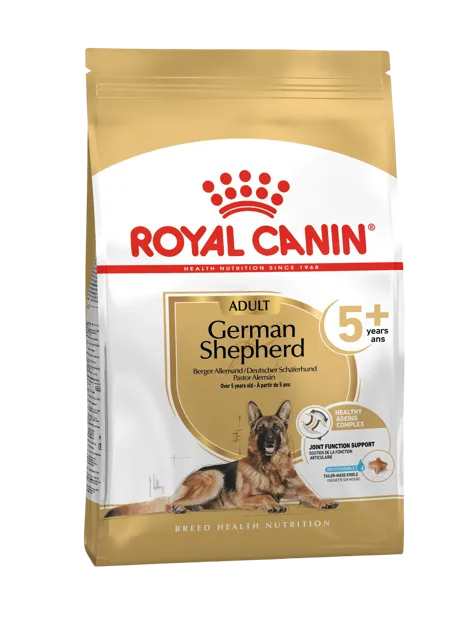
Royal Canin German Shepherd 5+ – —

Royal Canin

Royal Canin German Shepherd 5+ review

34.8/100Average
DryAdultSenior

Royal Canin German Shepherd 5+ is a maintenance kibble for the older shepherd, built on rice and maize flour with dehydrated poultry proteins sitting behind them. The senior thinking turns up in the smaller entries, where hydrolysed collagen is declared at 0.9%, chondroitin comes from cartilage and dried tomato pulp is there for its lycopene. It sits in our Average band, and the reason is transparency more than anything a dog would notice at dinner, since the grains lead the list and not one animal entry names a species.

Where to buy: coming soon
Live retailer pricing is coming soon. Once we have prices from UK retailers, the best price, cost per day and where to buy will appear here.

Our view

Likely to suit

For a shepherd in their later years who has always got on with a straightforward bag of kibble, this keeps the routine going.

  • Older shepherds and other big dogs past the middle of their lives, the audience the recipe is drawn up for
  • Owners who like a joint entry they can point at, with hydrolysed collagen declared at 0.9% and chondroitin from cartilage
  • Ageing dogs who do better with more fibre in the day, declared at 3.6% and drawn from beet pulp, cellulose and vegetable fibres
  • Two dogs at different stages in one house, since the label covers adults and older dogs alike

Worth watching

Before you commit to a sack this size, a few entries deserve a plain explanation.

  • The digestibility note on this label is attached to wheat gluten rather than to the meat, which matters if wheat is the ingredient you keep an eye on
  • Every animal entry is generic, from the poultry proteins to the animal fats, so the bag cannot carry an elimination trial
  • Fish oil is in the mix, so this is not a fish-free food
  • Cellulose powder is here as a bulking fibre rather than as a nutrient, worth knowing if you prefer fibre that arrives with something else attached

Written by our editorial team. Independent guidance, not veterinary advice.

How this scores

How we score
34.8/100Average
Protein and processingPoor
Nutritional balanceGood
TransparencyPoor
ValueAverage

The Details

Dog fit

For a shepherd in their later years who has always got on with a straightforward bag of kibble, this keeps the routine going. Before you commit to a sack this size, a few entries deserve a plain explanation.

Food type

Dry

Life stage

Adult, Senior

Main protein

Poultry

The score, in context

Our scoring leaves this one in the Average band, a step below the Good band that the middle of the adult dry shelf reaches. Three of the first four places go to rice, maize flour and wheat gluten before any meat appears, and the animal entries name nothing in particular. Transparency reads Poor alongside protein and processing, with nutritional balance landing in our Good band.

Read the analysis on its own and it is unremarkable, not poor. Protein converts to 27.2% of dry matter, fat to 20.7% and estimated carbohydrate to 41.8%, under the 46.2% typical of adult dry food. The pack leaves moisture out, so those dry matter figures rest on the usual 8% assumed for a kibble. The band is a comment on how little this label commits to, not a warning about the dinner in front of your dog.

What's in it

Ingredients, as declared: Rice, maize flour, wheat gluten*, dehydrated poultry proteins, animal fats, hydrolysed animal proteins, cellulose powder, vegetable fibres, beet pulp, minerals, soya oil, fish oil, copra oil, yeasts products, dried tomato pulp (source of lycopene), hydrolysed collagen (0.9%), yeasts (source of manno-oligosaccharides), marigold meal, hydrolysed cartilage (source of chondroitin). * L.I.P.: protein selected for its very high digestibility.

Named ingredients

Rice, maize flour, wheat gluten*, dehydrated poultry proteins, animal fats, hydrolysed animal proteins, cellulose powder, vegetable fibres, beet pulp, minerals, soya oil, fish oil, copra oil, yeasts products, dried tomato pulp (source of lycopene), hydrolysed collagen (0.9%), yeasts (source of manno-oligosaccharides), marigold meal, hydrolysed cartilage (source of chondroitin). * L.I.P.: protein selected for its very high digestibility.

Nutritional additives

Additives (per kg): Nutritional additives: Vitamin A: 29126 IU, Vitamin D3: 780 IU, Iron (3b103): 72 mg, Iodine (3b201, 3b202): 5.9 mg, Copper (3b405, 3b406): 14 mg, Manganese (3b502, 3b504): 72 mg, Zinc (3b603, 3b605, 3b606): 144 mg, Selenium (3b801, 3b811, 3b812): 0.18 mg - Technological additives: Clinoptilolite of sedimentary origin: 10 g - Preservatives - Antioxidants.

Ingredient notes

Rice and maize flour open proceedings, and the third entry is wheat gluten, which is where the label chooses to put its digestibility badge. That is worth pausing over: the asterisk marking a protein picked for how well a dog absorbs it sits against a cereal protein, not against the bird.

Dehydrated poultry proteins arrive fourth. Dehydrated is the helpful word here: the water is gone before the weighing. Poultry is the unhelpful one. Chicken, turkey, duck or goose: any of them can be behind it, and a recipe written that way can move between them without the label changing a letter. Animal fats and hydrolysed animal proteins are no more specific.

The senior touches are real, not decorative. Hydrolysed collagen is declared at 0.9%, chondroitin arrives from hydrolysed cartilage, dried tomato pulp is included as a lycopene source and yeasts supply manno-oligosaccharides for the gut. Copra oil, pressed from coconut, sits alongside the animal fats, while fish oil supplies the marine omega 3s.

Fibre is doing more work here than on an ordinary adult kibble, declared at 3.6% and drawn from cellulose powder, vegetable fibres and beet pulp. Cellulose is the one to understand. It adds bulk and very little else, a purified plant fibre that keeps a less active older dog comfortable without being a nutrient in its own right.

The label does not print an energy figure, so the 384 kcal per 100g here is calculated and best taken as a guide. The mineral panel is dosed in print, with zinc at 144 mg, iron at 72 mg and selenium at 0.18 mg per kilo. Clinoptilolite at 10 g per kilo is a mineral clay, working as a processing aid and not as nutrition.

Price and value

£5.73 a kilo, in a single 12kg bag.

The standard comparison, a 15kg adult in moderate condition needing about 840 kcal a day (110 × bodyweight^0.75), comes out at roughly 219 grams and £1.25 a day. This food is aimed at a far bigger animal than that: the label asks 312 grams a day for a 30kg shepherd at low activity, so work the bag out against your own dog's weight.

Nutritional analysis

Declared analysis

Energy
383.8 kcal/100g

Estimated using Modified Atwater factors*

Protein

25%

Fat

19%

Fibre

3.6%

Ash

5.9%

Dry weight

Protein

27.2%

Fat

20.7%

Fibre

3.9%

Ash

6.4%

Carbs

41.8%

As-fed composition

Estimated breakdown of the finished product by ingredient category, from the declared ingredient list and ingoing weights. These are estimates, not measurements.

Meat

14.4%

Carbs

77.8%

Veg

1.1%

Oils

3.8%

Other

2.8%

Pricing & size
Pack size
12 kg
Retailer pricing
Coming soon

Live retailer pricing is not yet available for this food. Prices, cost per day and where to buy will appear here once retailer data is live.

Ingredients and nutrition are taken from manufacturer data. Retailer pricing is not yet live for this food.

Related dog food guides

Ranked shortlists that include foods like this one.
All reviews

Featured feeding accessories

All feeding accessories

Brackenwood

Slow Feeder Maze Bowl

Slows fast eaters and eases gulping at mealtimes.

From £12.99· 4 retailers
View

Tarn & Co

Raised Double Diner

Height-set stand for easier, tidier eating.

From £28.99· 3 retailers
View

Reviewed by Off the Leash Editorial

Last updated 28 August 2026