



Royal Canin
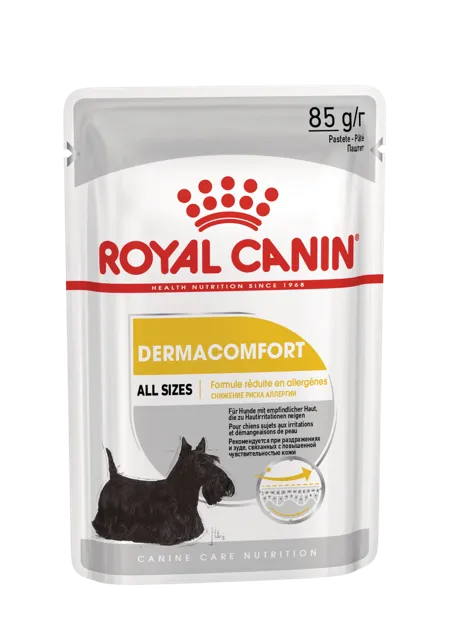
Royal Canin Dermacomfort Care Loaf review
Royal Canin Dermacomfort Care Loaf is pitched at small dogs whose skin and coat need a little attention, served in 85 g portions of smooth loaf. The recipe reads in full as meat and animal derivatives, derivatives of vegetable origin, cereals, minerals, oils and fats, various sugars. The skin support is therefore a promise about the formula, and nothing you can trace on the pack. It sits in our Average band, driven by that silence rather than by the analysis, which reads perfectly normally for a wet food.
Our view
Likely to suit
If your dog's coat is the thing you keep worrying about, this is the recipe the maker points at that particular problem.
- Small adult dogs whose skin and coat need support, the dog this loaf is designed around
- Owners who want the portion measured out for them, at 85 g a serving
- Dogs that need fat in the diet for coat condition, with fat converting to 30.0% of dry matter
- Older dogs, since the maker lists this one for seniors alongside adults
- Dogs that struggle with texture, as a loaf takes no chewing at all
- Households that like a routine, with every serving identical to the last
Worth watching
Before you lean on this for a skin problem, there are a few things the label will not tell you.
- A dog with a suspected food allergy cannot be tested on this, since the recipe names no animal anywhere
- The pack prints no fatty acid figures, so the coat claim rests on the maker's formulation rather than on anything you can read
- The list includes various sugars, one to note if you keep sugars out of your dog's food
- Energy is not declared, so the 99 kcal per 100g in our table is an estimate
- A skin problem that will not settle deserves a vet's eye alongside any change of diet
Written by our editorial team. Independent guidance, not veterinary advice.
How this scores
How we scoreThe Details
Dog fit
If your dog's coat is the thing you keep worrying about, this is the recipe the maker points at that particular problem. Before you lean on this for a skin problem, there are a few things the label will not tell you.
Wet
Adult, Senior
Small
The score, in context
This loaf comes out in our Average band, with protein and processing and transparency each reading Average and nutritional balance Outstanding, and the cause of the placing is visible in six entries of ingredients. A scoring system reads what a label declares, and a label written wholly in category terms declares next to nothing about the recipe behind it. Wet is one of the stronger categories we score, and the typical adult recipe lands in our Excellent band, which puts a good deal of distance between it and this loaf.
That distance is about disclosure, not about safety. It says the recipe is private, and a private recipe cannot be judged on its merits, however well it may be working in your kitchen.
What's in it
Ingredients, as declared: meat and animal derivatives, derivatives of vegetable origin, cereals, minerals, oils and fats, various sugars.
Named ingredients
Nutritional additives
Additives (per kg): Nutritional additives: Vitamin D3: 200 IU, E1 (Iron): 10 mg, E2 (Iodine): 0.3 mg, E4 (Copper): 2.1 mg, E5 (Manganese): 3.1 mg, E6 (Zinc): 30 mg - Technological additives: Clinoptilolite of sedimentary origin: 2.2 g.
Ingredient notes
The recipe is six category terms long. Meat and animal derivatives is the broadest description in the pet food rulebook, covering the fleshy parts and processing products of any warm blooded land animal, and derivatives of vegetable origin is nearly as wide. Neither is a hygiene concern in itself. Both simply keep the formula private and leave the maker free to alter it batch by batch while the pack stays the same.
Ordinary is the right word for the analysis, and it is a compliment. Protein converts to 39.1% of dry matter, fat to 30.0% and the carbohydrate estimate to 16.4%, within touching distance of the 15.8% typical of an adult wet food. Fat is the figure that stands out, and it at least sits sensibly with a recipe sold for coat condition, since dietary fat is where a shiny coat starts.
Minerals are listed ahead of oils and fats here, which is a small clue that the added mineral content outweighs the added oil. It is one of the very few things the ingredient order will tell you on a label written this way.
The added panel is dosed throughout: vitamin D3 at 200 IU, iron at 10mg, copper at 2.1mg, manganese at 3.1mg, zinc at 30mg and iodine at 0.3mg per kilo. Zinc is the largest trace element figure of the set, which is worth noting on a skin and coat recipe, since zinc is one of the minerals that condition depends on. Clinoptilolite at 2.2 g per kilo firms up the loaf.
Plenty of dogs have come through an itchy season on a Royal Canin diet, and the research behind the brand is not a marketing invention. Buy this one for what the maker says it does, knowing that the label asks you to take that on faith and does not show you the working.
Price and value
£13.06 a kilo, in 85 g servings sold in packs of 12.
As a guide, a 15kg adult dog in moderate condition would eat around 850 grams a day at roughly £11.10, assuming about 840 kcal a day (110 × bodyweight^0.75, the standard maintenance estimate). This loaf is portioned for much smaller dogs, so a real daily amount here is a fraction of that figure.
Nutritional analysis
Declared analysis
Estimated using Modified Atwater factors*
8.6%
6.6%
1.3%
1.9%
78%
Dry weight
39.1%
30%
5.9%
8.6%
16.4%
As-fed composition
Estimated breakdown of the finished product by ingredient category, from the declared ingredient list and ingoing weights. These are estimates, not measurements.
39.4%
13%
40.8%
2.6%
4.3%
Pricing & size
- Pack size
- 12x85 g
- Retailer pricing
- Coming soon
Live retailer pricing is not yet available for this food. Prices, cost per day and where to buy will appear here once retailer data is live.
Ingredients and nutrition are taken from manufacturer data. Retailer pricing is not yet live for this food.
Related dog food guides
Ranked shortlists that include foods like this one.