



Royal Canin
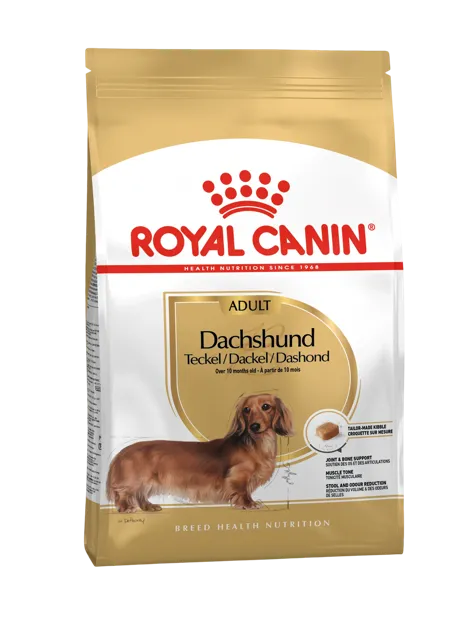
Royal Canin Dachshund Adult review
Royal Canin Dachshund Adult carries a strong protein figure for a small breed kibble, 28.0% as fed and 30.4% of dry matter, with moisture declared at 8.0% so that conversion is measured rather than assumed. Rice is the only cereal, dehydrated poultry protein comes second and a vegetable protein isolate third, and the kibble is made small and easy for a low, long dog to take cleanly. Estimated carbohydrate lands at 44.2% of dry matter. It sits in our Average band, a placing set by unnamed animal entries and not by the numbers.
Our view
Likely to suit
Keeping a dachshund trim is most of the job, and this bag is shaped and portioned with that in mind.
- Owners of adult dachshunds who want a small kibble a low, long dog can take cleanly
- Dogs off maize and wheat, with rice the single grain in the bag
- Owners who want joint ingredients named on the pack, with hydrolysed crustaceans supplying glucosamine and hydrolysed cartilage supplying chondroitin
- Households that portion carefully, as the label's table starts at a 2kg dog and works up to a 10kg one
- Owners who like a protein figure at the upper end, 30.4% of dry matter here
Worth watching
There is a bit of small print here that pays to read before you buy the big bag.
- This is an adult food, so it covers the middle of a dachshund's life and not the growing months
- Poultry names a family here, not a species, which gives an elimination plan nothing firm to start from
- Third on the list is a vegetable protein isolate, which means plants supply some of the protein figure
- Fish oil appears in the recipe, and that matters if your dog stays clear of fish
- The glucosamine comes from hydrolysed crustaceans, so shellfish is present in the food
Written by our editorial team. Independent guidance, not veterinary advice.
How this scores
How we scoreThe Details
Dog fit
Keeping a dachshund trim is most of the job, and this bag is shaped and portioned with that in mind. There is a bit of small print here that pays to read before you buy the big bag.
Dry
Adult
Small
Poultry
The score, in context
Average is the band this one lands in, a step under the Good the typical adult dry food occupies, and the distance has little to do with the analysis. Protein converts to 30.4% of dry matter, fat to 15.2% and estimated carbohydrate to 44.2%, under the 46.2% typical for adult dry food. Read on its own, that panel would not raise an eyebrow.
What pulls the placing down is naming. Dehydrated poultry protein, hydrolysed animal proteins and animal fats each describe a category instead of an animal, and the third entry on the list is a plant protein isolate. That is what takes protein and processing to Poor and holds transparency at Average. Fed to a dachshund in good health, this is a workable everyday food that will keep condition steady. The reservation is about the amount of detail the pack gives you, not about the feeding.
What's in it
Ingredients, as declared: rice, dehydrated poultry protein, vegetable protein isolate*, hydrolysed animal proteins, animal fats, vegetable fibres, beet pulp, fish oil, soya oil, minerals, fructo-oligo-saccharides, borage oil, marigold extract (source of lutein), hydrolysed crustaceans (source of glucosamine), hydrolysed cartilage (source of chondroitin).
Named ingredients
Nutritional additives
Additives (per kg): Nutritional additives: Vitamin A: 31500 IU, Vitamin D3: 800 IU, E1 (Iron): 35 mg, E2 (Iodine): 3.6 mg, E4 (Copper): 11 mg, E5 (Manganese): 46 mg, E6 (Zinc): 139 mg, E8 (Selenium): 0.07 mg - Technological additives: Clinoptilolite of sedimentary origin: 10 g - Sensory additives: tea extract (source of polyphenols): 150 mg - Preservatives - Antioxidants.
Ingredient notes
Rice stands alone as the cereal in this recipe, and a single named grain is a good deal easier to live with than a blend. It is gentle and most dogs tolerate it well. Nothing else joins it, so the list shows no cereal gluten, no wheat and no maize. For an owner who has been through a grain problem before, that alone makes this label simpler to read than most.
Behind it, in second place, is dehydrated poultry protein. Drying happens before the mixing, so its protein is not water waiting to leave in the oven, and the position it holds is roughly the contribution it makes. Poultry is the limiting word: chicken, turkey, duck or goose can all sit behind it, and none of them is settled on. Hydrolysed animal proteins, further down and there mainly to make the food taste of something, keep the same silence about species.
Third place goes to a vegetable protein isolate marked with an asterisk, which the maker explains as protein selected for very high digestibility. The claim is about absorption, and the origin is still plant. It contributes to the 30.4% of dry matter the panel shows. It is also why a strong protein figure does not add up to an especially meaty bowl.
The rest of the list is quietly sensible. Vegetable fibres and beet pulp bring the bulk that keeps stools well formed. Crude fibre lands at 3.2% of dry matter, and fructo-oligo-saccharides feed the gut's good bacteria. Fish oil supplies marine omega 3s, soya oil sits behind it, and borage oil adds gamma-linolenic acid, which is the fatty acid most often chosen where skin comfort is the goal. Lutein comes from marigold extract, and polyphenols from a tea extract declared at 150 mg per kilo.
Every added vitamin and mineral carries a dose. For a reader who likes to check, that is the most useful part of the pack. Zinc is at 139 mg, manganese at 46 mg, iron at 35 mg, copper at 11 mg, iodine at 3.6 mg and selenium at 0.07 mg per kilo. Vitamin A is at 31500 IU and vitamin D3 at 800 IU, with clinoptilolite, a natural mineral clay, at 10 g per kilo as a technological aid. The joint ingredients are less forthcoming. Hydrolysed crustaceans and hydrolysed cartilage finish the list with no quantity attached to either, so take them as support offered without a measured dose.
Price and value
The bags are 1.5kg and 7.5kg, at £6.98 a kilo.
Our standard guide assumes a 15kg adult dog in moderate condition on around 840 kcal a day (110 × bodyweight^0.75, the usual maintenance estimate). That comes to roughly 225 grams a day and £1.57 a day. A dachshund is a much smaller dog than that, so portion from the pack's own table instead. It asks 43 grams a day at 2kg, 85 grams at 5kg and 143 grams at 10kg for a dog at low activity.
Nutritional analysis
Declared analysis
28%
14%
2.9%
6.4%
8%
Dry weight
30.4%
15.2%
3.2%
7%
44.2%
As-fed composition
Estimated breakdown of the finished product by ingredient category, from the declared ingredient list and ingoing weights. These are estimates, not measurements.
37.3%
43.4%
13%
5.4%
0.9%
Pricing & size
- Pack size
- 1.5 kg, 7.5 kg
- Retailer pricing
- Coming soon
Live retailer pricing is not yet available for this food. Prices, cost per day and where to buy will appear here once retailer data is live.
Ingredients and nutrition are taken from manufacturer data. Retailer pricing is not yet live for this food.
Related dog food guides
Ranked shortlists that include foods like this one.