



Royal Canin
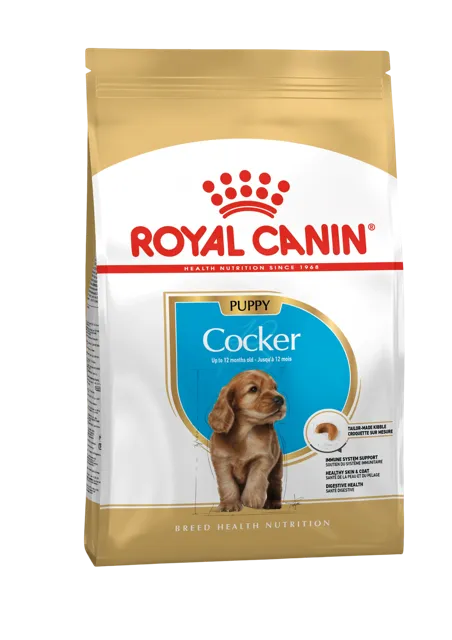
Royal Canin Cocker Puppy review
At 32.0%, Royal Canin Cocker Puppy carries the highest declared protein of the maker's breed puppy recipes. Moisture is printed here and nowhere else in that group, so the dry matter column rests on a declared number. Behind those two points the list leans hard on cereal, with maize, wheat, wheat flour, rice, maize flour and maize gluten spread through it behind a single unnamed meat entry. Psyllium, borage oil and a named joint pair round it off, and the food lands in our Average band.
Our view
Likely to suit
If you have a Cocker pup, you will know they eat with enthusiasm and wear every dietary decision in their coat.
- Cocker Spaniel puppies, the breed the recipe has been written around
- Owners who want protein at the top of the growth range, declared at 32.0% and converting to 35.2% of dry matter
- Pups beginning joint care early, with hydrolysed crustaceans and hydrolysed cartilage named as the sources of glucosamine and chondroitin
- Readers who like moisture declared, since 9.0% on the pack means the dry matter figures here are calculated rather than assumed
- Puppies whose digestion needs steadying, with psyllium husks and seeds joining beet pulp and fructo-oligo-saccharides at 0.34%
- Coat-conscious households, with borage oil at 0.1% and fish oil both on the list
Worth watching
This is the label in the range that asks the most of a reader, so take these slowly.
- Cereal turns up in six forms, from maize and wheat through to maize gluten, and that last one is plant protein lifting the analysis, not meat
- The single meat entry is dehydrated poultry protein, so no bird is named and no percentage is given for it
- Calcium is left off the analysis, which is the one mineral a growth food is usually judged on
- Wheat and wheat flour both feature, worth knowing if your pup has a gut that reacts to it
- The energy figure of 375 kcal per 100g is our estimate, since the pack declares none
Written by our editorial team. Independent guidance, not veterinary advice.
How this scores
How we scoreThe Details
Dog fit
If you have a Cocker pup, you will know they eat with enthusiasm and wear every dietary decision in their coat. This is the label in the range that asks the most of a reader, so take these slowly.
Dry
Puppy
Medium
Poultry
The score, in context
Our band for this food is Average, a step under the Good band the typical puppy dry food holds. Transparency reads Poor and protein and processing Average, while nutritional balance comes back Excellent. The analysis is the better half of the story, with protein at the top of the range and moisture actually printed. Most of the reading is made on the ingredient list, and this one puts cereal in six different forms behind a meat entry that names no bird.
That said, this is a complete food with a properly dosed additive panel and a functional tail Royal Canin has not skimped on. A Cocker pup raised on it will not be short of anything the label is obliged to provide. Our reading rewards recipes that lead with named meat and print the figures behind it, and this is the ground the label chooses not to contest.
What's in it
Ingredients, as declared: dehydrated poultry protein, maize, animal fats, vegetable protein isolate*, beet pulp, wheat, wheat flour, rice, maize gluten, hydrolysed animal proteins, maize flour, fish oil, minerals, soya oil, yeasts and parts thereof, fructo-oligo-saccharides (0.34%), psyllium husks and seeds, hydrolysed yeast (source of manno-oligo-saccharides), yeasts extracts (source of betaglucans), borage oil (0.1%), marigold extract (source of lutein), hydrolysed crustaceans (source of glucosamine), hydrolysed cartilage (source of chondroitin).
Named ingredients
Nutritional additives
ADDITIVES (per kg): Nutritional additives: Vitamin A: 29500 IU, Vitamin D3: 800 IU, Vitamin E: 590 mg, E1 (Iron): 35 mg, E2 (Iodine): 3.5 mg, E4 (Copper): 11 mg, E5 (Manganese): 46 mg, E6 (Zinc): 96 mg, E8 (Selenium): 0.06 mg - Technological additives: Clinoptilolite of sedimentary origin: 10 g - Sensory additives: Yucca extract: 125 mg - Preservatives - Antioxidants.
Ingredient notes
The only meat on the list is dehydrated poultry protein, right at the head of it. Poultry is a group name, and the bird behind it can change between production runs: chicken, turkey, duck or goose. With no percentage attached, how much of the bag it fills is anyone's guess. Hydrolysed animal proteins further down are equally unspecific, and animal fats keep the pattern going.
The cereal side is the busiest part of the recipe. Maize sits second, then wheat, wheat flour, rice, maize flour and maize gluten follow at intervals. Maize gluten is worth singling out. It is a milling by-product, there to raise the protein figure. Plant protein of that kind is harder for a puppy to use than the equivalent from meat. That is part of why a headline of 32.0% protein needs reading alongside the list that produced it.
Moisture at 9.0% is a small point that matters more than it looks. Royal Canin prints it here and not on its sibling recipes, so every dry matter figure on this page is worked from a declared number. Protein reads 35.2%, fat 19.8% and carbohydrate an estimated 34.5%, the last of those sitting under the 39.0% typical of a puppy dry food.
The support ingredients are the strongest part of the label. Psyllium husks and seeds carry the soluble fibre, with beet pulp for bulk. Fructo-oligo-saccharides carry a figure at 0.34%, and hydrolysed yeast and yeast extracts bring manno-oligo-saccharides and betaglucans. Borage oil at 0.1% is rich in gamma-linolenic acid, a sensible thing to have on a breed carrying that much coat.
Glucosamine and chondroitin come from hydrolysed crustaceans and hydrolysed cartilage, named at source rather than listed as bare compounds, though neither carries a dose. The vitamin and trace mineral panel does carry its doses in full: vitamin A at 29500 IU, vitamin D3 at 800 IU and vitamin E at 590 mg per kilo. Zinc is at 96 mg, manganese at 46 mg, iron at 35 mg, copper at 11 mg, iodine at 3.5 mg and selenium at 0.06 mg.
For all that detail, calcium never appears. A Cocker finishes medium sized, not large, so getting it slightly wrong matters less. A growth food that prints six analytical lines and leaves out the one governing bone development is still holding back the figure an owner would check first.
Price and value
£8.03 a kilo, sold in a 3kg bag.
The guide on the pack works towards a 12 kg adult, and the daily amount shifts more than once across the first year. Treat the chart as a moving target and re-read it as your pup gains, never settling on a single figure.
Nutritional analysis
Declared analysis
Estimated using Modified Atwater factors*
32%
18%
1.8%
7.7%
9%
Dry weight
35.2%
19.8%
2%
8.5%
34.5%
As-fed composition
Estimated breakdown of the finished product by ingredient category, from the declared ingredient list and ingoing weights. These are estimates, not measurements.
40.3%
44%
6.5%
8.7%
0.6%
Pricing & size
- Pack size
- 3 kg
- Retailer pricing
- Coming soon
Live retailer pricing is not yet available for this food. Prices, cost per day and where to buy will appear here once retailer data is live.
Ingredients and nutrition are taken from manufacturer data. Retailer pricing is not yet live for this food.
Related dog food guides
Ranked shortlists that include foods like this one.