



Royal Canin
Royal Canin Cocker Adult review
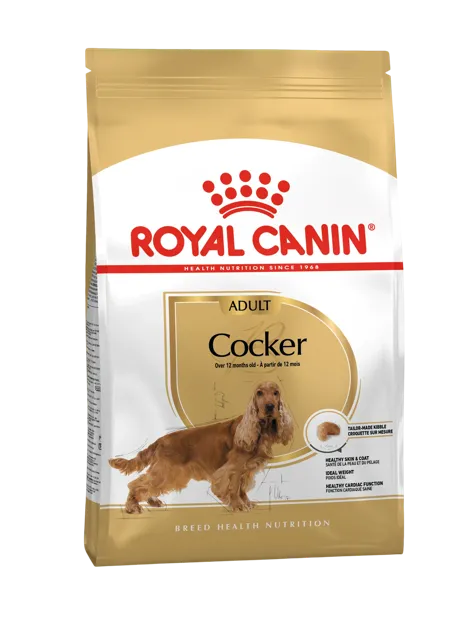
Royal Canin Cocker Adult is a shaped kibble for a medium dog with a heavy coat and heavier ears. It is cereal led from the first line: rice, then maize, with dehydrated poultry protein third and maize gluten fourth. Protein reads 25.0% as fed and estimated carbohydrate reaches 50.0% of dry matter, with fish oil and borage oil supplying the omega side and marigold extract adding lutein. The front half of the ingredients list holds every reason it sits in our Average band.
Our view
Likely to suit
If your cocker is settled, well covered and eating happily, there is a real case for leaving a working routine alone.
- Owners of medium adult cockers who want a kibble shaped for the breed and easy to find on a shelf
- A dog who has never had a moment's trouble with rice or maize
- Owners feeding with the coat in mind, with fish oil and borage oil on the list and zinc declared at 142 mg per kilo
- A cocker into its senior years, with the label covering seniors alongside adults
- Households that like a choice of pack size, since the food comes in 3kg as well as 12kg
Worth watching
Before you fill the bowl, it helps to see how this recipe is built.
- Two cereals sit ahead of the first meat entry, so grain leads this recipe rather than follows it
- The protein figure gets a lift from maize gluten, a plant protein that a dog uses less readily than the protein in meat
- Estimated carbohydrate reaches 50.0% of dry matter against the 46.2% typical for adult dry food
- Bulk is thin here, with crude fibre at 1.5% of dry matter, so a dog that needs it to settle its stools may want more from elsewhere in the day
- Species is missing from the poultry and the animal fats, and the fish oil rules out a fish-free bowl
Written by our editorial team. Independent guidance, not veterinary advice.
How this scores
How we scoreThe Details
Dog fit
If your cocker is settled, well covered and eating happily, there is a real case for leaving a working routine alone. Before you fill the bowl, it helps to see how this recipe is built.
Dry
Adult, Senior
Medium
Poultry
The score, in context
This one finishes in our Average band, under the Good band of the typical adult dry food. Protein and processing and transparency read Poor, and nutritional balance reads Average. The ingredient order accounts for most of that. Rice and maize take the opening two places, and maize gluten arrives fourth to top up the protein figure. The animal entries that follow give a category where an animal name should be.
The analysis follows the same shape. Estimated carbohydrate at 50.0% of dry matter runs above the 46.2% typical for adult dry food, protein converts to 27.5% and crude fibre to a light 1.5%. None of that stops a healthy cocker doing perfectly well on it, and many have for years. What it does mean is that a label reader is given very little to verify, which is the honest reason the placing sits where it does.
What's in it
Ingredients, as declared: rice, maize, dehydrated poultry protein, maize gluten, animal fats, hydrolysed animal proteins, beet pulp, vegetable protein isolate*, fish oil, minerals, psyllium husks and seeds, soya oil, fructo-oligo-saccharides, hydrolysed yeast (source of manno-oligo-saccharides), borage oil (0.1%), hydrolysed crustaceans (source of glucosamine), marigold extract (source of lutein), hydrolysed cartilage (source of chondroitin).
Named ingredients
Nutritional additives
Additives (per kg): Nutritional additives: Vitamin A: 30500 IU, Vitamin D3: 800 IU, E1 (Iron): 42 mg, E2 (Iodine): 4.2 mg, E4 (Copper): 13 mg, E5 (Manganese): 54 mg, E6 (Zinc): 142 mg, E8 (Selenium): 0.09 mg - Sensory additives: tea extract (source of polyphenols): 150 mg - Preservatives - Antioxidants.
Ingredient notes
Rice and maize open the recipe together. Both are perfectly digestible cereals once they have been cooked properly, rice being the gentler of the pair, and neither is a problem ingredient in itself. The point is the position. With two grains ahead of the first meat entry, the starch side of this food is doing the heavy lifting, which is exactly what the carbohydrate figure of 50.0% of dry matter reflects.
Dehydrated poultry protein takes third place, dried before mixing so its protein counts for close to its listed weight rather than mostly evaporating in the oven. Poultry is a family name, and chicken, turkey, duck or goose can all answer to it, so the bird is never pinned down. The hydrolysed animal proteins further along keep that vagueness going. For most dogs this is academic. For an owner working out which protein their dog reacts to, it is the detail that matters most.
Maize gluten sits fourth, and it is there to raise the protein number. It comes out of maize processing as a by-product, genuinely protein rich. Lifting a panel this way, without adding meat, is common enough. A dog's system handles plant protein less completely than the protein it takes from an animal, so the figure on the panel flatters the recipe slightly. It is worth knowing, not worth fearing, and it matters most for a dog that has been sensitive to maize before.
The list gets more generous in its back half. Beet pulp gives the stools structure, and soluble fibre arrives with psyllium husks and seeds. Fructo-oligo-saccharides with hydrolysed yeast keep the useful gut bacteria fed. The fish oil brings marine omega 3s and marigold extract carries lutein. Borage oil at 0.1% is where the gamma-linolenic acid comes from, the fatty acid reached for when skin comfort is the aim. On a breed with this much coat to maintain, that combination is the part of the label pulling its weight.
The added nutrition is printed with quantities throughout. Zinc at 142 mg, manganese at 54 mg, iron at 42 mg, copper at 13 mg, iodine at 4.2 mg and selenium at 0.09 mg per kilo. Vitamin A is at 30500 IU, vitamin D3 at 800 IU, and tea extract at 150 mg per kilo as a polyphenol source. The joint pair is not treated the same way. Hydrolysed crustaceans for glucosamine and hydrolysed cartilage for chondroitin close the list without a figure between them. Read them as a gesture towards joint comfort, not a helping you can measure.
Price and value
£5.42 a kilo, sold in 3kg and 12kg bags.
As a guide, a 15kg adult dog in moderate condition needs about 230 grams a day. That assumes around 840 kcal a day (110 × bodyweight^0.75, the standard maintenance estimate) and works out at £1.24 a day. For a 10kg cocker the label's own table asks 138 grams, and 196 grams for a 16kg one. If the two guides disagree, let the waistline settle it.
Nutritional analysis
Declared analysis
Estimated using Modified Atwater factors*
25%
14%
1.4%
5.1%
9%
Dry weight
27.5%
15.4%
1.5%
5.6%
50%
As-fed composition
Estimated breakdown of the finished product by ingredient category, from the declared ingredient list and ingoing weights. These are estimates, not measurements.
19.9%
74%
1.1%
4.2%
0.9%
Pricing & size
- Pack size
- 3 kg, 12 kg
- Retailer pricing
- Coming soon
Live retailer pricing is not yet available for this food. Prices, cost per day and where to buy will appear here once retailer data is live.
Ingredients and nutrition are taken from manufacturer data. Retailer pricing is not yet live for this food.
Related dog food guides
Ranked shortlists that include foods like this one.