



Royal Canin
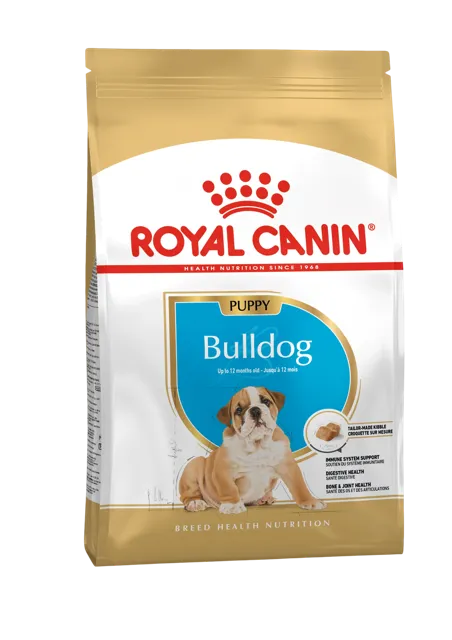
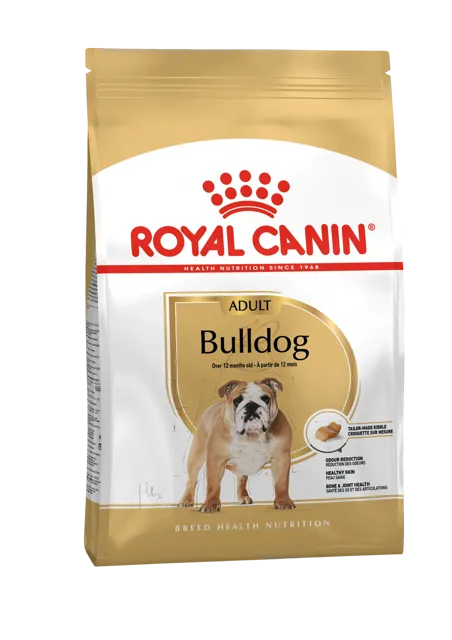
Royal Canin Bulldog Adult review
Royal Canin Bulldog Adult keeps its cereal list down to a single entry, rice, which is unusual for a kibble at this end of the market. The piece itself is shaped for a short, wide muzzle that has to work at an angle. Dehydrated poultry protein comes second, animal fats third, and a vegetable protein isolate and dehydrated pork protein share the load behind them. At 24.0% as fed the protein is gentle, and energy reads 372 kcal per 100g. The food sits in our Average band.
Our view
Likely to suit
Feeding a bulldog is partly an engineering problem, and this bag has been designed around it.
- Owners of adult bulldogs who want a kibble a broad, short muzzle can actually pick up
- Dogs kept away from maize and wheat, since rice is the only cereal anywhere in the recipe
- A dog whose digestion needs settling, with beet pulp, vegetable fibres and hydrolysed yeast doing that job further down the list
- An older bulldog, since this label is written for adults and seniors alike
- Owners who portion from the pack, with a table running from an 18kg dog up to a 30kg one
Worth watching
None of the following should worry you, but it is all worth having straight before you buy.
- At 26.1% of dry matter the protein is gentle for an adult dry food, so a meat-hungry dog may look for more
- Estimated carbohydrate reaches 48.7% of dry matter, above the 46.2% typical for adult dry food, so a fair share of the energy is starch
- Pig is on the list as dehydrated pork protein, worth knowing if you avoid it
- The poultry and the animal fats are named by category rather than by species
- There is no declared moisture, so the 8% standard for a dry food is what the dry matter figures below use
Written by our editorial team. Independent guidance, not veterinary advice.
How this scores
How we scoreThe Details
Dog fit
Feeding a bulldog is partly an engineering problem, and this bag has been designed around it. None of the following should worry you, but it is all worth having straight before you buy.
Dry
Adult, Senior
Medium
Poultry
The score, in context
Our Average band is where this one lands, one band under the Good the typical adult dry food occupies, and the split between the pillars tells the story better than the headline does. Nutritional balance reads Average: the analysis is unshowy but perfectly serviceable, with fat at 15.2% of dry matter and 372 kcal per 100g, and the fibre and mineral work behind it is sound.
Transparency reads Poor and protein and processing only Average, and that is where the ground goes. The two biggest animal entries are described by legal category instead of by animal, and a vegetable protein isolate is asked to carry a share of the protein a meat would normally supply. It is fairer to read this as a food that tells you less than it could than as one that does less than it should. A bulldog eating it happily is not a bulldog being short-changed.
What's in it
Ingredients, as declared: rice, dehydrated poultry protein, animal fats, vegetable protein isolate*, hydrolysed animal proteins, dehydrated pork protein*, beet pulp, vegetable fibres, minerals, fish oil, soya oil, hydrolysed yeast (source of manno-oligo-saccharides), hydrolysed crustaceans (source of glucosamine), marigold extract (source of lutein), hydrolysed cartilage (source of chondroitin).
Named ingredients
Nutritional additives
Additives (per kg): Nutritional additives: Vitamin A: 30000 IU, Vitamin D3: 800 IU, E1 (Iron): 48 mg, E2 (Iodine): 4.8 mg, E4 (Copper): 15 mg, E5 (Manganese): 62 mg, E6 (Zinc): 141 mg, E8 (Selenium): 0.1 mg - Technological additives: Clinoptilolite of sedimentary origin: 10 g - Sensory additives:tea extract (source of polyphenols): 150 mg - Preservatives - Antioxidants.
Ingredient notes
Only one cereal appears here, rice, and that is worth more than it might sound. Where a lot of kibbles blend three or four grains and leave you guessing which one upset your dog, this one names a single, gentle, well tolerated starch and stops. Maize, wheat and maize gluten are all absent from the list. For anyone whose dog has had trouble with cereals before, that makes the label an unusually easy read.
Dehydrated poultry protein follows in second place. It goes into the mixer already dry. Its protein is not mostly water that the oven will drive off, and it counts for close to what it says. The word poultry stretches to chicken, turkey, duck and goose, and pins down none of them. That is the recipe's main blind spot for an owner trying to isolate a problem ingredient. Dehydrated pork protein appears further down, a comparatively uncommon meat in kibble and a welcome one, and hydrolysed animal proteins sit alongside as a palatant.
The vegetable protein isolate carries an asterisk. The maker explains it as a protein picked for very high digestibility. That is a claim about absorption, not about source, and the source is plant. It is a legitimate way to firm up a protein figure. It also means the meat content here is more modest than the poultry's position on the list suggests.
The digestive package is the quiet strength of the label. Beet pulp and vegetable fibres bring bulk that helps stools hold their shape. Hydrolysed yeast supplies manno-oligo-saccharides, food for the bacteria further down the gut. Crude fibre lands at 3.0% of dry matter, a sensible working level for a dog whose digestion you would rather keep uneventful.
The omega 3s come from fish oil, with soya oil behind it. Marigold extract is there for lutein. Tea extract is declared at 150 mg per kilo for polyphenols. The trace minerals are all printed with a dose. Zinc at 141 mg, manganese at 62 mg, iron at 48 mg, copper at 15 mg, iodine at 4.8 mg and selenium at 0.1 mg per kilo. Above them sit vitamin A at 30000 IU and vitamin D3 at 800 IU. Clinoptilolite is at 10 g per kilo as a technological aid. The joint entries get no such treatment: hydrolysed crustaceans for glucosamine and hydrolysed cartilage for chondroitin close the list with no quantity attached. Read them as a supportive gesture, not a measured dose.
Price and value
£5.73 a kilo, sold as a 12kg bag.
As a guide, a 15kg adult dog in moderate condition works out at about 226 grams a day. That assumes around 840 kcal a day (110 × bodyweight^0.75, the standard maintenance estimate) and comes to £1.29 a day. A bulldog will usually weigh more than that, and the pack's own table is the better guide for the breed. It asks 223 grams a day at 18kg, rising to 327 grams at 30kg for a dog at low activity.
Nutritional analysis
Declared analysis
24%
14%
2.8%
6.4%
Dry weight
26.1%
15.2%
3%
7%
48.7%
As-fed composition
Estimated breakdown of the finished product by ingredient category, from the declared ingredient list and ingoing weights. These are estimates, not measurements.
38.3%
43.6%
7.9%
9.2%
1.1%
Pricing & size
- Pack size
- 12 kg
- Retailer pricing
- Coming soon
Live retailer pricing is not yet available for this food. Prices, cost per day and where to buy will appear here once retailer data is live.
Ingredients and nutrition are taken from manufacturer data. Retailer pricing is not yet live for this food.
Related dog food guides
Ranked shortlists that include foods like this one.