



Royal Canin
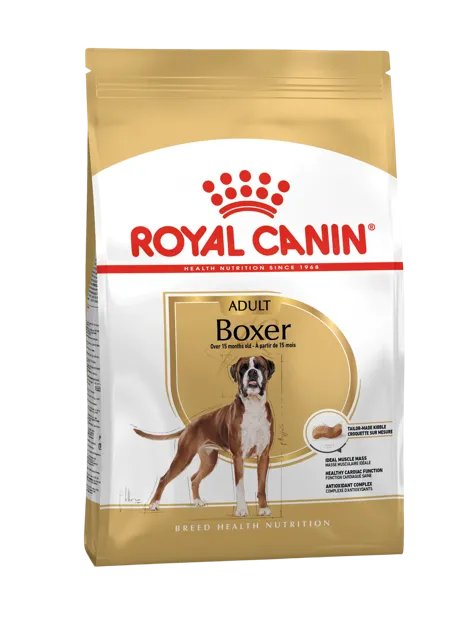
Royal Canin Boxer Adult review
Royal Canin Boxer Adult is a notably rich recipe for a breed-specific kibble, with fat at 20.0% as fed and 404 kcal in every 100g. It is built for a muscular dog that runs at full tilt all day. Rice opens the list, animal fats come second, dehydrated poultry protein third and dehydrated pork protein a few places behind, with L-carnitine declared at 830 mg per kilo. It finishes in our Average band, and the pillars split: nutritional balance reads Good, while protein and processing and transparency both read Poor.
Our view
Likely to suit
A boxer rarely does anything by halves, and this recipe is put together around the energy that goes with that.
- Busy adult boxers who empty the bowl and immediately ask what happens next, with 404 kcal in every 100 grams
- Dogs that hold condition better on a fattier bowl, with fat converting to 21.7% of dry matter
- Owners who want L-carnitine printed with a quantity, declared here at 830 mg per kilo
- Households feeding a large adult, since the label's table runs from a 24kg dog up to a 38kg one
- Older boxers, with the same label covering seniors and adults alike
Worth watching
Before the big bag arrives, it is worth knowing how this label is put together.
- Rice and animal fats take the first two places, so the leading meat entry comes in third
- Dehydrated pork protein sits on the list beside the poultry, which is worth knowing if pig is off the menu at your house
- Neither the poultry nor the animal fats names a species, which blunts the label as a tool for tracking down a sensitivity
- The recipe carries fish oil, a point for anyone whose dog steers clear of fish
- The pack does not declare moisture, and the dry matter figures below take the 8% standard for a dry food
Written by our editorial team. Independent guidance, not veterinary advice.
How this scores
How we scoreThe Details
Dog fit
A boxer rarely does anything by halves, and this recipe is put together around the energy that goes with that. Before the big bag arrives, it is worth knowing how this label is put together.
Dry
Adult, Senior
Poultry
The score, in context
This recipe gets closer to the middle of the field than its placing on its own suggests. The typical adult dry food occupies our Good band and this one finishes a step under it, in our Average band. Fat does much of that work: at 21.7% of dry matter it lifts the energy density well clear of a typical dry food. Estimated carbohydrate falls to 40.8%, under the 46.2% typical for the category.
The reason for the placing is right at the start of the ingredients. The recipe opens with rice, not meat, and animal fats follow. The animal entries that matter most are described by category, never by species. For an owner feeding a boxer that trains, works or simply never stops, none of that reads as a warning. It is the trade this recipe makes, and it makes it deliberately.
What's in it
Ingredients, as declared: rice, animal fats, dehydrated poultry protein, maize, vegetable protein isolate*, dehydrated pork protein, hydrolysed animal proteins, vegetable fibres, beet pulp, minerals, soya oil, fish oil, copra oil, dehydrated tomato, hydrolysed yeast (source of manno-oligo-saccharides), hydrolysed crustaceans (source of glucosamine), marigold extract (source of lutein), hydrolysed cartilage (source of chondroitin).
Named ingredients
Nutritional additives
Additives (per kg): Nutritional additives: Vitamin A: 27500 IU, Vitamin D3: 700 IU, E1 (Iron): 51 mg, E2 (Iodine): 5.1 mg, E4 (Copper): 15 mg, E5 (Manganese): 66 mg, E6 (Zinc): 141 mg, E8 (Selenium): 0.11 mg - L-carnitine: 830 mg - Technological additives: Clinoptilolite of sedimentary origin: 10 g - Sensory additives: tea extract (source of polyphenols): 150 mg - Preservatives - Antioxidants.
Ingredient notes
Rice comes first and animal fats second, which is an unusual order and tells you what the recipe is for. Fat carries more than twice the energy of starch or protein by weight. Putting it that high is how a food reaches 404 kcal per 100g and keeps a hard-working dog in condition on a sensible bowl. The reservation is the wording: animal fats names no species, so the fat could come from one animal or several, and it can change between production runs without a word altering on the pack.
Two dried meats follow. Dehydrated poultry protein is third and dehydrated pork protein a few lines below it, both already dried so their protein arrives intact rather than mostly as water. Pork is comparatively rare in kibble, and that makes it useful when the usual birds have lost their appeal. Here it plays a supporting part, not a leading one. Hydrolysed animal proteins sit alongside them, broken down small and there largely to make the bowl taste of something.
What marks this recipe out from its stablemates is L-carnitine, declared at 830 mg per kilo. The body uses carnitine, an amino acid, to shuttle fat into cells to be burned for energy. It is a natural companion to a recipe with this much fat in it, and it is usually chosen where the aim is a lean, muscular dog. Declaring it with a figure is the useful part.
The plant side is short and purposeful. Vegetable fibres and beet pulp give the stools something to hold onto, and hydrolysed yeast supplies manno-oligo-saccharides for the gut. Dehydrated tomato brings antioxidants, and tea extract is declared at 150 mg per kilo as a source of polyphenols. Copra oil, pressed from coconut, joins the soya oil and fish oil in the fat blend and is an unusual sight on a dog food list. Crude fibre lands at 2.7% of dry matter, on the light side, which suits a food built to be digested rather than to fill.
The added nutrition is properly printed: zinc at 141 mg, manganese at 66 mg, iron at 51 mg, copper at 15 mg, iodine at 5.1 mg and selenium at 0.11 mg per kilo. Vitamin A is at 27500 IU and vitamin D3 at 700 IU. Clinoptilolite, a natural mineral clay, is included at 10 g per kilo as a technological additive. The joint entries are the exception to all that precision. The list closes with hydrolysed crustaceans for glucosamine and hydrolysed cartilage for chondroitin, neither with a quantity beside it. Take them as a supportive touch, not a measured helping.
Price and value
£5.73 a kilo, sold as a 12kg bag.
As a guide, a 15kg adult dog in moderate condition needs roughly 208 grams a day. That assumes about 840 kcal a day (110 × bodyweight^0.75, the standard maintenance estimate) and works out at £1.19 a day. Most boxers are a good deal heavier than that, and the label's own table is the better starting point for the breed. It asks 255 grams a day at 24kg, rising to 360 grams at 38kg for a dog at low activity.
Nutritional analysis
Declared analysis
26%
20%
2.5%
6%
Dry weight
28.3%
21.7%
2.7%
6.5%
40.8%
As-fed composition
Estimated breakdown of the finished product by ingredient category, from the declared ingredient list and ingoing weights. These are estimates, not measurements.
25.5%
54.2%
5.8%
14.1%
0.5%
Pricing & size
- Pack size
- 12 kg
- Retailer pricing
- Coming soon
Live retailer pricing is not yet available for this food. Prices, cost per day and where to buy will appear here once retailer data is live.
Ingredients and nutrition are taken from manufacturer data. Retailer pricing is not yet live for this food.
Related dog food guides
Ranked shortlists that include foods like this one.