

Skip to content
Off the Leash
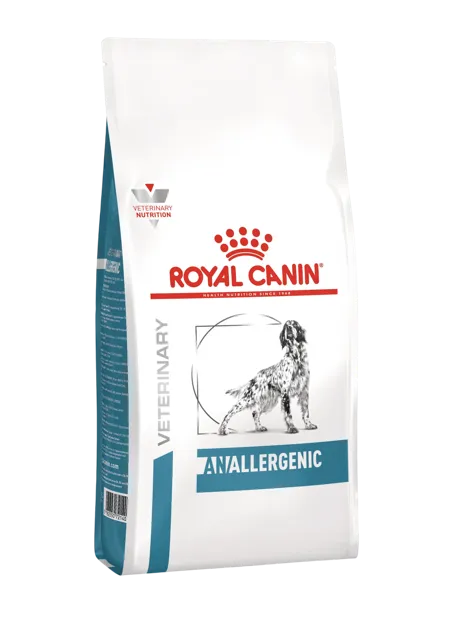
Royal Canin Anallergenic – —

Royal Canin

Royal Canin Anallergenic review

We don't put a score on this food. It is a veterinary diet, formulated for a diagnosed condition and meant to be fed on a vet's advice. Your vet has seen your dog and we have not, so a number from us could only pull you towards their advice or away from it, and neither of those is ours to do. What follows is what the label declares, what the analysis works out at, and where to buy it, with no judgement attached to any of it.

Anallergenic is the name Royal Canin gives this dry food. The maker puts it forward for food elimination trials and for long term feeding of dogs it describes as severely food sensitive.

DryAdultSenior
Where to buy: coming soon
Live retailer pricing is coming soon. Once we have prices from UK retailers, the best price, cost per day and where to buy will appear here.

The Details

Dog fit
Food type

Dry

Life stage

Adult, Senior

Breed size

Small

Main protein

Fish

What's in it

Ingredients, as declared: Maize starch, feather hydrolysate with low molecular weight (source of L-amino acids and oligopeptides), copra oil, soya oil, minerals, vegetable fibres, chicory pulp, fructo-oligosaccharides, fish oil, mono - and diglycerides of palmitic and stearic acids esterified with citric acid, animal fat, marigold meal. Protein source: feather hydrolysate with low molecular weight (19.78%). Carbohydrate source: maize starch (46.3%).

Named ingredients

Maize starch, feather hydrolysate with low molecular weight (source of L-amino acids and oligopeptides), copra oil, soya oil, minerals, vegetable fibres, chicory pulp, fructo-oligosaccharides, fish oil, mono - and diglycerides of palmitic and stearic acids esterified with citric acid, animal fat, marigold meal. Protein source: feather hydrolysate with low molecular weight (19.78%). Carbohydrate source: maize starch (46.3%).

Nutritional additives

Additives (per kg): Nutritional additives: Vitamin A: 38500 IU, Vitamin D3: 800 IU, Iron (3b103): 41 mg, Iodine (3b201, 3b202): 3.5 mg, Copper (3b405, 3b406): 15 mg, Manganese (3b502, 3b504): 55 mg, Zinc (3b603, 3b605, 3b606): 149 mg, Selenium (3b801, 3b811, 3b812): 0.34 mg - Technological additives: Clinoptilolite of sedimentary origin: 9.8 g - Preservatives - Antioxidants.

What's on the label

Maize starch opens the list and is printed at 46.3% as the carbohydrate source. One protein source does all the work here: feather hydrolysate with low molecular weight, declared at 19.78%. The label calls it a source of L-amino acids and oligopeptides. Hydrolysis chops protein into very short fragments, and that is the entire idea behind this recipe: no meat cut, meal or named fish appears anywhere on the ingredient list.

The fats are a mix. Copra oil and soya oil sit high up, fish oil comes further down and animal fat is listed at the tail end without a species beside it. Those last two matter on a strict exclusion. Fish oil is fish-derived even though it carries no fish protein, and the unnamed animal fat cannot be traced to a species from the label alone.

Behind the fats the recipe is fibre and minerals. The bulk comes from vegetable fibres and chicory pulp. Fructo-oligosaccharides do the prebiotic work, and marigold meal closes the list. An emulsifier is spelled out in full as mono- and diglycerides of palmitic and stearic acids esterified with citric acid. It is a processing aid that holds the fats and starch together, not a nutritional inclusion.

Converted to dry matter, protein reads 19.6% and fat 17.9%, with crude fibre at 2.2%, crude ash at 6.7% and the carbohydrate estimate at 53.6%. Energy works out at 376 kcal per 100g. Protein sits well down for a dry food and starch well up. That follows from building the recipe around a single hydrolysed protein and maize. Read those figures as the shape of the diet, not as something missing.

The added panel is printed with doses throughout: vitamin A at 38500 IU and vitamin D3 at 800 IU. Iron follows at 41mg, iodine at 3.5mg, copper at 15mg, manganese at 55mg, zinc at 149mg and selenium at 0.34mg per kilogram. Clinoptilolite is declared separately at 9.8g as a technological additive, while the preservatives and antioxidants are named only by category. Feeding runs from 54 grams a day for a 2kg dog through 243 grams at 15kg to 854 grams at 80kg. On a diet like this the practitioner who prescribed it sets the amount, not the table.

Price and where to buy

It is bagged in 3kg and 8kg.

Nutritional analysis

Declared analysis

Energy
375.8 kcal/100g

Estimated using Modified Atwater factors*

Protein

18%

Fat

16.5%

Fibre

2%

Ash

6.2%

Dry weight

Protein

19.6%

Fat

17.9%

Fibre

2.2%

Ash

6.7%

Carbs

53.6%

As-fed composition

Estimated breakdown of the finished product by ingredient category, from the declared ingredient list and ingoing weights. These are estimates, not measurements.

Carbs

61.2%

Veg

4.8%

Oils

15.4%

Other

18.6%

Pricing & size
Pack size
3 kg, 8 kg
Retailer pricing
Coming soon

Live retailer pricing is not yet available for this food. Prices, cost per day and where to buy will appear here once retailer data is live.

Ingredients and nutrition are taken from manufacturer data. Retailer pricing is not yet live for this food.

Related dog food guides

Ranked shortlists that include foods like this one.
All reviews

Featured feeding accessories

All feeding accessories

Brackenwood

Slow Feeder Maze Bowl

Slows fast eaters and eases gulping at mealtimes.

From £12.99· 4 retailers
View

Tarn & Co

Raised Double Diner

Height-set stand for easier, tidier eating.

From £28.99· 3 retailers
View

Reviewed by Off the Leash Editorial

Last updated 24 August 2026