

Skip to content
Off the Leash
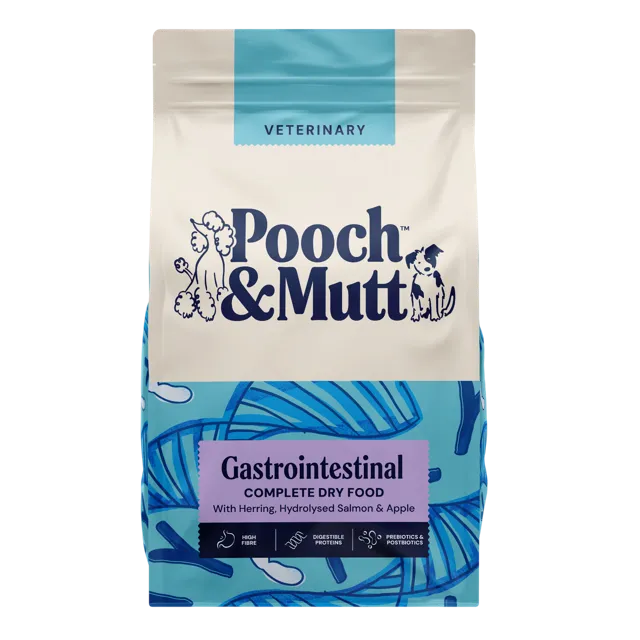
Pooch & Mutt Veterinary Gastrointestinal Dry Food – —

Pooch & Mutt

Pooch & Mutt Veterinary Gastrointestinal Dry Food review

We don't put a score on this food. It is a veterinary diet, formulated for a diagnosed condition and meant to be fed on a vet's advice. Your vet has seen your dog and we have not, so a number from us could only pull you towards their advice or away from it, and neither of those is ours to do. What follows is what the label declares, what the analysis works out at, and where to buy it, with no judgement attached to any of it.

Pooch & Mutt sells this one as its Veterinary Gastrointestinal dry food. It is a herring and hydrolysed salmon kibble, offered for dogs whose digestion is being handled alongside a vet.

DryPuppyAdult
Where to buy: coming soon
Live retailer pricing is coming soon. Once we have prices from UK retailers, the best price, cost per day and where to buy will appear here.

The Details

Dog fit
Food type

Dry

Life stage

Puppy, Adult, Senior

Breed size

Toy, Small, Medium, Large, Giant

Main protein

Herring

What's in it

Ingredients, as declared: Herring Protein (26 %), Yellow Peas (25 %), Hydrolysed Salmon Protein (12 %), Buckwheat (11 %), Chicken Fat (10 %), Dried Apple Pulp (7.6 %), Salmon Oil (3 %), Brewers Yeast (2 %), Sodium Chloride (1 %), Pea Protein, Dried Algae (Ascophyllum nodosum, 0.5 %), Egg Shells (a source of Calcium, 0.5 %), Psyllium Husks & Seeds (0.5 %), Potassium Chloride (0.4 %), Mannan-oligosaccharides (0.025 %), β-glucans (0.02 %), Fructo-oligosaccharides (0.02 %), Mojave Yucca (0.018 %), Dried Sea Buckthorn (0.015 %), Lactobacillus helveticus HA-122 inactivated (15x10⁹ cells/kg).

Named ingredients

Herring Protein (26 %), Yellow Peas (25 %), Hydrolysed Salmon Protein (12 %), Buckwheat (11 %), Chicken Fat (10 %), Dried Apple Pulp (7.6 %), Salmon Oil (3 %), Brewers Yeast (2 %), Sodium Chloride (1 %), Pea Protein, Dried Algae (Ascophyllum nodosum, 0.5 %), Egg Shells (a source of Calcium, 0.5 %), Psyllium Husks & Seeds (0.5 %), Potassium Chloride (0.4 %), Mannan-oligosaccharides (0.025 %), β-glucans (0.02 %), Fructo-oligosaccharides (0.02 %), Mojave Yucca (0.018 %), Dried Sea Buckthorn (0.015 %), Lactobacillus helveticus HA-122 inactivated (15x10⁹ cells/kg).
What's on the label

The whole list is named, with a percentage beside almost every entry. Herring protein leads at 26%, yellow peas follow at 25%, hydrolysed salmon protein sits at 12% and buckwheat at 11%, with chicken fat at 10% and dried apple pulp at 7.6% behind them.

Fish is the protein story, herring first and salmon in hydrolysed form second, with salmon oil at 3% further down. Hydrolysis cuts a protein into fragments, but it does not take the salmon out of the recipe, and the chicken fat at 10% puts chicken in the bowl too even though no chicken meat appears. If your dog is coming off poultry, raise those two entries with your vet.

Sodium chloride at 1% and potassium chloride at 0.4% are printed as ingredients, not folded into a mineral heading. They are the pair a maker reaches for when a gut recipe has to put back what a dog loses. Egg shells at 0.5% are named as the calcium source, with dried algae at 0.5% and Mojave yucca at 0.018% alongside them.

The fermentable fibres are dosed and printed too: mannan-oligosaccharides at 0.025%, beta-glucans at 0.02% and fructo-oligosaccharides at 0.02%, with psyllium husks and seeds at 0.5% bringing soluble fibre. A Lactobacillus helveticus culture closes the list at 15 billion cells per kilogram. It is inactivated and not live, and on a gut diet that is a deliberate choice, not a lapse.

Protein converts to 28.9% of dry matter and fat to 16.7%, with carbohydrate estimated at 46.3% and energy at 385 kcal per 100g. Crude fibre reads 2.3% of dry matter, which looks slight until you notice that the fibre work is being done by the named prebiotics and the psyllium, not by bulk. Calcium sits at 0.78% of dry matter, which is what the egg shells are there for.

Feeding is grouped by weight: 95 grams a day up to 5kg, 160 to 320 grams across the 10 to 25kg range and 540 grams at 50kg. The food is put forward for puppies, adults and seniors alike, not for one life stage. Whether it suits your dog is settled with the vet overseeing the case.

Price and where to buy

It comes in 2kg and 10kg bags, at £7.40 a kilo. On the label's guide a 15kg dog eats around 218 grams a day, which puts the daily cost at £1.61.

Nutritional analysis

Declared analysis

Energy
385.2 kcal/100g
Protein

26%

Fat

15%

Fibre

2.1%

Ash

5.2%

Moisture

10%

Dry weight

Protein

28.9%

Fat

16.7%

Fibre

2.3%

Ash

5.8%

Carbs

46.3%

As-fed composition

Estimated breakdown of the finished product by ingredient category, from the declared ingredient list and ingoing weights. These are estimates, not measurements.

Meat

38.3%

Carbs

36.7%

Veg

7.9%

Oils

13%

Other

4.1%

Pricing & size
Pack size
2kg (£19.99) · 10kg (£73.99)
Retailer pricing
Coming soon

Live retailer pricing is not yet available for this food. Prices, cost per day and where to buy will appear here once retailer data is live.

Ingredients and nutrition are taken from manufacturer data. Retailer pricing is not yet live for this food.

Related dog food guides

Ranked shortlists that include foods like this one.
All reviews

Featured feeding accessories

All feeding accessories

Brackenwood

Slow Feeder Maze Bowl

Slows fast eaters and eases gulping at mealtimes.

From £12.99· 4 retailers
View

Tarn & Co

Raised Double Diner

Height-set stand for easier, tidier eating.

From £28.99· 3 retailers
View

Reviewed by Off the Leash Editorial

Last updated 24 August 2026