



Pedigree
Pedigree Puppy Tins with Jelly: With Lamb & Rice review
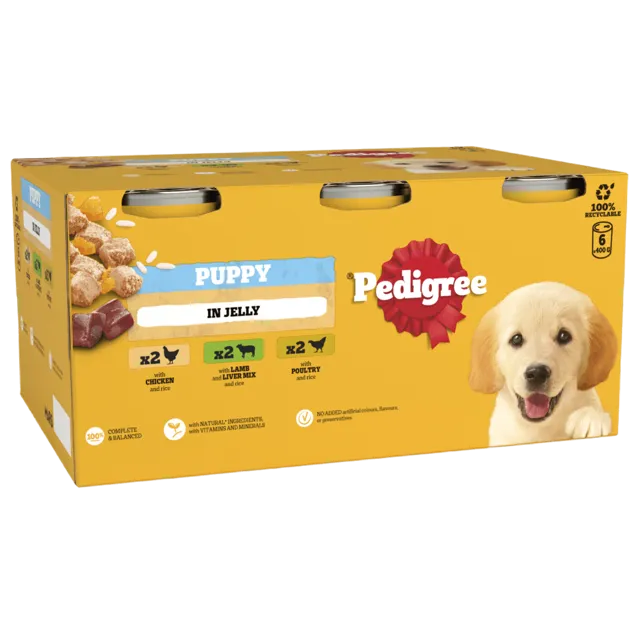
Pedigree Puppy Tins with Jelly come in three versions, with chicken, with lamb and with poultry, and all three share one analysis and one recipe pattern. Meat and animal derivatives leads, with the headline animal declared at 4% in the chicken and poultry tins and at 2% in the lamb, and liver at 4% in all three. Cereals follow with rice at 1.1%, then fish and fish derivatives, vegetable protein extract and derivatives of vegetable origin. Protein converts to 44.0% of dry matter and carbohydrate to 13.2%, and the range sits in our Average band.
Our view
Likely to suit
You will not need to talk your puppy into a jelly tin.
- Puppies who need tempting, since jelly tins are one of the easiest textures to get a young dog eating
- Owners rotating flavours, with chicken, lamb and poultry versions on the same shelf
- Pups whose intake needs to lean on meat rather than starch, with protein converting to 44.0% of dry matter
- Households feeding more than one puppy, with 400g tins to share out
- Owners adding wet food to a dry diet, with a tin declared at 81.8% moisture bringing water into the bowl alongside the appeal
Worth watching
A few of this range's label habits are worth understanding first.
- Broad categories account for nearly the whole recipe, so an exclusion diet has nothing here to work with
- Calcium converts to 1.65% of dry matter, above the level most large breed growth plans keep to, so check the plan with a vet for a pup that will finish big
- Every one of the three versions carries fish and fish derivatives, so a fish-free option is not on offer here
- Cassia gum at 1175mg per kilo sets the jelly, and a number of owners like to avoid it
- At 88 kcal per 100g the tins run under the 106 typical of a puppy wet food, so it takes more of them to reach the same intake
Written by our editorial team. Independent guidance, not veterinary advice.
How this scores
How we scoreThe Details
Dog fit
You will not need to talk your puppy into a jelly tin. A few of this range's label habits are worth understanding first.
Wet
Puppy
Toy, Small, Medium, Large, Giant
Chicken
The score, in context
The middle of the puppy wet category reaches our Excellent band, a strong showing, and these tins sit two bands under it, in Average. Nutritional balance reads Outstanding, the fairest reading of an analysis that is genuinely decent. Dry matter protein is 44.0% and carbohydrate 13.2%, about level with the category typical of 13.6%. What pulls the rest down is that so little of the recipe is named. Meat and animal derivatives, cereals, fish and fish derivatives, vegetable protein extract and derivatives of vegetable origin account for most of the tin. Only 4% chicken or poultry, 2% lamb, 4% liver and 1.1% rice are pinned to anything specific. That is why protein and processing comes back Average.
What's in it
Ingredients, as declared: With Chicken and Rice: Meat and Animal Derivatives* (including Chicken 4% and Liver 4%), Cereals (including Rice 1.1%, equivalent to Cooked Rice 4%), Fish and Fish Derivatives*, Minerals, Vegetable Protein Extract, Derivatives of Vegetable Origin *92% Natural, With Lamb and Liver Mix and Rice: Meat and Animal Derivatives* (including a Mix of Lamb 2% and Liver 4%), Cereals (including Rice 1.1%, equivalent to Cooked Rice 4%), Fish and Fish Derivatives*, Minerals, Vegetable Protein Extract, Derivatives of Vegetable Origin *92% Natural, With Poultry and Rice: Meat and Animal Derivatives* (including Poultry 4% and Liver 4%), Cereals (including Rice 1.1%, equivalent to Cooked Rice 4%), Fish and Fish Derivatives*, Minerals, Vegetable Protein Extract, Derivatives of Vegetable Origin *92% Natural
Named ingredients
Nutritional additives
Additives per kg:, Nutritional additives:, Vitamin D3: 150 IU, Vitamin E: 75.0 mg, Copper (Copper(II) sulphate pentahydrate): 1.7 mg, lodine (Calcium iodate, anhydrous): 0.35 mg, Iron (Iron(II) sulphate monohydrate): 4.5 mg, Manganese (Manganous sulphate, monohydrate): 2.7 mg, Zinc (Zinc sulphate, monohydrate): 22.7 mg, Technological additives:, Cassia gum: 1175 mg
Ingredient notes
The named part of the recipe is small. The chicken and poultry versions declare 4% of their headline animal inside the meat and animal derivatives, the lamb version declares 2%, and all three declare 4% liver in the same place. Everything else in that category is unaccounted for, and the 92% natural note on the tin speaks to processing rather than to what the meat actually is.
Liver is the ingredient here to be pleased about. Weight for weight it is one of the richest foods a dog can eat, carrying vitamin B12, vitamin A, copper, folate, riboflavin and selenium alongside protein in an easily used form. Puppies almost universally take to it.
Meat and animal derivatives, fish and fish derivatives and derivatives of vegetable origin are all umbrella terms, and each can sit over a wide range of quality without the label ever narrowing it. There are respectable reasons a maker uses them, protecting a formula among them. The practical effect on you is the same: the composition can move between batches, and a reaction cannot be traced back to a specific ingredient.
Cereals do the starch. Rice comes in at 1.1%, declared as equivalent to 4% once cooked, and the load in the finished tin is light at 13.2% of dry matter. Vegetable protein extract deserves the closest attention of the lot. For a dog it falls short of what animal protein gives, and neither the source nor the extraction method is stated.
The declared figures look small on the tin and read very differently once the water comes out. Protein at 8.0%, fat at 5.5% and ash at 2.0% sit against 81.8% moisture, and on a dry matter basis that becomes 44.0% protein, 30.2% fat and 11.0% ash. Fibre is negligible at 1.6% of dry matter.
Calcium comes out at 1.65% of dry matter, plenty of mineral for laying down bone. It also runs past what a large breed growth plan tends to allow, hence the note above. The added panel runs to vitamin D3 at 150 IU, vitamin E at 75mg, zinc at 22.7mg, iron at 4.5mg, manganese at 2.7mg, copper at 1.7mg and iodine at 0.35mg per kilo. Cassia gum at 1175mg is the thickener behind the jelly, and it is the one technological additive here that attracts a genuine argument.
How this variety differs
The lamb version is the odd one out on quantity, declaring a mix of lamb at 2% where the other two give their headline animal 4%, with the same 4% liver behind it. Lamb is an excellent meat for dogs, easily digested and palatable with it. Being a red meat, it carries more cholesterol and more purines than the poultry versions do. Everything else on the label, the analysis included, matches its siblings.
Price and value
Sold in 6 x 400g tins.
No puppy portion stays put for long, so start from the guide on the tin for your pup's expected adult size and let their shape do the fine tuning. That guide reaches 800g to 1300g a day for a pup on track to reach 20kg.
Nutritional analysis
Declared analysis
8%
5.5%
0.3%
2%
81.8%
Dry weight
44%
30.2%
1.6%
11%
13.2%
As-fed composition
Estimated breakdown of the finished product by ingredient category, from the declared ingredient list and ingoing weights. These are estimates, not measurements.
100%
Pricing & size
- Pack size
- 6x400g
- Retailer pricing
- Coming soon
Live retailer pricing is not yet available for this food. Prices, cost per day and where to buy will appear here once retailer data is live.
Ingredients and nutrition are taken from manufacturer data. Retailer pricing is not yet live for this food.
Related dog food guides
Ranked shortlists that include foods like this one.