



Pedigree
Pedigree Puppy Junior Dry: With Poultry & Vegetables review
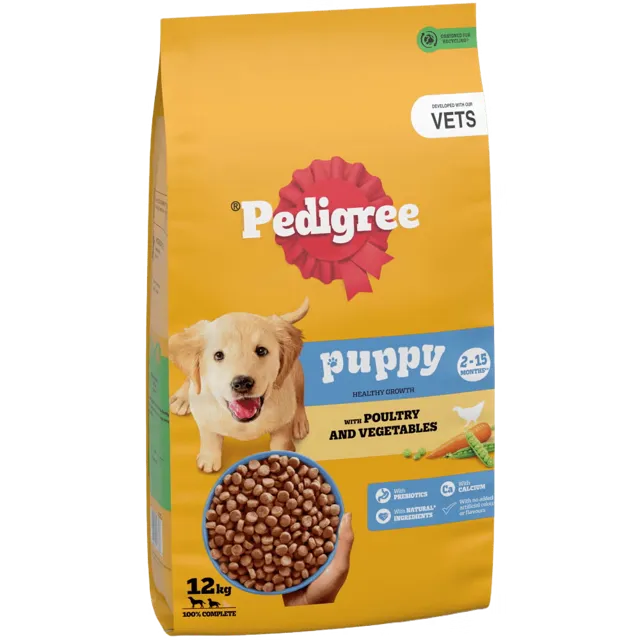
Pedigree Puppy Junior is a mainstream growth kibble sold in three versions, one plain and two with a named flavour. All three are written in broad categories, with cereals first and meat and animal derivatives behind them, and only a small named percentage of chicken, beef or poultry inside that. Energy is right on the mark for a puppy kibble at 377 kcal per 100g on the plain bag, where carbohydrate converts to 44.6% of dry matter. Our Poor band holds two of the three bags, with the poultry version a step up in Average.
Our view
Likely to suit
This is the bag you can pick up almost anywhere, and for a lot of households that counts.
- Owners who need a puppy food stocked in every supermarket and pet shop in the country
- Puppies who do well on a straightforward everyday kibble, with the plain bag running at 377 kcal per 100g against the 376 typical
- Households rearing a litter, with bags running up to 12kg
- Pups who like a change of flavour, with beef and poultry versions sitting alongside the plain one
- Owners of large breed pups feeding the plain bag, which prints calcium at 1.41% of dry matter
Worth watching
There are a handful of things about these labels you will want to know.
- Cereals lead all three recipes and carbohydrate converts to 44.6% of dry matter on the plain bag, which is more starch than most growth kibbles carry
- Only 4% of a named animal sits inside the meat category, so a dog on an exclusion diet cannot be fed from this range
- The two flavoured bags print no calcium figure at all, which matters most if you are rearing a large breed pup on one of them
- The plain bag declares colourants among its additives, which some owners would rather not see in a puppy food
Written by our editorial team. Independent guidance, not veterinary advice.
How this scores
How we scoreThe Details
Dog fit
This is the bag you can pick up almost anywhere, and for a lot of households that counts. There are a handful of things about these labels you will want to know.
Dry
Puppy
Toy, Small, Medium, Large, Giant
Poultry
The score, in context
The middle of the puppy dry shelf sits in our Good band, and this range falls some way short: the plain and beef bags read Poor, the poultry bag Average. Protein and processing reads Poor right across the range, nutritional balance and transparency fall between Poor and Good depending on the bag, and the reasons run together. Cereals lead every recipe, and the meat sits under a category term with 4% of a named animal inside it. The oils and fats go unnamed on two of the three bags, and protein tops out at 29.7% of dry matter on the plain version. None of that makes the food unsafe or incomplete, and it rears a great many puppies perfectly well. It simply declares less, and delivers less meat, than the foods sitting above it.
What's in it
Ingredients, as declared: Cereals*, Meat and Animal Derivatives (including Poultry 4%), Oils and Fats, Derivatives of Vegetable Origin (including Dried Beet Pulp 3%), Minerals, Vegetables* (including Dried Peas and Carrots mix 0.7%, Equivalent to Peas and Carrots mix 4%), Yeast (including Brewer's Yeast 0.4%), * Natural ingredients, Cereals*, Meat and Animal Derivatives (including Poultry 4%), Oils and Fats, Derivatives of Vegetable Origin (including Dried Beet Pulp* 3%), Minerals, Vegetables* (including Dried Peas and Carrots Mix 0.7%, Equivalent to Peas and Carrots mix 4%), Yeast (including Brewer's Yeast 0.4%), *Natural ingredients
Named ingredients
Nutritional additives
- _3kg:_ Additives: per kg:, Antioxidants, Preservatives, Nutritional additives:, Vitamin B2: 10.7 mg, Vitamin D3: 1500 IU, Vitamin E: 100 mg, Biotin: 0.15 mg, Copper (Copper(II) sulphate pentahydrate): 9 mg, Iodine (Potassium iodide): 2.3 mg, Manganese (Manganous sulphate, monohydrate): 24.8 mg, Selenium (Sodium selenite): 0.2 mg, Zinc (Zinc sulphate, monohydrate): 70.1 mg - _12kg:_ Additives per kg:, Antioxidants, Preservatives;, Nutritional additives:, Vitamin B₂: 10.7 mg, Vitamin D₃: 1500 IU, Vitamin E: 100 mg, Biotin: 0.15 mg, Copper (Copper(II) sulphate pentahydrate): 9 mg, Iodine (Potassium iodide): 2.3 mg, Manganese (Manganous sulphate, monohydrate): 24.8 mg, Selenium (Sodium selenite): 0.2 mg, Zinc (Zinc sulphate, monohydrate): 70.1 mg
Ingredient notes
Cereals lead all three recipes, and only the plain bag pins any of them down, declaring rice at 4%. The category can cover anything from good whole grains to low-grade milling by-products, and because the type is not fixed the maker is free to change the grain from batch to batch. That is the single biggest reason this range reads the way it does.
Meat and animal derivatives follows. On the plain bag the category is quantified at 30%, with chicken declared at 4% of it. The beef and poultry bags name their headline animal at 4% and leave the rest of the category unquantified. Under European law the term covers the fleshy parts of any warm-blooded land animal along with the products of processing a carcass, which is why the allergen picture for this range is so wide.
The fat is where the three bags part company. The plain version names sunflower oil at 0.4% inside its oils and fats. Sunflower oil is a decent one, easy on saturated fat and carrying vitamin E naturally. The two flavoured bags declare oils and fats with nothing named at all, so the source cannot be read off the label.
The flavoured bags do bring a few named extras. Dried beet pulp at 3% supplies gentle fibre. A dried mix of peas and carrots at 0.7% is declared as equivalent to 4% of the fresh version, and brewer's yeast comes in at 0.4%. Brewer's yeast has real merit. Few natural ingredients carry the B vitamin group better, and it is a complete protein too, though at 0.4% it works as a garnish.
The plain bag declares its moisture at 8.0%, so its dry matter figures are firm: protein at 29.7%, fat at 15.1% and carbohydrate at 44.6%. The two flavoured bags print no moisture at all, so their dry matter readings rest on the standard 8% assumption applied when a label leaves the figure out. On that basis they come out lower still, at 27.2% protein and 50.1% carbohydrate.
Calcium is where a puppy owner should look hardest, and only one of these three bags helps. The plain version prints it, and at 1.41% of dry matter it sits where growth wants it. The beef and poultry bags print no calcium figure, yet all three are sold from toy right up to giant. A large breed pup on either flavoured bag is being reared without the number that matters most on view.
The added panel is complete and ordinary. The plain bag carries vitamin D3 at 1500 IU, vitamin E at 100 IU, zinc at 89mg, manganese at 31.5mg, copper at 9mg, iodine at 2.3mg and selenium at 0.2mg per kilo. Antioxidants and colourants are declared alongside. The flavoured bags swap the colourants for preservatives and add vitamin B2 and biotin. Selenium comes as sodium selenite throughout, the more commonly used of the two permitted forms, in tiny and routine doses, though the organic form is the better taken up of the two.
How this variety differs
The poultry version is the same recipe with poultry named at 4% in place of beef, and it is the one sold in the larger 3kg and 12kg bags. Poultry as a term covers any domestic fowl without saying which, so it is a step less specific again than the beef bag. Its declared fibre runs a little higher at 2.3% and its ash a little lower at 7.1%. Vitamin B2 comes in at 10.7mg and biotin at 0.15mg per kilo, and like the beef bag it prints neither moisture nor calcium. Energy matches at 369 kcal per 100g.
Price and value
£2.25 a kilo for the two flavoured bags. Across the range the bag sizes are 1.4kg, 3kg, 10kg and 12kg.
The amount a growing dog wants keeps changing, so read the bag's chart against the adult size you expect and adjust every couple of weeks. For a pup headed towards a 20kg adult, that chart reaches 245g to 270g a day on the plain bag.
Nutritional analysis
Declared analysis
25%
11.5%
2.3%
7.1%
Dry weight
27.2%
12.5%
2.5%
7.7%
50.1%
As-fed composition
Estimated breakdown of the finished product by ingredient category, from the declared ingredient list and ingoing weights. These are estimates, not measurements.
27.6%
54.1%
3%
9%
6.4%
Pricing & size
- Pack size
- 3kg, 12kg
- Retailer pricing
- Coming soon
Live retailer pricing is not yet available for this food. Prices, cost per day and where to buy will appear here once retailer data is live.
Ingredients and nutrition are taken from manufacturer data. Retailer pricing is not yet live for this food.
Related dog food guides
Ranked shortlists that include foods like this one.