


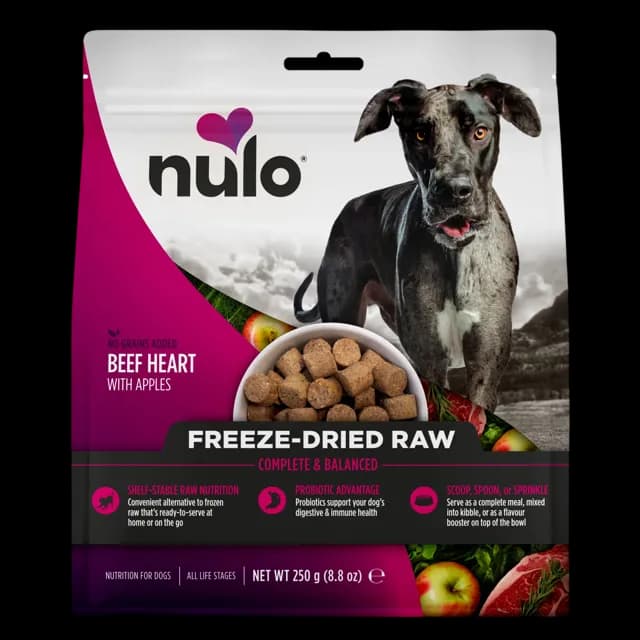

Nulo
Nulo Limited+ Adult review
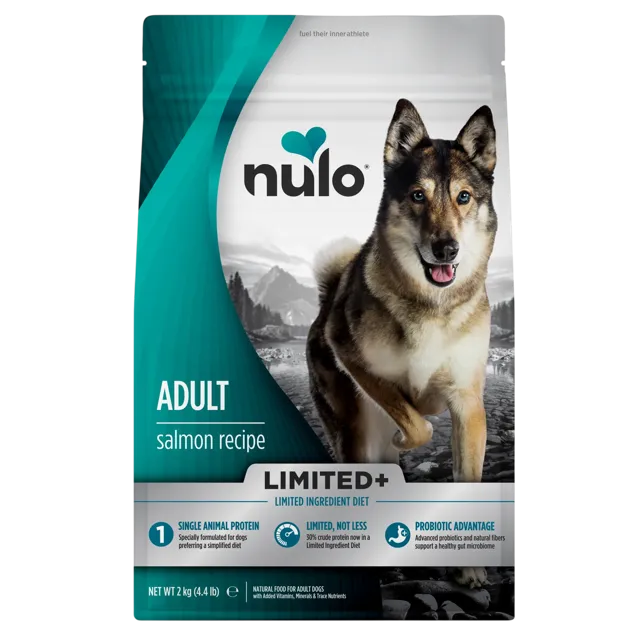
Nulo Limited+ Adult is a short recipe built on a single animal. Salmon is the only species anywhere on the label, arriving fresh at 23%, dried at 22% and once more as a hydrolysed protein. Sweet potato and chickpeas carry the starch, and sunflower oil supplies the added fat. There is no long tail of botanicals and no second animal tucked into the fats. A recipe like this exists to be exactly that short. It comes out in our Good band.
Our view
Likely to suit
A short list makes it far easier to work out what your dog is reacting to.
- Dogs on a one animal diet, since no species but salmon is named on this label
- Owners working through an elimination plan with their vet, helped by an ingredient list this brief
- Dogs kept off land meats, because even the added fat is sunflower oil rather than a chicken or pork fat
- Itchy dogs whose owners want fewer moving parts in the bowl, with no botanical tail to complicate the reading
Worth watching
A recipe this short brings trade-offs with it, so read the next few points before you buy.
- Pea protein and pea fibre both appear, so a little of the protein on the panel is plant protein, not salmon
- Salmon is in every animal entry, so a fish reaction in the past rules this one out
- The label prints no moisture figure, so the dry matter numbers here rest on a standard assumption rather than a declaration
Written by our editorial team. Independent guidance, not veterinary advice.
How this scores
How we scoreThe Details
Dog fit
A short list makes it far easier to work out what your dog is reacting to. A recipe this short brings trade-offs with it, so read the next few points before you buy.
Dry
Adult
Toy, Small, Medium, Large, Giant
Salmon
The score, in context
The Good band is where this one comes out, the same band that marks the middle of the adult dry shelf. Two salmon entries at the very top do most of that work, with protein converting to 32.6% of dry matter and estimated carbohydrate to 35.3% where adult dry food usually runs 46.2%. Both conversions assume 8% moisture, since the label leaves that figure out. A restricted recipe often pays for its simplicity in the scoring, and this one largely does not.
What's in it
Ingredients, as declared: Fresh salmon (23%), dehydrated salmon proteins (22%), sweet potato, chickpeas, sunflower oil,inactivated yeasts, hydrolysed salmon protein, chicory inulin, pea fibre, autolysed inactivated yeasts, minerals, pea protein.
Named ingredients
Nutritional additives
Nutritional additives: Vitamin A (3a672a) 14,000 IU; Vitamin D3 (3a671) 788 IU; Vitamin E (3a700i) 100 mg; Vitamin C (3a312) 50 mg; DL-methionine 2,400 mg; Choline chloride (3a890) 1,200 mg; Taurine 1,200 mg; 3b405 (Cu: 5.10 mg); 3b413 (Cu: 2.19 mg); 3b103 (Fe: 29.16 mg); 3b108 (Fe: 11.67 mg); 3b503 (Mn: 14.00 mg); 3b506 (Mn: 4.67 mg); 3b605 (Zn: 57.17 mg); 3b607 (Zn: 24.50 mg); 3b201 (I: 1.46 mg); 3b814 (Se: 0.04 mg); 3b802 (Se: 0.04 mg). Technological additives: Antioxidants: Tocopherol extracts from vegetable oils. Zootechnical additives: Gut flora stabilisers (CFU/kg): 4b1707 Enterococcus faecium DSM 10663/NCIMB 10415: 1 × 10¹⁰.
Ingredient notes
One animal, and the list keeps to it from top to bottom. Fresh salmon at 23% goes into the oven and comes out much lighter. Dehydrated salmon proteins at 22% are what survives that oven intact. The hydrolysed salmon protein further down is salmon again, with no new species creeping in. That last point matters, because hydrolysed proteins are exactly where a supposedly limited recipe usually springs a leak.
The added fat is sunflower oil, and it is named. Plenty of labels never get that far. It is light on saturated fat and carries vitamin E naturally, and choosing it over an animal fat is what allows the recipe to stay on one species. The omega 3 in the bowl therefore comes from the salmon itself, with no separate oil on the list.
Sweet potato and chickpeas are the only real carbohydrate sources, which keeps the plant side as short as the animal side. Pea fibre and pea protein sit lower down, the fibre for bulk and the protein as a way of lifting the panel without adding more fish. A recipe this focused would read better still without the pea protein.
The gut gets deliberate attention. Inactivated yeasts and autolysed inactivated yeasts are the source of the mannan-oligosaccharides that feed friendly bacteria, and chicory inulin does similar work as a soluble fibre. Declared beside them is a live Enterococcus faecium culture, put there to steady the gut flora. For a dog whose digestion is part of the reason you are reading a limited label at all, that is a thoughtful trio to find.
The added nutrients are all declared. Taurine is dosed at 1,200 mg per kilo and DL-methionine at 2,400 mg. Each trace mineral is listed twice in two different forms. The preservative is a tocopherol extract, the natural vitamin E route. There is nothing decorative on this label at all, which is unusual and rather refreshing.
Price and value
Sold in 2kg, 4kg and 8kg bags.
As a guide, a 15kg adult dog in moderate condition gets through about 224 grams a day, assuming around 840 kcal a day (110 × bodyweight^0.75, the standard maintenance estimate). The label asks 162 to 272 grams for a dog between 10kg and 20kg. Where that and the guide above disagree, the waistline decides.
Nutritional analysis
Declared analysis
30%
17%
4.5%
8%
Dry weight
32.6%
18.5%
4.9%
8.7%
35.3%
As-fed composition
Estimated breakdown of the finished product by ingredient category, from the declared ingredient list and ingoing weights. These are estimates, not measurements.
49.1%
40.3%
1.6%
4.9%
4.1%
Pricing & size
- Pack size
- 2 kg (4.4 lb), 4 kg (8.8 lb), 8 kg (17.6 lb)
- Retailer pricing
- Coming soon
Live retailer pricing is not yet available for this food. Prices, cost per day and where to buy will appear here once retailer data is live.
Ingredients and nutrition are taken from manufacturer data. Retailer pricing is not yet live for this food.
Related dog food guides
Ranked shortlists that include foods like this one.