



Nood
Nood Dry: Grass-Fed Beef review
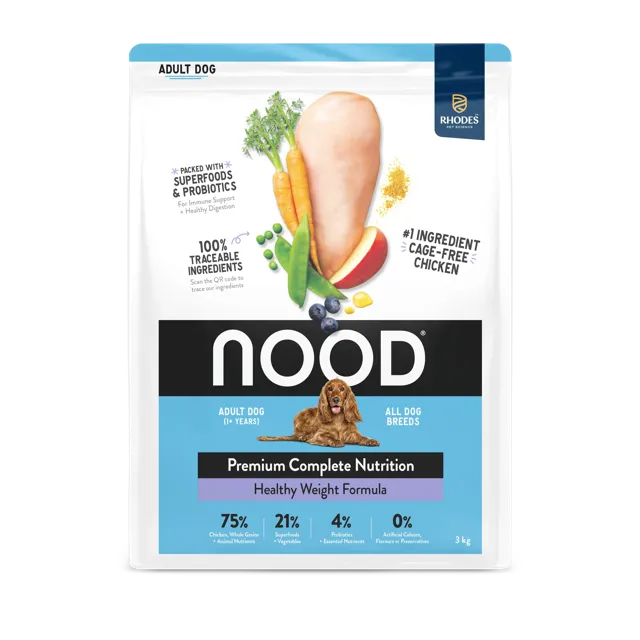
Nood Dry is a pair of everyday kibbles that lead with a named fresh meat and then let pork do a good deal of the lifting. Fresh chicken or fresh beef opens each list at 14%, dehydrated pork protein follows straight behind, and maize, barley and whole peas carry the starch. Both recipes come out in our Good band. The small print is more considered than the front of the bag suggests, with a named gut culture, chicory root and a dosed vitamin and mineral panel.
Our view
Likely to suit
If your house holds dogs of different ages, this is a simple bag to keep by the back door.
- Households at every life stage, since puppy, adult and senior all sit on the one label
- Dogs that get along perfectly well with cereal, as maize and barley sit high in the list
- Dogs new to pork, which is still an unfamiliar meat for most British dogs and does much of the protein work here
- Owners who like to see a gut culture named, with Enterococcus faecium printed on the additives panel
- Older dogs, with glucosamine hydrochloride and chondroitin both on the ingredients list
Worth watching
Read a little further down the label before you settle on a flavour.
- The animal on the front is the fresh one at 14%, with dried pork protein doing more of the finished work, so neither bag is a one-animal recipe
- Salmon oil runs through both flavours, so this is not a fish-free choice
- The hydrolysed poultry protein names no bird, and an owner ruling a particular species in or out will not find it here
- Puppies are on the label but calcium is not declared, leaving anyone rearing a big breed puppy short of a figure they want
Written by our editorial team. Independent guidance, not veterinary advice.
How this scores
How we scoreThe Details
Dog fit
If your house holds dogs of different ages, this is a simple bag to keep by the back door. Read a little further down the label before you settle on a flavour.
Dry
Puppy, Adult, Senior
Toy, Small, Medium, Large, Giant
Beef
The score, in context
Nothing separates the two bags in our reading, and both finish in the Good band where the broad middle of the adult dry category lands. Think of Nood as a straight everyday kibble, neither a step up nor a step down. The label explains why. Protein converts to 27.5% of dry matter and carbohydrate to 44.1%, close to the 46.2% typical for a dry food. Much of that protein comes from dried pork, not from the meat pictured on the bag. What pulls it back up is the detail work. A basic kibble does not usually bother with a named gut culture, with chicory root and beet pulp, or with a joint pairing.
What's in it
Ingredients, as declared: Fresh Beef (14%), Dehydrated Pork Protein, Maize, Barley, Whole Peas (10%), Split Peas, Hydrolyzed Poultry Protein, Pork Fat (preserved with Mixed Tocopherols), Dried Beet Pulp, Dehydrated Chicken Protein, Salmon Oil (0.5%), Dried Chicory Root (a natural source of FOS and Inulin), Linseed (0.25%), Dried Brewer's Yeast, Blueberry (0.01%), Sweet Potato (0.01%), Carrot (0.01%), Spinach (0.01%), Green Peas (0.01%), Apple (0.01%), Turmeric (0.01%), Althea, Peppermint (0.01%), Glucosamine Hydrochloride, Chondroitin Sulphate. Additives (per kg): Vitamins: Vitamin A 3a672a: 15000 IU, Vitamin D3 3a671: 1500 IU, Vitamin E 3a700: 101 mg, L-Carnitine (3a910): 145 mg. Trace Elements: Iron (Iron sulphate monohydrate) 3b103: 50 mg, Iodine (Calcium iodate anhydrous) 3b202: 1.5 mg, Copper (Copper sulphate pentahydrate) 3b405: 10.0 mg, Manganese (Manganese sulphate monohydrate) 3b503:10.0 mg, Zinc (Zinc sulphate monohydrate) 3b605: 62.5 mg, Selenium (Sodium selenite) 3b801: 0.20 mg. Binders: Sepiolite 350 mg. Gut Flora Stabilizer: Enterococcus faecium NCIMB 10415 109 cfu. Antioxidants: (Natural) tocopherol extracts from vegetable oil.
Named ingredients
Nutritional additives
inline in ingredients — the dry composition ends with a full EU additives panel ("Additives (per kg): Vitamins… Trace Elements… Binders… Gut Flora Stabilizer… Antioxidants…"), reproduced verbatim above.
Ingredient notes
The headline is fresh chicken or fresh beef at 14%. A fresh meat entry is mostly water to begin with, and the oven takes that away. The entry that really shapes the finished kibble is the dehydrated pork protein sitting immediately behind it, already dry and already concentrated. None of that is a complaint about the recipe. Pork has a genuine advantage of its own: it appears in so few dog foods that most dogs will never have tasted it. That makes it a useful option where the usual birds have already caused a reaction.
Maize and barley are the cereals, with whole peas at 10% and split peas behind them. Barley carries gluten, and a dog kept off gluten is not suited to this range. The peas carry starch, and they carry some fibre and a small amount of plant protein too.
Pork fat is the main fat, kept fresh with mixed tocopherols, the natural vitamin E preservative and not a chemical one. Salmon oil at 0.5% and linseed at 0.25% are the omega 3 sources, so the fish content is small but real and runs through both flavours.
The gut gets more attention here than an everyday kibble normally gives it. Dried beet pulp supplies fibre, dried chicory root brings inulin and FOS, and dried brewer's yeast adds B vitamins. Enterococcus faecium NCIMB 10415 is on the label as a gut flora stabiliser. That is a live culture and not a marketing line.
The additives panel is dosed all the way down. L-carnitine is at 145 mg, zinc at 62.5 mg and iron at 50 mg. Copper and manganese are at 10.0 mg each, iodine at 1.5 mg and selenium at 0.20 mg per kilo. Every trace mineral here comes as a sulphate. Of the two forms, the sulphate is the more basic. The joint entries are the exception to all that dosing. Glucosamine hydrochloride and chondroitin appear last on the list, with no figure beside them.
The garden at the bottom of the list, blueberry, sweet potato, carrot, spinach, green peas, apple, turmeric and peppermint, is declared at 0.01% each. Those are seasoning and not substance. What the recipe stands or falls on is the pork, the cereals and the fresh meat well above them.
How this variety differs
Fresh beef at 14% leads here and the oats drop out, so maize and barley carry the cereal side alone. Dehydrated chicken protein still appears on this list, and a dog kept off chicken cannot take the beef bag. Its energy figure is an estimate rather than a declaration, at 347 kcal per 100g.
Price and value
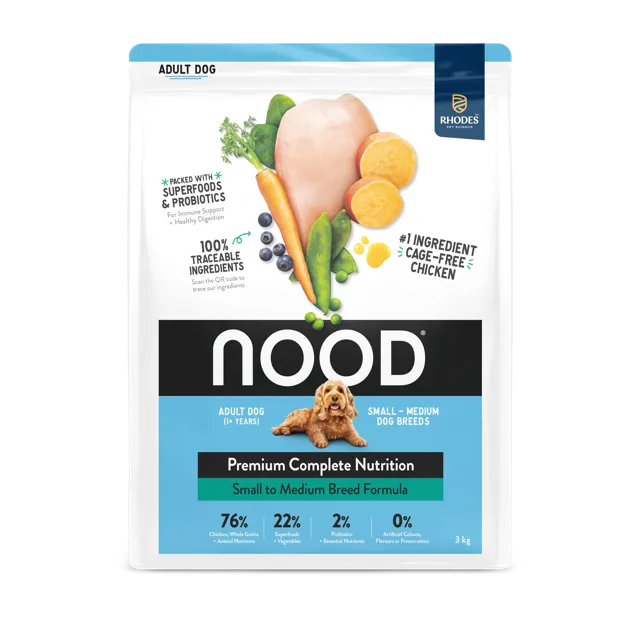
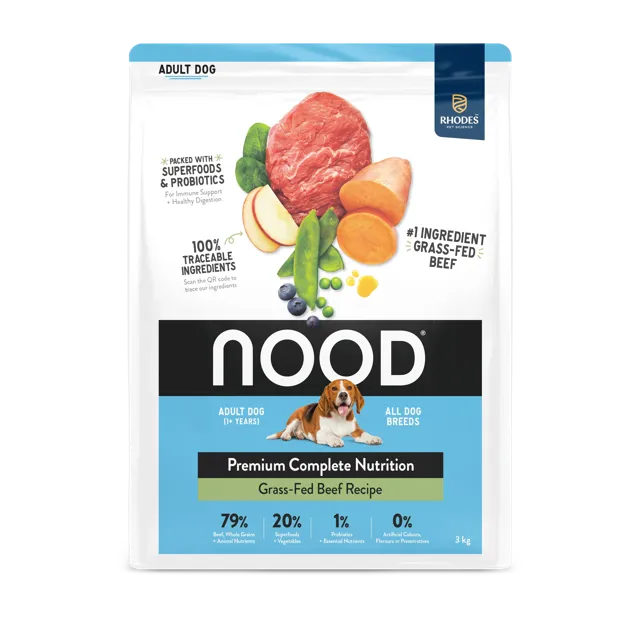
The chicken comes in 1.4kg and 3kg bags and the beef in 1.42kg and 3kg.
As a guide, a 15kg adult dog in moderate condition eats about 233 grams a day of the chicken recipe and 242 grams of the beef. The working figure is around 840 kcal a day (110 × bodyweight^0.75, the standard maintenance estimate). Its own table asks 226 to 380 grams for a dog between 10kg and 19kg. Where the two disagree, go by your dog's waistline.
Nutritional analysis
Declared analysis
Estimated using Modified Atwater factors*
25%
14%
4%
7.8%
9%
Dry weight
27.5%
15.4%
4.4%
8.6%
44.1%
As-fed composition
Estimated breakdown of the finished product by ingredient category, from the declared ingredient list and ingoing weights. These are estimates, not measurements.
47.5%
48.8%
0.6%
2.1%
1.1%
Pricing & size
- Pack size
- 1.42kg · 3kg
- Retailer pricing
- Coming soon
Live retailer pricing is not yet available for this food. Prices, cost per day and where to buy will appear here once retailer data is live.
Ingredients and nutrition are taken from manufacturer data. Retailer pricing is not yet live for this food.
Related dog food guides
Ranked shortlists that include foods like this one.