



Natures Deli
Natures Deli Grain Free Adult: Duck & Sweet Potato review
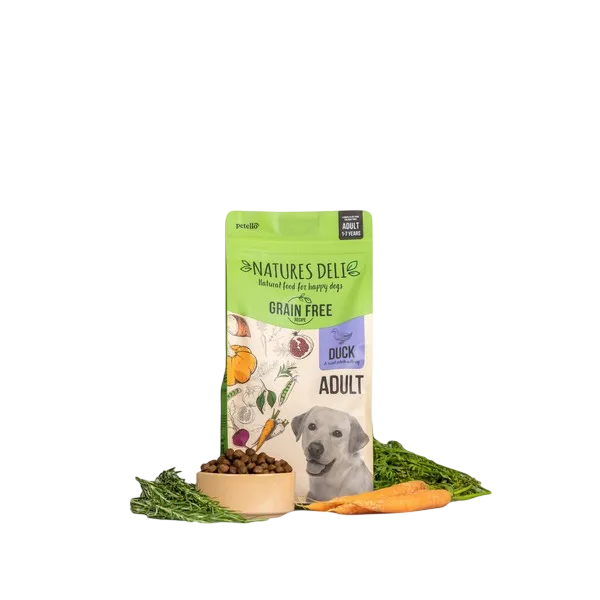
Natures Deli Grain Free Adult is a two recipe range that keeps each bag to a single animal. The duck version declares duck at 40.3% on a base of dried sweet potato, and the salmon version declares salmon at 35.1% with sweet potato and dried potato underneath it. Neither carries cereal of any kind, both print their meal, meat and stock shares separately, and both list taurine, a joint pair and a prebiotic duo in the small print. The two finish together in our Good band.
Our view
Likely to suit
Working out what your dog agrees with is a great deal simpler when each bag holds one animal.
- Dogs on an exclusion diet, since the duck bag names only duck and the salmon bag only salmon
- Owners avoiding cereal altogether, with the starch work left to sweet potato and potato
- Dogs that have reacted to chicken, because neither recipe contains any
- Dogs kept off fish, as the duck bag has no fish in it at all
- Older dogs needing a little joint help, with glucosamine and chondroitin sulphate printed with their percentages
Worth watching
Pick between the two with these honest limits in mind.
- Dried sweet potato is the biggest plant entry in both bags, so grain free here means no cereal rather than little starch
- The duck recipe runs calcium at 2.2% of dry matter, a high adult level, so growth feeding belongs on a bag written for it
- Glucosamine and chondroitin are animal derived supplements, so a strict elimination trial should count them in
- The salmon bag is fish from the meat to the oil, which is the whole point of it and worth knowing for a fish avoiding dog
Written by our editorial team. Independent guidance, not veterinary advice.
How this scores
How we scoreThe Details
Dog fit
Working out what your dog agrees with is a great deal simpler when each bag holds one animal. Pick between the two with these honest limits in mind.
Dry
Adult
Toy, Small, Medium, Large, Giant
Duck
The score, in context
Both recipes come out in our Good band, which is the middle ground for adult dry food. There is little between them, so your dog's preference should decide this one. The meat declarations are respectable, 40.3% for the duck and 35.1% for the salmon, and most of that arrives as meal, the dried form that carries its protein intact into the kibble. Protein converts to 28.0% of dry matter in the duck, 27.5% in the salmon. What holds the two where they are is the plant side, since dried sweet potato is the second ingredient in both bags and estimated carbohydrate reaches 44.0% and 46.2% of dry matter respectively. Transparency reads Outstanding on both, with protein and processing Good and nutritional balance Average, the profile of a sensible, unshowy food that knows exactly who it is for.
What's in it
Ingredients, as declared: Duck (40.3%; including duck meal (28.4%), duck (10.1%), duck gravy (1.8%)), dried sweet potato (36.5%), dried beet pulp, duck fat, dried peas (3.7%), dried chick peas (2.8%), brewers' yeast, dried pumpkin (1.8%), minerals, linseed oil, vegetable stock, dried carrot (0.5%), yeast (as a source of mannan-oligosaccharides (prebiotic MOS; 0.23%)), chicory root extract (as a source of fructo-oligosaccharides (prebiotic FOS; 0.23%)), dried ginger, dried rosemary, yucca schidigera (0.023%), glucosamine (0.011%), dried cranberry, dried dandelion root, dried pomegranate, chondroitin sulphate (0.005%)
Named ingredients
Nutritional additives
Vitamins: Vitamin A 35,000 IU, Vitamin D3 1,500 IU, Vitamin E 560 mg, Vitamin C 75 mg, Biotin 0.2 mg, L-carnitine 150 mg, Taurine 1,000 mg; Trace Elements: Zinc (as Zinc oxide) 70 mg, Zinc (as Zinc chelate of protein hydrolysates) 50 mg, Iron (as Iron (II) sulphate monohydrate) 40 mg, Copper (as Copper (II) sulphate pentahydrate) 5 mg, Manganese (as Manganese (II) oxide) 25 mg, Iodine (as Calcium iodate anhydrous) 1.5 mg, Selenium (as Sodium selenite) 0.2 mg; Antioxidants: Tocopherol extracts from vegetable oils 66 mg; Flavourings: Rosemary extract 5 mg; Gut Flora Stabilisers: Bacillus subtilis DSM 15544 1,200,000,000 CFU
Ingredient notes
Both bags declare their meat in three parts, which is worth more than a single big percentage. In the duck recipe, duck meal at 28.4% does the heavy lifting. Fresh duck at 10.1% adds flavour and moisture that largely leaves in the oven, and duck gravy at 1.8% makes the kibble taste of something. The salmon recipe follows the same idea with salmon meal at 25.7%, salmon at 7.5% and salmon stock at 1.9%.
Dried sweet potato is the plant standing in for cereal: 36.5% of the duck recipe, 31.4% of the salmon, where dried potato at 15.1% joins it. Sweet potato is a slower, more nutrient dense starch than white rice, and there is a fair amount of it in both bags, which the carbohydrate figures reflect honestly.
The added fat tells you which recipe you are holding. The duck bag uses duck fat, the salmon bag uses salmon oil, and both add linseed oil on top. The salmon recipe therefore brings the long chain marine omega 3s a dog can use directly. The duck recipe leans on the plant form, which the body takes longer to convert, so give a coat some weeks before judging either way.
Taurine is declared in print on both labels, and L-carnitine sits alongside it. Taurine is the amino acid with a name for looking after heart muscle. Neither is required on a label, so seeing both dosed is a sign of a maker paying attention to the small print rather than only to the front of the bag.
The gut and joint entries are common to both. Mannan-oligosaccharides from yeast and fructo-oligosaccharides from chicory root are dosed at 0.23% each, then glucosamine and chondroitin sulphate arrive at the tail with their percentages attached. Dried ginger, cranberry, dandelion root and pomegranate follow in flourish quantities that read well on a bag without changing how a dog feels.
The mineral panels are identical in shape. Zinc is supplied twice over, 70 mg as the oxide and 50 mg as a chelate, and a dog's gut generally handles the chelated share more easily. One small difference is that vitamin D3 is printed on the duck panel and not on the salmon one. Note it, but there is nothing to worry about, oily fish being a natural source of that vitamin in its own right.
How this variety differs
Duck at 40.3% is the larger meat declaration of the two. It splits into duck meal at 28.4%, then fresh duck at 10.1%, then duck gravy at 1.8%, and with duck fat further down, every animal entry belongs to the same bird. Dried sweet potato at 36.5% is the only substantial plant, protein reaches 28.0% of dry matter and estimated carbohydrate stops at 44.0%, the lower figure of the pair. Calcium runs to 2.2% of dry matter, an adult level and not a growth one.
Price and value
Both recipes come in 2kg and 12kg bags.
As a rough guide, a 15kg adult dog in moderate condition eats about 254 grams a day of the duck or 250 grams of the salmon. That works from 840 kcal a day (110 × bodyweight^0.75, the standard maintenance estimate). The maker's own table asks 175 to 295 grams for a dog between 10kg and 20kg, so begin there and let your dog's shape narrow it down.
Nutritional analysis
Declared analysis
Estimated using Modified Atwater factors*
25.5%
12%
4%
9.5%
9%
Dry weight
28%
13.2%
4.4%
10.4%
44%
As-fed composition
Estimated breakdown of the finished product by ingredient category, from the declared ingredient list and ingoing weights. These are estimates, not measurements.
28.4%
1.5%
56.2%
2.8%
5.5%
5.6%
Pricing & size
- Pack size
- 2kg, 12kg
- Retailer pricing
- Coming soon
Live retailer pricing is not yet available for this food. Prices, cost per day and where to buy will appear here once retailer data is live.
Ingredients and nutrition are taken from manufacturer data. Retailer pricing is not yet live for this food.
Related dog food guides
Ranked shortlists that include foods like this one.