


Nature's Variety
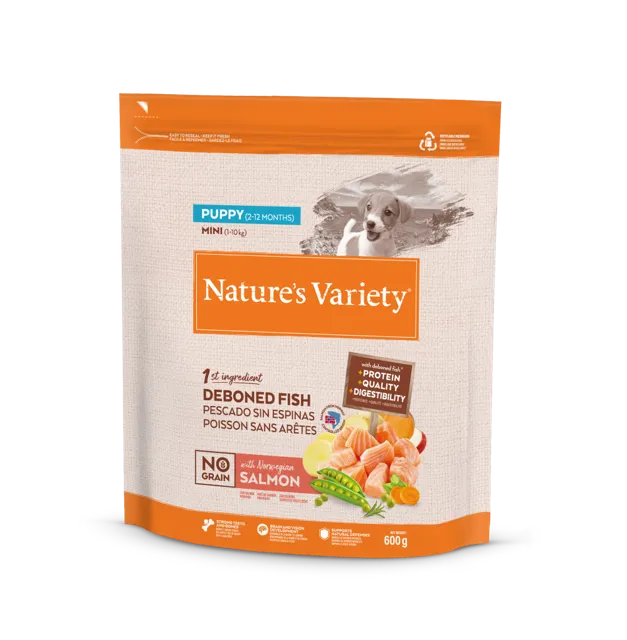
Nature's Variety No Grain Puppy Mini: Norwegian Salmon review
Nature's Variety No Grain Puppy Mini takes the same salmon and tuna recipe as its bigger stablemate and packs it for small breed puppies. The list opens on deboned Norwegian salmon at 20%, backed by dried tuna protein at 18%, with dried peas, potato and sweet potato where grain would be. Protein converts to 35.9% of dry matter, carbohydrate to an estimated 32.5%. Our Good band is where it comes to rest.
Our view
Likely to suit
You have less margin for error with a small dog's portions, so a clear label earns its keep.
- Small breed puppies, the one size group the maker writes this bag for
- Young dogs raised on fish, with Norwegian salmon and dried tuna protein supplying most of the animal protein
- Homes with no cereal in the bowl, where pea starch joins dried potato and sweet potato to do that work
- Little dogs who never sit still, since energy runs to an estimated 382 kcal per 100g against 376 for the typical puppy kibble
Worth watching
A handful of details here reward a careful read of the pack.
- Salmon and tuna share the protein duty, and the poultry fat and hydrolysed proteins bring land animals in too, so this is no single protein diet
- Calcium is missing from the printed analysis, and it is the growth figure worth having whatever size a puppy will finish
Written by our editorial team. Independent guidance, not veterinary advice.
How this scores
How we scoreThe Details
Dog fit
You have less margin for error with a small dog's portions, so a clear label earns its keep. A handful of details here reward a careful read of the pack.
Dry
Puppy
Small
Salmon
The score, in context
A Good band placing is what this small breed recipe earns, level with the band the puppy kibble field occupies in the middle while finishing on the right side of it. Nutritional balance comes back Excellent, with protein and processing Good. Its strongest cards are the named fish opening the list and a carbohydrate share of only an estimated 32.5% of dry matter against 39.0% for the field. The plant proteins in the second half and the unprinted moisture and calcium lines stop it going further.
What's in it
Ingredients, as declared: Deboned Norwegian salmon* (20%), dried tuna protein (18%), dried peas* (15%), dried potato* (8%), potato protein, poultry fat* (7%), sweet potato* (4%), hydrolysed animal proteins (poultry, pork, fish) (4%), pea protein*, beet pulp*, pea starch*, minerals, dried carrot* (0.5% equivalent to 4% of fresh carrot), dried apple* (0.3% equivalent to 2% fresh apple), dried seaweed (kelp)* (0.01%), dried rosemary* (0.01%). *Natural ingredients
Named ingredients
Nutritional additives
vitamin A 27000 IU, vitamin E 650 mg, vitamin C 300 mg, iron(II) sulphate monohydrate 260 mg (Fe: 86 mg), potassium iodide 1.9 mg (I: 1.4 mg), copper(II) sulphate pentahydrate 33 mg (Cu: 8.8 mg), manganous sulphate monohydrate 123 mg (Mn: 40 mg), zinc sulphate monohydrate 315 mg (Zn: 115 mg), sodium selenite 0.24 mg (Se: 0.11 mg),
Ingredient notes
Both fish are named, which is the first mark in this recipe's favour. Deboned Norwegian salmon at 20% goes in fresh, and cooking takes most of its water. Dried tuna protein at 18% is already dry when weighed. It therefore carries more of the kibble's finished protein than a glance at the list order suggests.
The binding falls to dried peas at 15%, then dried potato at 8%, then sweet potato at 4%, with pea starch behind them. Nothing from a cereal field appears anywhere. The starch load stays sensible for a grain free food, with carbohydrate working out at an estimated 32.5% of dry matter where the typical puppy kibble sits at 39.0%.
Potato protein and pea protein sit lower down the list and are worth reading for what they are. Both are concentrated plant proteins, less digestible than the protein fish supplies, so the declared 33.0%, or 35.9% of dry matter, is a total that leans partly on them.
Poultry fat at 7% covers a group of birds, not a single one. Poultry, pork and fish are all declared in the hydrolysed animal proteins at 4%. Most small breed puppies will never notice, and an owner running a proper elimination trial needs both entries flagged.
Beet pulp supplies the fibre. The finishing entries are small and fully declared: dried carrot at 0.5%, equivalent to 4% fresh, dried apple at 0.3% standing in for 2% fresh, and dried kelp with rosemary at 0.01% each. The kelp brings iodine and trace minerals naturally. Rosemary is the natural antioxidant at the end of the list.
The printed analysis covers protein at 33.0%, fat at 19.0%, fibre at 3.0% and ash at 7.0%, and leaves moisture out, so dry matter conversions here use the standard 8% figure for a kibble. Calcium is absent as well. Small breed growth is more forgiving on calcium than large breed growth. The number is still the one a puppy food is judged on, and it is a fair thing to ask the maker for. The 382 kcal per 100g is our estimate rather than a declaration.
Price and value
Sold in 0.6kg, 1.5kg and 3kg bags.
A growing dog's ration climbs and then settles again. Treat the chart on the pack as a guide for age and adult size, and run your hands over your pup every week or so to check you have it right.
Nutritional analysis
Declared analysis
Estimated using Modified Atwater factors*
33%
19%
3%
7%
Dry weight
35.9%
20.7%
3.3%
7.6%
32.5%
As-fed composition
Estimated breakdown of the finished product by ingredient category, from the declared ingredient list and ingoing weights. These are estimates, not measurements.
42%
49.1%
1.1%
7%
0.8%
Pricing & size
- Pack size
- 0.600 Kg, 1.500 Kg, 3 Kg
- Retailer pricing
- Coming soon
Live retailer pricing is not yet available for this food. Prices, cost per day and where to buy will appear here once retailer data is live.
Ingredients and nutrition are taken from manufacturer data. Retailer pricing is not yet live for this food.
Related dog food guides
Ranked shortlists that include foods like this one.