


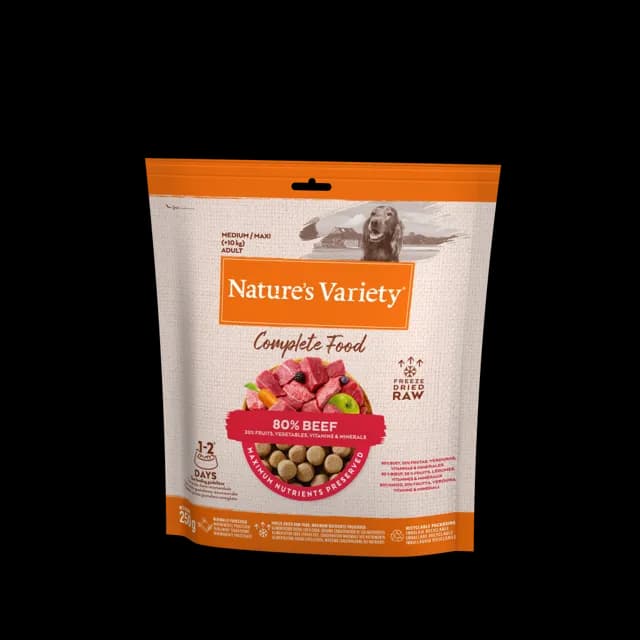

Nature's Variety
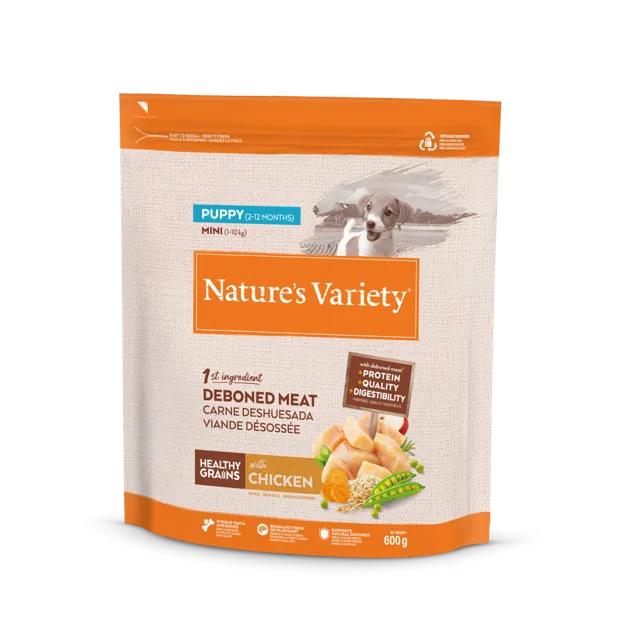
Nature's Variety Healthy Grains Puppy Mini: Chicken review
Nature's Variety Healthy Grains Puppy Mini is the small breed member of this chicken and whole grain growth range. Named chicken opens the recipe twice over, at 20% deboned and 19% dried chicken protein, with dried peas, maize protein and three whole grains behind them. Protein converts to 35.9% of dry matter and energy to an estimated 384 kcal per 100g. Our Good band is where it settles.
Our view
Likely to suit
Small dogs do their growing up in a hurry, and you want a bowl that keeps up with them.
- Small breed puppies, the only size the maker lists this recipe for
- Busy little dogs who burn through their food, since an estimated 384 kcal per 100g sits above the 376 typical of puppy kibble
- Owners who prefer whole grains to a grain free build, with brown rice at 7%, whole barley and oats at 5% on the list
- Households that want the meat identified, with chicken named in its deboned form and again in its dried form
Worth watching
Read this label properly before you commit, because a few things repay the effort.
- No calcium is printed on the analysis, and it is the growth figure most worth having even when a puppy will finish small
- The hydrolysed animal proteins cover poultry, pork and fish at once, which rules this recipe out for an exclusion diet
Written by our editorial team. Independent guidance, not veterinary advice.
How this scores
How we scoreThe Details
Dog fit
Small dogs do their growing up in a hurry, and you want a bowl that keeps up with them. Read this label properly before you commit, because a few things repay the effort.
Dry
Puppy
Small
Chicken
The score, in context
This mini recipe finishes in our Good band, where the puppy dry field settles in the middle. It sits comfortably with the pack. The pillar readings come back Average for protein and processing, Excellent for nutritional balance and Outstanding for transparency. What earns the placing is a top of list that names its chicken twice and a carbohydrate share converting to an estimated 33.1% of dry matter where the field typically runs 39.0%. What limits it is the plant protein sitting mid list, and an analysis that leaves moisture and calcium unprinted.
What's in it
Ingredients, as declared: Deboned chicken meat* (20%), dried chicken protein (19%), dried peas* (15%), maize protein, poultry fat* (7%), brown rice* (7%), whole barley*, oats* (5%), hydrolysed animal proteins (poultry, pork, fish) (4%), minerals, fish oil* (1%), dried carrot* (0.5% equivalent to 4% of fresh carrot), dried apple* (0.3% equivalent to 2% fresh apple), dried seaweed (kelp)* (0.01%), dried rosemary* (0.01%). *Natural ingredients
Named ingredients
Nutritional additives
vitamin A 27000 IU, vitamin D3 1200 IU, vitamin E 650 mg, vitamin C 300 mg, iron(II) sulphate monohydrate 260 mg (Fe: 86 mg), potassium iodide 1.9 mg (I: 1.4 mg), copper(II) sulphate pentahydrate 33 mg (Cu: 8.8 mg), manganous sulphate monohydrate 123 mg (Mn: 40 mg), zinc sulphate monohydrate 351 mg (Zn: 128 mg), sodium selenite 0.24 mg (Se: 0.11 mg),
Ingredient notes
Two chicken entries open the list and both are specific. The deboned chicken at 20% goes in fresh and gives up most of its water during cooking. The dried chicken protein at 19% has already lost its own. It therefore carries a bigger share of the finished protein than its position implies.
Dried peas at 15% and maize protein follow. At this level peas are a decent inclusion, bringing fibre and micronutrients alongside their protein. Maize protein does exactly what its name says, a concentrated plant protein. Between them they mean the declared 33.0% protein, or 35.9% of dry matter, is not purely a meat figure.
The grains are the reason this range exists. Brown rice at 7%, whole barley and oats at 5% are cereals a small dog digests easily. They hold the estimated carbohydrate to 33.1% of dry matter, comfortably under the 39.0% carried by the typical puppy kibble.
Poultry fat at 7% gives a family name and no species. At 4% the hydrolysed animal proteins are declared across poultry, pork and fish. Fish oil at 1% is the most transparent fat on the list and the one supplying long chain omega 3.
The finishing touches are modest and clearly quantified: dried carrot at 0.5%, given as the equivalent of 4% fresh, dried apple at 0.3% for 2% fresh, then dried kelp and rosemary at 0.01% apiece. The added vitamin and trace mineral panel behind them is dosed in print, with vitamins A, D3, E and C all named.
The label runs out of detail at the analysis. Protein at 33.0%, fat at 19.0%, fibre at 2.5% and ash at 7.0% are declared, moisture is not, so the dry matter conversions here rest on the standard 8% assumption for kibble. Calcium is not printed either. A small breed puppy has more room for error on calcium than a giant one. Even so, calcium remains the figure a growth food gets judged on, and the maker is worth asking for it. The energy value of 384 kcal per 100g is our estimate, not a declaration.
Price and value
Sold in 0.6kg, 1.5kg, 3kg and 7kg bags.
Feeding a puppy is a weekly conversation, never a fixed rule. Begin with the bag's chart for age and adult size, then let your dog's condition settle the rest.
Nutritional analysis
Declared analysis
Estimated using Modified Atwater factors*
33%
19%
2.5%
7%
Dry weight
35.9%
20.7%
2.7%
7.6%
33.1%
As-fed composition
Estimated breakdown of the finished product by ingredient category, from the declared ingredient list and ingoing weights. These are estimates, not measurements.
43%
44%
2.8%
8%
2.2%
Pricing & size
- Pack size
- 0.600 Kg, 1.500 Kg, 3 Kg, 7 Kg
- Retailer pricing
- Coming soon
Live retailer pricing is not yet available for this food. Prices, cost per day and where to buy will appear here once retailer data is live.
Ingredients and nutrition are taken from manufacturer data. Retailer pricing is not yet live for this food.
Related dog food guides
Ranked shortlists that include foods like this one.